What a Reflex Action Is
Definition
Reflex action
A rapid, automatic response to a stimulus that happens without conscious thought.
- A reflex action is a rapid, automatic response to a stimulus that happens without conscious thought.
- It is involuntary, so it happens whether or not you want it to and you cannot stop it by deciding not to.
- Every person shows the same response to the same stimulus, because the pathway is not learned.
- Most reflexes are protective, and they prevent injury by acting before the brain has processed what is happening.
The Reflex Arc
Definition
Reflex arc
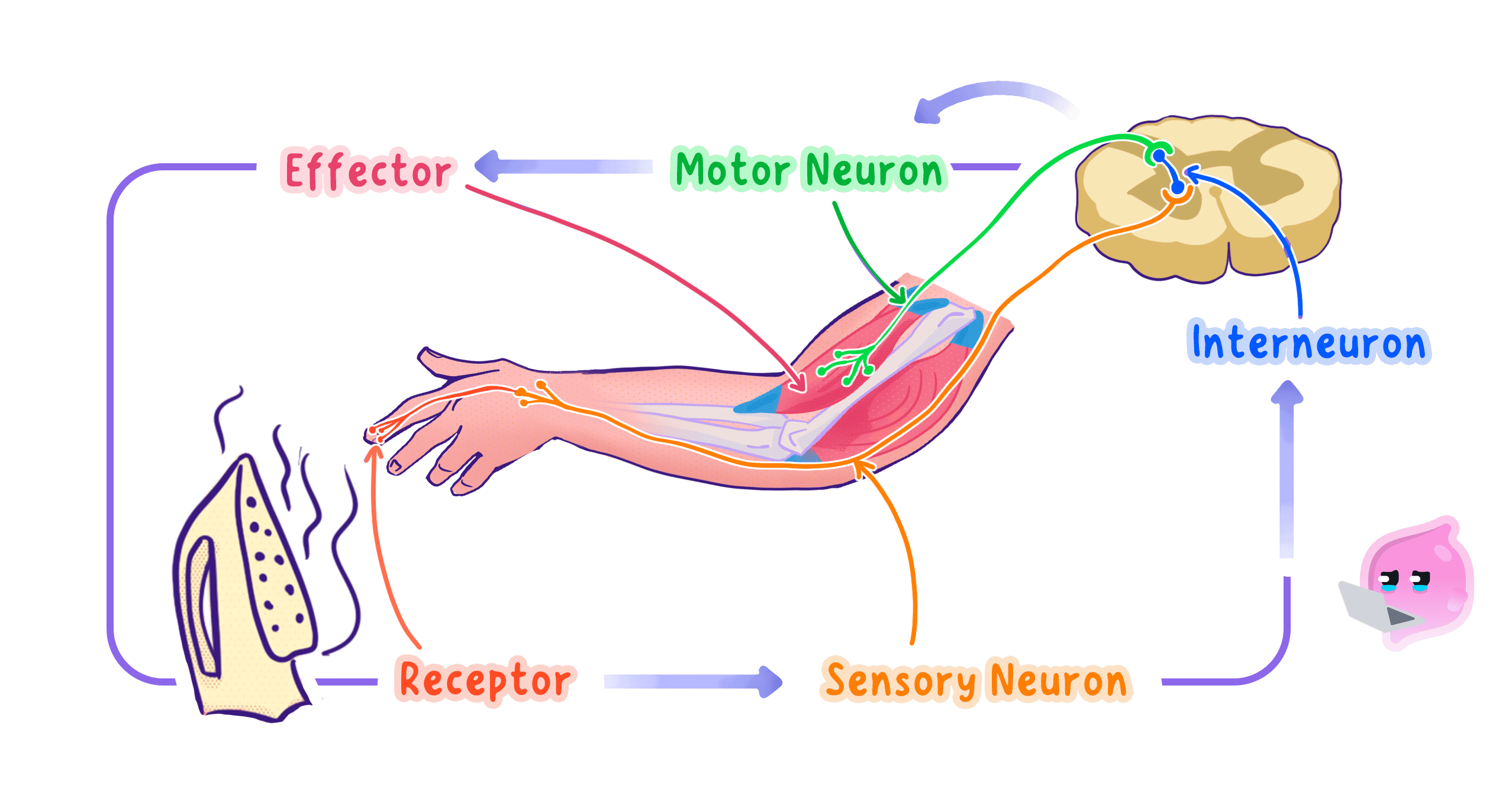
The pathway of receptor, sensory neurone, relay neurone, motor neurone and effector that brings about a reflex action.
- The reflex arc is the pathway of neurones that produces a reflex action.
- A stimulus is detected by a receptor, which converts it into an electrical impulse.
- A sensory neurone carries the impulse from the receptor to the central nervous system, usually the spinal cord.
- A relay neurone inside the CNS passes the impulse straight across to a motor neurone.
- A motor neurone carries the impulse out to the effector.
- The effector, a muscle or a gland, produces the response by contracting or by secreting.
- The impulse crosses a synapse between each pair of neurones, and a neurotransmitter carries it over each gap.
Why the Brain Is Bypassed
- The impulse travels through the spinal cord and does not pass through the conscious part of the brain first.
- Missing out the brain means fewer synapses, and each synapse adds a delay because the neurotransmitter has to diffuse across the gap.
- A shorter pathway means a shorter reaction time, so the response happens before serious damage is done.
- No decision is needed, so nothing is gained by involving conscious thought.
- An impulse is still sent up to the brain, which is why you feel the pain a moment after your hand has already moved.
Hint
The withdrawal is faster than the pain because the movement and the sensation travel by different routes, and the reflex route is the shorter one.
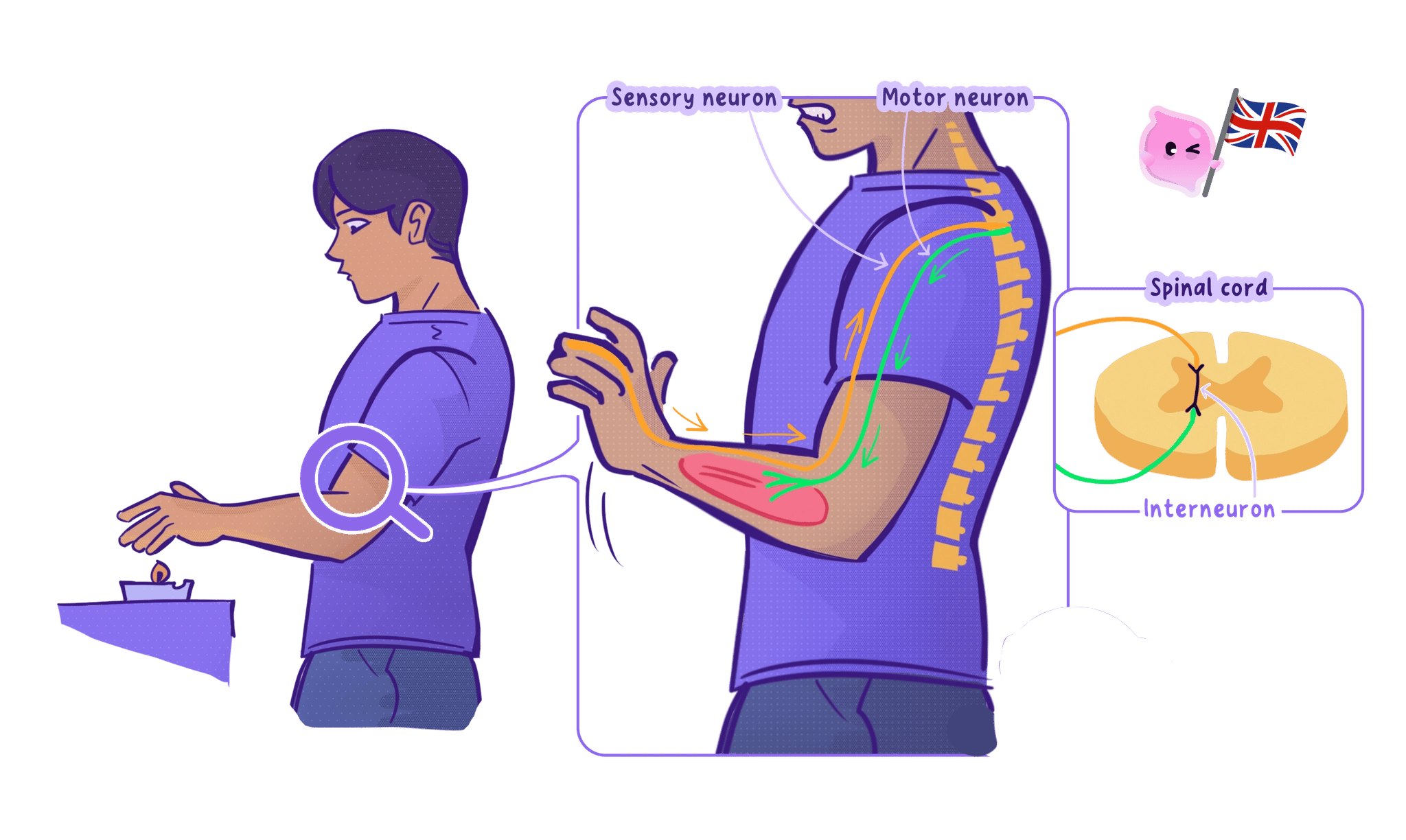
When you touch a hot object
- Stimulus. You touch a hot oven tray, and the heat is the stimulus.
- Receptor. Temperature and pain receptors in the skin of the finger detect it and generate an impulse.
- Sensory neurone. The impulse travels up the arm to the spinal cord.
- Relay neurone. In the spinal cord the impulse is passed across to a motor neurone.
- Motor neurone. The impulse travels back down the arm to the biceps muscle.
- Effector and response. The biceps contracts and the hand is pulled away from the tray.
Other Reflexes in the Body
- The pupil reflex. In bright light the iris contracts the pupil, which protects the retina from damage.
- Blinking. An object approaching the eye triggers the eyelid to close and shield the cornea.
- The knee jerk. Tapping the tendon below the knee makes the thigh muscle contract, which helps to maintain posture.
- Coughing and sneezing. Irritants in the airways trigger a sharp expulsion of air that clears them.
- Some reflexes are coordinated by the brain rather than the spinal cord, and the pupil reflex and blinking are both handled in the brain.
Common Mistake
Do not write that a reflex does not involve the nervous system or the brain at all. A reflex uses the nervous system throughout, and the brain is bypassed only in the decision, not in the pathway.
Practical
Investigation: Measuring Reaction Time
- Aim: To measure reaction time using the ruler drop test and to find whether a factor such as caffeine, practice or a distraction changes it. Edexcel lists investigating reaction times and investigating human responses to external stimuli as suggested practicals for Topic 2.
- Apparatus: A 30 cm ruler, a chair and a table with a straight edge, a volunteer and a partner, a results table, a conversion chart or calculator.
- Method:
- The volunteer sits with their forearm flat along the table so the hand hangs over the edge, which stops them lowering the whole arm to catch the ruler.
- The partner holds the ruler vertically, with the zero mark level with the top of the volunteer's thumb and first finger and a gap of about 1 cm between them.
- The partner drops the ruler without warning and without a countdown, so the volunteer cannot anticipate it.
- The volunteer catches the ruler as fast as they can and reads the measurement level with the top of the thumb.
- Record the distance in centimetres and repeat 10 times, discarding any drop the volunteer missed.
- Calculate the mean catch distance.
- Repeat the whole set for the second condition, for example 20 minutes after a caffeinated drink, using the same volunteer.
- Variables: The independent variable is the condition being tested, such as caffeine or no caffeine, and the dependent variable is the distance the ruler falls before it is caught. Keep the same volunteer, the same hand, the same ruler, the same starting gap and the same seated position, and vary the interval before each drop.
- Results: A shorter catch distance means a shorter reaction time. Distances typically fall between 10 cm and 25 cm, and the mean usually shortens over the first few attempts as the volunteer gets used to the task.
- Maths: Calculate the mean before you compare conditions. mean distance=sum of the distancesnumber of drops\text{mean distance} = \frac{\text{sum of the distances}}{\text{number of drops}}mean distance=number of dropssum of the distances
- The distance can be converted to a time using t=2dgt = \sqrt{\frac{2d}{g}}t=g2d
- where ddd is the distance in metres and ggg is 9.8 m/s29.8\ \text{m/s}^29.8 m/s2. A catch at 0.20 m0.20\ \text{m}0.20 m gives a reaction time of about 0.20 s0.20\ \text{s}0.20 s.
- Watch out: Any countdown or eye contact lets the volunteer anticipate the drop, which measures prediction instead of reaction. Comparing two different people confounds the result with their natural differences, so use the same volunteer for both conditions.
- Safety: Low hazard. Keep the ruler away from faces and make sure the table edge is clear.
Exam technique
- The six mark question on this topic is marked by levels, and the top level needs the structural components linked in a complete pathway and then linked to the function of the reflex as a rapid protective response.
- Write the pathway in strict order and name every component, because a missing relay neurone or effector breaks the chain examiners are looking for.
- Bring in the myelin sheath speeding up transmission and the small number of synapses if you need extra detail for the higher levels.
- Finish with the function rather than stopping at the structure, saying that the response is rapid, automatic and protects the body from damage.
Self review
- Define a reflex action.
- List the parts of a reflex arc in order from stimulus to response.
- Explain why a reflex action is faster than a voluntary response.
- Why do you feel the pain only after you have pulled your hand away?
- Give two examples of a protective reflex other than the withdrawal reflex.
