The Nervous System Carries Electrical Impulses
Neurone
A specialised cell adapted to carry electrical impulses rapidly from one part of the body to another.
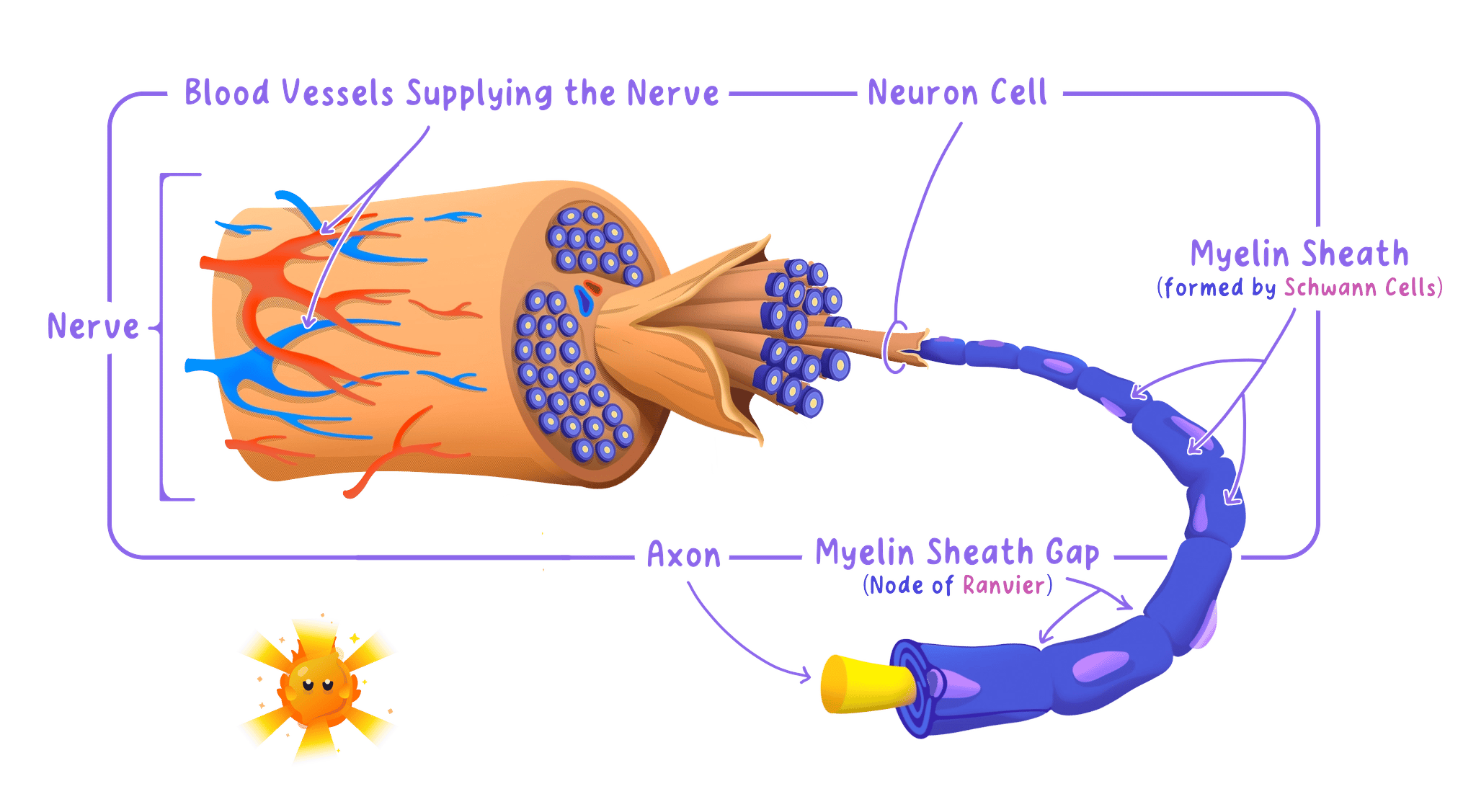
- A neurone is a cell specialised to carry an electrical impulse rapidly from one part of the body to another.
- Bundles of neurones are wrapped in connective tissue to form the nerves that run through the body.
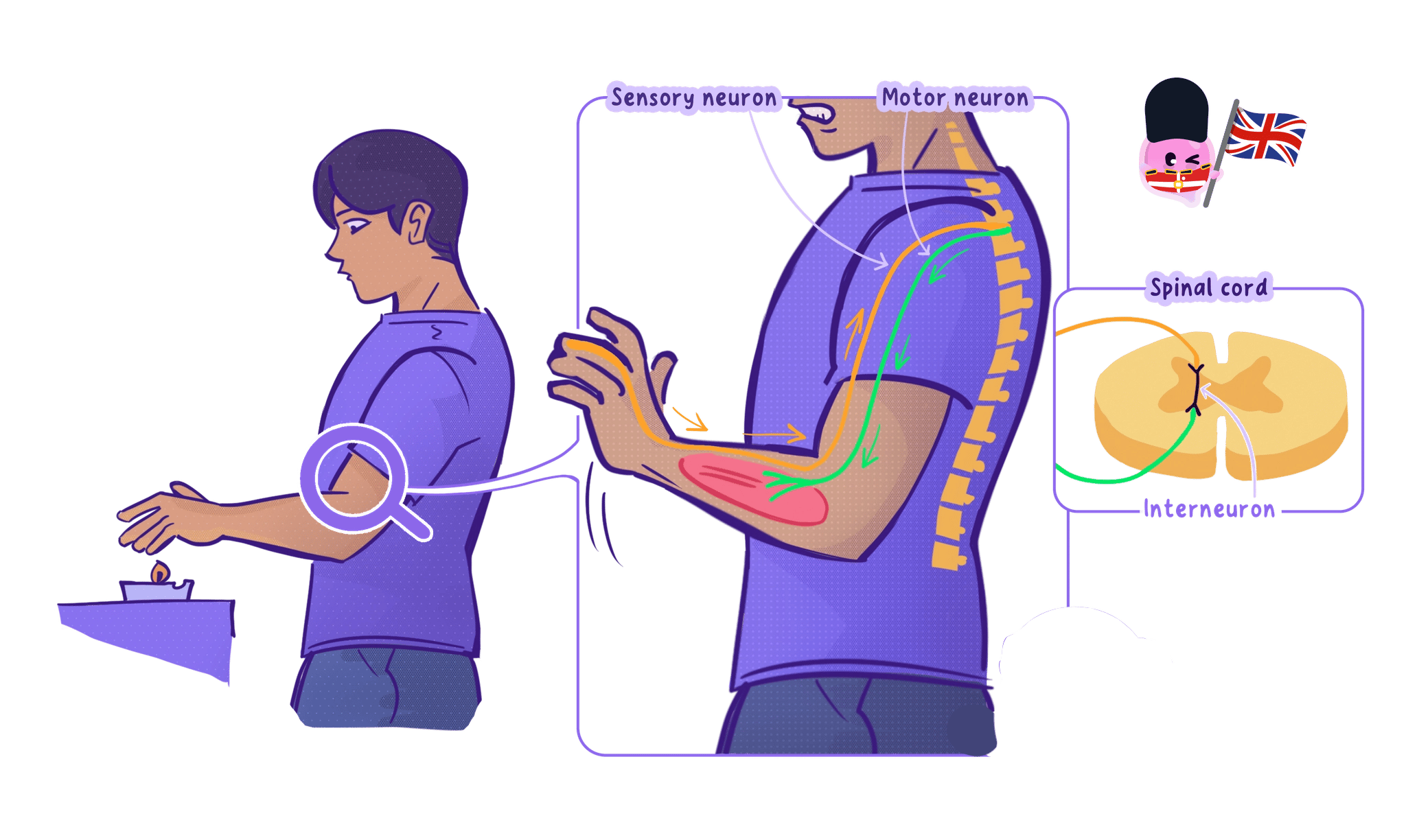
- The pathway of any nervous response follows the same order: stimulus, receptor, sensory neurone, CNS, motor neurone, effector, response.
- Nervous responses are fast and short lived, which is what distinguishes them from the slower, longer lasting effects of hormones.
Receptors Detect the Stimulus
Receptor
A cell or group of cells that detects a stimulus and converts it into an electrical impulse.
- A receptor detects a stimulus and converts that stimulus into an electrical impulse.
- Receptors are usually grouped inside a sense organ, so light receptors sit in the retina of the eye and sound receptors sit in the cochlea of the ear.
- Each type of receptor responds to only one type of stimulus, which is why the eye cannot detect sound.
- The skin contains separate receptors for touch, pressure, temperature and pain.
- Receptors inside the body monitor conditions such as blood glucose concentration, blood pressure and the position of the muscles.
Sensory Neurones
Sensory neurone
A neurone that carries electrical impulses from a receptor to the central nervous system.
- A sensory neurone carries the impulse from a receptor to the central nervous system.
- It has a long dendron that carries the impulse towards the cell body, and a shorter axon that carries it onwards into the CNS.
- The cell body sits partway along the side of the neurone rather than at one end, which is the easiest way to recognise it in a diagram.
Relay Neurones
Relay neurone
A neurone inside the central nervous system that carries electrical impulses from a sensory neurone to a motor neurone.
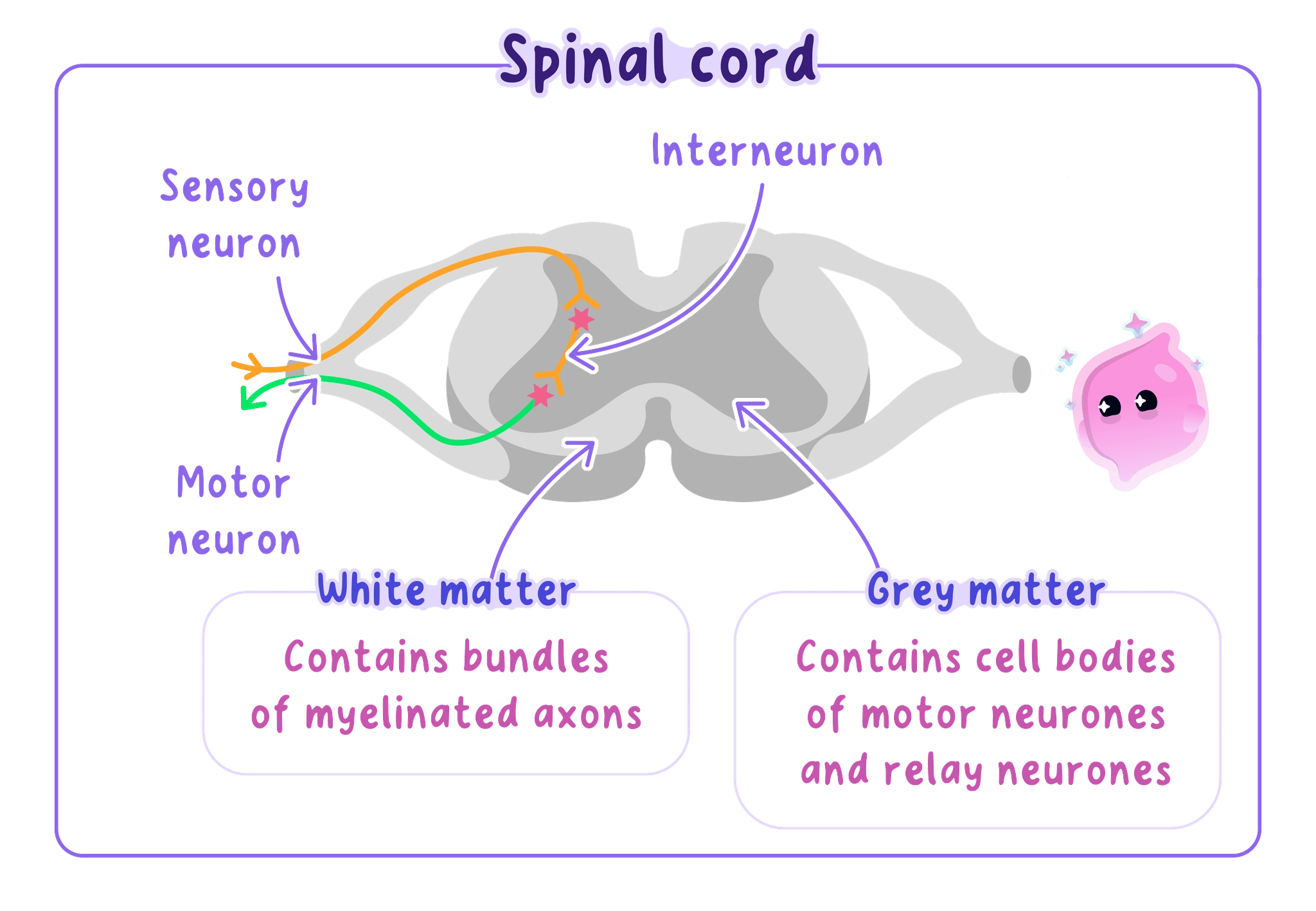
- A relay neurone lies entirely within the central nervous system, in the brain or the spinal cord.
- It carries the impulse from a sensory neurone to a motor neurone.
- It is short, with a cell body in the middle and many short branches at both ends.
- Those branches connect to large numbers of other neurones, which is how the CNS links incoming information to a coordinated response.
Motor Neurones
Motor neurone
A neurone that carries electrical impulses from the central nervous system to an effector.
- A motor neurone carries the impulse from the central nervous system to an effector.
- Its cell body sits at one end, inside the CNS, with many short dendrites branching from it.
- A single very long axon then runs all the way to the effector, and in an adult a motor neurone reaching the foot can be about a metre long.
- The axon ends in branches that spread across the muscle so that many muscle fibres are stimulated at once.
The Axon and the Dendron
Axon
The long fibre of a neurone that carries the electrical impulse away from the cell body.
- The axon carries the impulse away from the cell body, and the dendron carries it towards the cell body.
- Both are long and thin, which allows a single cell to span a large distance without the impulse being passed between cells.
- Passing an impulse along one continuous fibre is far faster than passing it from cell to cell, because every junction adds a delay.
- A sensory neurone has both a dendron and an axon, while a motor neurone has dendrites and one long axon.
The Myelin Sheath
Myelin sheath
A fatty layer that insulates the axon of a neurone and increases the speed at which the electrical impulse travels.
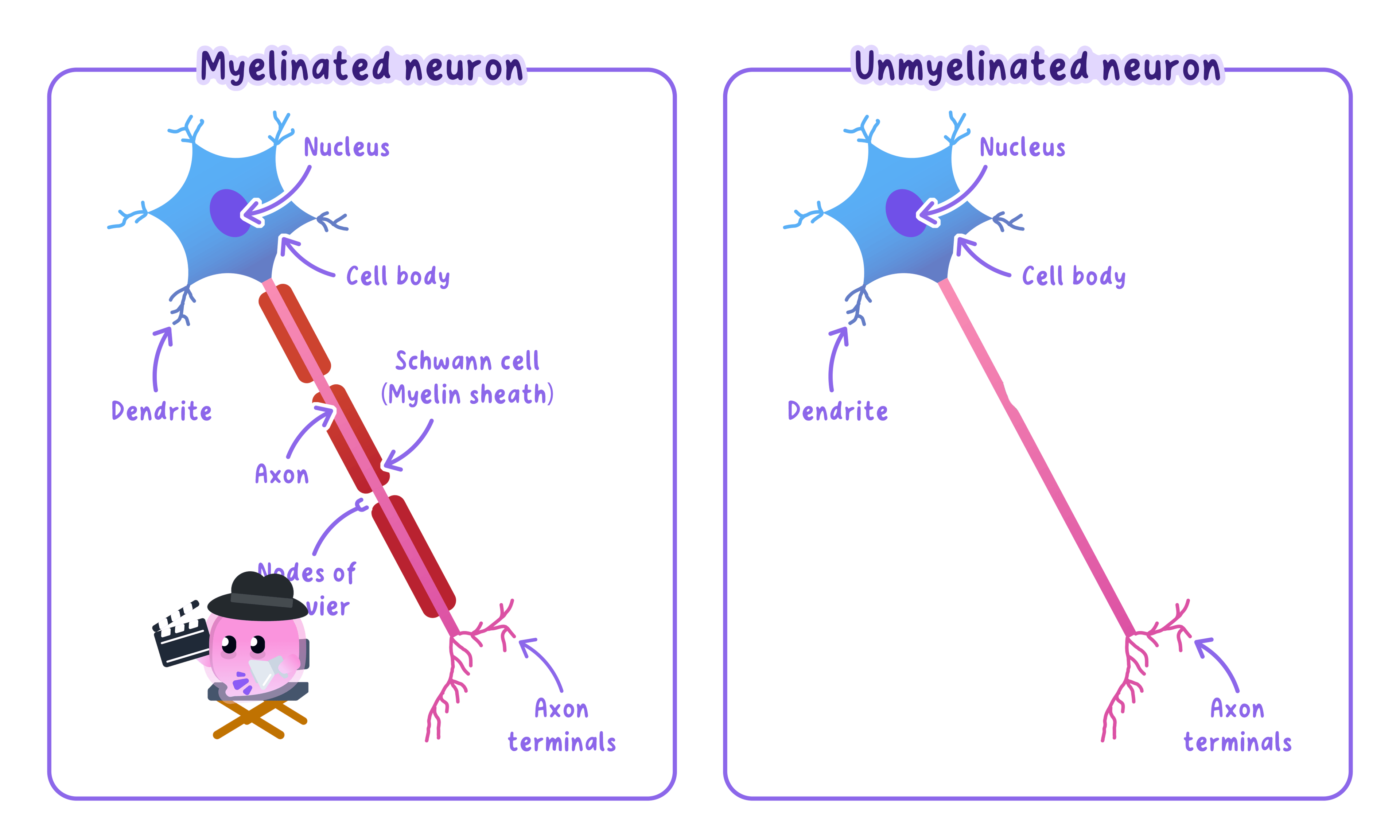
- Many axons are wrapped in a myelin sheath, a fatty layer made by cells that coil around the fibre.
- The sheath acts as an electrical insulator, so the impulse cannot leak out through the membrane.
- The sheath is broken by regular gaps, and the impulse jumps from one gap to the next instead of travelling along the whole membrane.
- This makes the impulse travel much faster, and a myelinated neurone can conduct at over 100 metres per second while an unmyelinated one manages about 1 metre per second.
- Myelin also stops impulses crossing between neighbouring axons in the same nerve, so signals stay separate.
In multiple sclerosis the immune system destroys patches of myelin. Impulses then travel slowly or fail completely, which causes weakness, numbness and problems with coordination.
Effectors Carry Out the Response
Effector
A muscle or a gland that carries out the response, by contracting or by secreting a substance.
- An effector is a muscle or a gland.
- A muscle responds by contracting, which produces movement.
- A gland responds by secreting a substance such as a hormone, sweat or an enzyme.
- The impulse itself does not do anything useful until it reaches an effector, so the effector is what converts the signal into a response.
Synapses
Synapse
The junction between two neurones, where the impulse is carried across the gap by a neurotransmitter.
- Neurones do not physically touch, so there is a tiny gap between the end of one neurone and the start of the next.
- The junction, including the gap, is called a synapse.
- An electrical impulse cannot jump the gap, so the signal must be carried across in a different way.
- The signal is passed across by a chemical, which means transmission is electrical along the neurone and chemical at the synapse.
How an Impulse Crosses a Synapse
Neurotransmitter
A chemical released into a synapse that diffuses across the gap and binds to receptors on the next neurone, triggering a new electrical impulse.
- The electrical impulse arrives at the end of the first neurone.
- This causes tiny sacs called vesicles to move to the membrane and release a neurotransmitter into the gap.
- The neurotransmitter diffuses across the gap, which is fast because the gap is extremely small.
- It binds to receptor molecules on the membrane of the next neurone, and the receptors have a shape complementary to the neurotransmitter.
- Binding triggers a new electrical impulse in the second neurone, and the impulse continues on its way.
- The neurotransmitter is then broken down or reabsorbed, so the second neurone is not stimulated continuously.
Why Synapses Are Useful
- Vesicles are only present on one side of the synapse, so the impulse can travel in one direction only.
- One neurone can form synapses with many others, which allows a single input to trigger several different responses.
- Several weak inputs can be added together at a synapse, so a response happens only when the stimulus is strong enough to matter.
- The cost is a slight delay, because diffusion takes longer than conduction along an axon, which is why a pathway with fewer synapses is faster.
Do not describe the impulse as jumping across the synapse. The electrical impulse stops at the gap, and a chemical carries the signal across by diffusion.
Measuring the Speed of a Nervous Response
Investigation: The Speed of a Nervous Response
- Aim: To estimate how fast an impulse travels through the nervous system by timing a hand squeeze passed along a chain of people. Edexcel lists this as a suggested practical for Topic 2 rather than as one of the eight core practicals.
- Apparatus: A group of at least 10 volunteers, a stop clock reading to 0.01 s, a tape measure, a blindfold or a screen, a calculator.
- Method:
- Stand the volunteers in a line or a circle and have everyone hold the hand of the person on each side.
- Ask everyone except the first person to close their eyes, so nobody can see the squeeze coming and anticipate it.
- The first person starts the stop clock and immediately squeezes the hand of the next person.
- Each person squeezes the next hand as soon as they feel their own hand squeezed.
- The last person in the chain calls out, and the first person stops the clock.
- Repeat the whole run five times and calculate the mean time.
- Measure the length of the nerve pathway in each person from one hand, up the arm, across the shoulders and down to the other hand, then add these lengths together for the whole chain.
- Variables: The independent variable is the total length of the nerve pathway, set by the number of people in the chain, and the dependent variable is the time taken. Keep the same volunteers, the same hand, the eyes closed and the same instruction throughout.
- Results: The time increases as more people join the chain. Repeating the run several times usually gives a shorter mean time, because the volunteers learn to anticipate the squeeze, which is a source of error rather than a real change in nerve speed.
- Maths: Speed is calculated from the total distance and the mean time. speed=total distancemean time\text{speed} = \frac{\text{total distance}}{\text{mean time}}speed=mean timetotal distance For a chain of 10 people with a total pathway of 15 m and a mean time of 2.5 s, the calculated speed is 6 m/s6\ \text{m/s}6 m/s.
- Watch out: The calculated value is far lower than the true speed of an impulse, because most of the time is taken up by the synapses in each person's central nervous system and by the reaction time of the brain, not by conduction along the axons. Anticipation is the other major error, and it is reduced by closing eyes and by varying the interval before each run.
- Safety: Low hazard. Make sure nobody with a hand or wrist injury takes part, and squeeze gently.
- Learn the response pathway as a fixed chain and write it in order, because each correct step in stimulus, receptor, sensory neurone, CNS, motor neurone, effector, response is separately creditable.
- For a question on how an impulse crosses a synapse, the four marking points are the release of neurotransmitter, diffusion across the gap, binding to receptors, and a new impulse in the next neurone.
- State the direction of travel when you name a neurone, since a sensory neurone carries impulses to the CNS and a motor neurone carries them away from it.
- If asked why the myelin sheath is useful, give both the insulation and the increase in speed, because one alone is often only worth one mark.
- Write out the full pathway of a nervous response from stimulus to response.
- State the function of a sensory neurone, a relay neurone and a motor neurone.
- Give two functions of the myelin sheath.
- Describe how an impulse is transmitted across a synapse.
- Explain why a synapse allows an impulse to travel in one direction only.
