Question 1
FWhitefly are insect pests that feed on tomato plants in greenhouses.
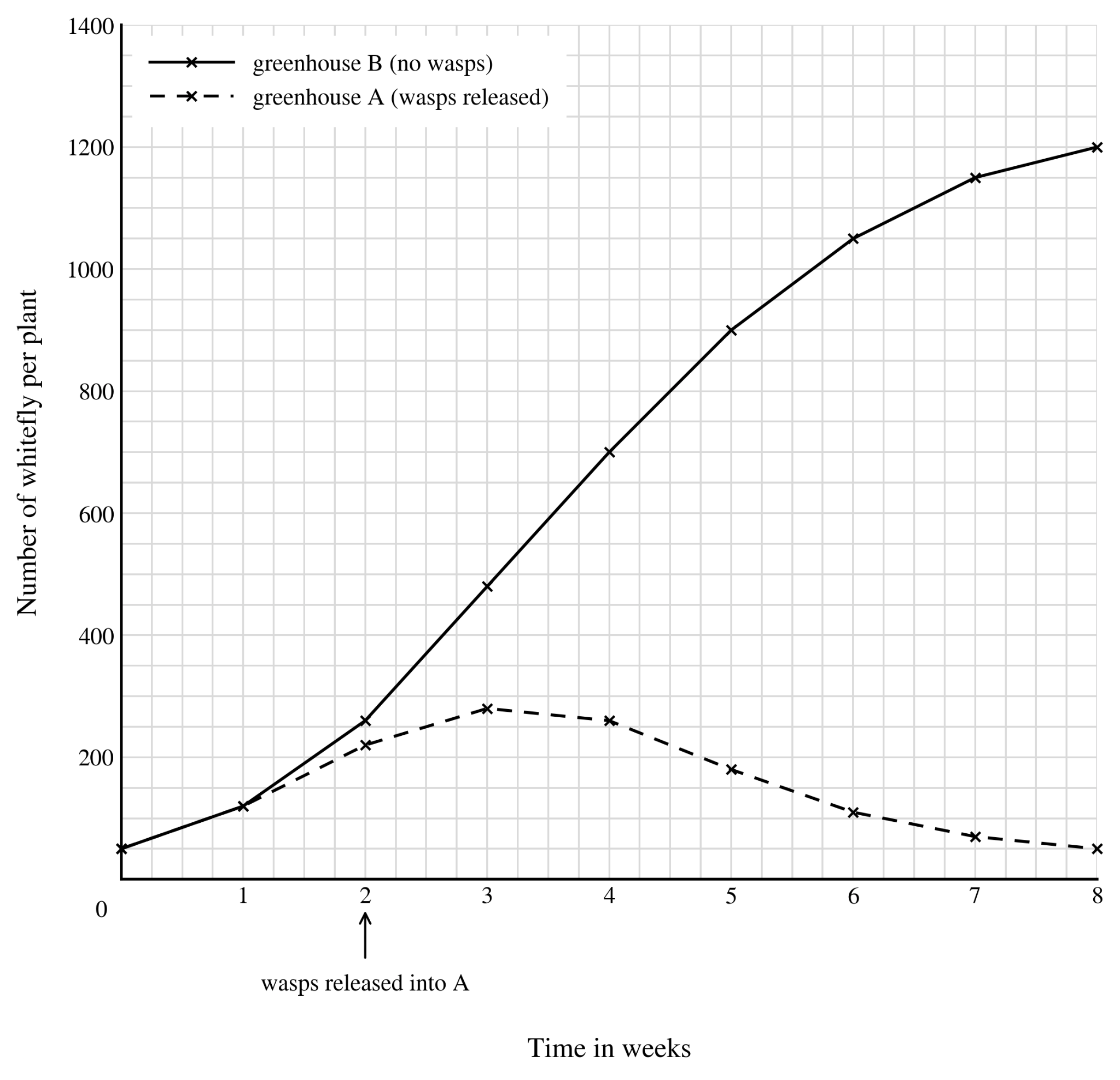
A grower released a small wasp into greenhouse A at week 2. The wasps lay their eggs inside young whitefly, which are then killed. No wasps were released into greenhouse B.
The Figure shows the number of whitefly in the two greenhouses over 8 weeks.
Figure
a.[1]
Use the Figure to give the number of whitefly per plant in greenhouse A at week 4.
b.[2]
Calculate how many times greater the number of whitefly per plant was in greenhouse B than in greenhouse A at week 8.
c.[2]
Explain why the number of whitefly in greenhouse A decreased after week 3.
d.[2]
Give two advantages of using wasps rather than chemical pesticides to control whitefly.
e.[1]
Give one disadvantage of using biological control.
4.3 Selective breeding and genetic modification Questions
44 exam-style questions on Edexcel GCSE Biology 4.3 Selective breeding and genetic modification, covering 4.3.1 Selective breeding and its impact, 4.3.2 Tissue culture, 4.3.3 Genetic engineering overview, 4.3.4 Main stages of genetic engineering, 4.3.5 Advantages and disadvantages of GM organisms, 4.3.6 Agricultural solutions for a growing population, and 4.3.7 Evaluating genetic engineering and breeding. Each one has a worked solution and a mark scheme showing where the marks go.