Light Intensity Falls With Distance
Definition
Inverse square law
The relationship in which light intensity is inversely proportional to the square of the distance from the light source.
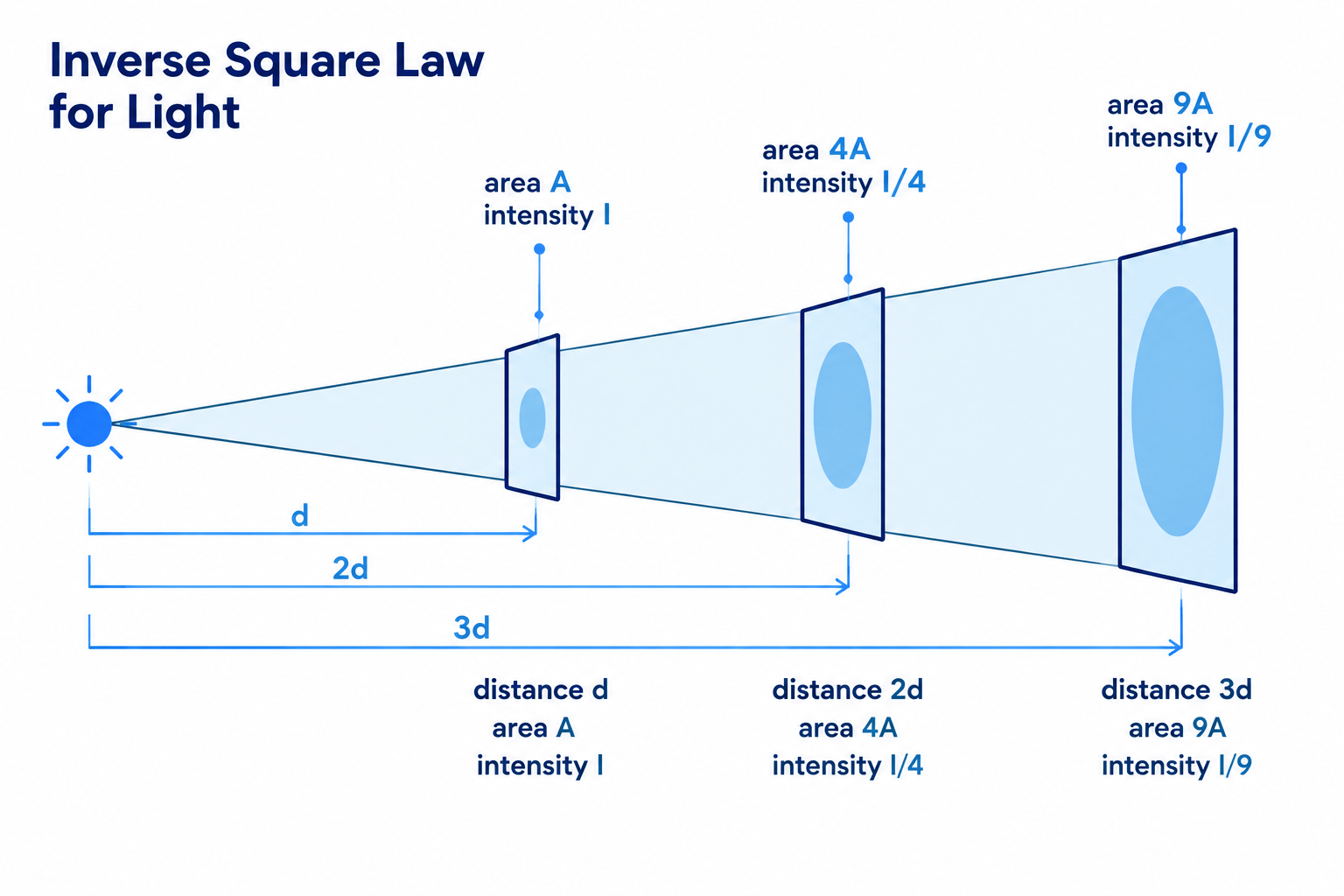
- Light from a lamp spreads over a larger area as distance increases, so the energy received per unit area decreases.
- The inverse square law states that light intensity is inversely proportional to the square of the distance from the source.
- The relationship is ** I∝1d2I \propto \dfrac{1}{d^2}I∝d21 **, where III is light intensity and ddd is distance.
- For relative light intensity, use ** I=1d2I = \dfrac{1}{d^2}I=d21 ** when no constant of proportionality is supplied.
Common Mistake
Distance and light intensity are not directly proportional, so doubling distance does not halve intensity.
Distance Changes Intensity by a Square
- If distance is multiplied by a scale factor nnn, light intensity is divided by n2n^2n2.
- Doubling distance gives ** 122=14\dfrac{1}{2^2} = \dfrac{1}{4}221=41 ** of the original intensity.
- Tripling distance gives ** 132=19\dfrac{1}{3^2} = \dfrac{1}{9}321=91 ** of the original intensity.
- Halving distance gives ** 1(1/2)2=4\dfrac{1}{(1/2)^2} = 4(1/2)21=4 ** times the original intensity.
Example
- A lamp is moved from 10 cm10\,\mathrm{cm}10cm to 30 cm30\,\mathrm{cm}30cm, so distance is multiplied by 333.
- The new relative intensity is 132=19\dfrac{1}{3^2} = \dfrac{1}{9}321=91 of the original intensity.
Calculate Relative Light Intensity
- Convert all distances to the same unit before squaring them.
- At d=0.20 md = 0.20\,\mathrm{m}d=0.20m, ** I=1(0.20)2=25 m−2I = \dfrac{1}{(0.20)^2} = 25\,\mathrm{m^{-2}}I=(0.20)21=25m−2 ** as a relative value.
- At d=0.40 md = 0.40\,\mathrm{m}d=0.40m, ** I=1(0.40)2=6.25 m−2I = \dfrac{1}{(0.40)^2} = 6.25\,\mathrm{m^{-2}}I=(0.40)21=6.25m−2 **.
- The second value is one quarter of the first because the distance doubled.
Example
- A lamp is 25 cm25\,\mathrm{cm}25cm from a plant, so the relative intensity is I=1252=1625=0.0016 cm−2I = \dfrac{1}{25^2} = \dfrac{1}{625} = 0.0016\,\mathrm{cm^{-2}}I=2521=6251=0.0016cm−2.
- At 50 cm50\,\mathrm{cm}50cm, I=1502=0.0004 cm−2I = \dfrac{1}{50^2} = 0.0004\,\mathrm{cm^{-2}}I=5021=0.0004cm−2, which is one quarter as large.
Link Intensity to Photosynthesis
- When light is the limiting factor, the rate of photosynthesis is directly proportional to light intensity.
- Moving a lamp closer increases light intensity, so chlorophyll absorbs more energy and the rate increases.
- The rate does not keep increasing indefinitely because carbon dioxide concentration or temperature can become limiting.
- A graph of rate against 1/d21/d^21/d2 tests the relationship more directly than a graph of rate against ddd.
Exam technique
Show the substitution, square the distance before taking the reciprocal, and state the final relationship to the rate of photosynthesis.
Check the Calculation
- A larger distance must give a smaller relative intensity, so use this pattern to check your answer.
- Keep the same distance unit throughout a comparison because changing units changes the numerical relative intensity.
Self review
- State the inverse square relationship.
- What happens to intensity when distance is tripled?
- Calculate relative intensity at d=5 cmd = 5\,\mathrm{cm}d=5cm.
- Why can photosynthesis stop rising even when light intensity increases?