Chromosomes in body cells
Definition
Chromosome
A long molecule of coiled DNA found in the nucleus, carrying many genes in a fixed order.
- A chromosome is a long molecule of DNA in the nucleus that carries the genes controlling a cell's characteristics.
- The nucleus of a human body cell contains 464646 chromosomes.
- These chromosomes are arranged in 232323 pairs, and the two chromosomes of a pair carry the same genes in the same order.
- One chromosome of each pair was inherited from the mother in the egg cell, and the other was inherited from the father in the sperm cell.
- A cell that contains two copies of every chromosome is described as diploid.
- The diploid number of a human body cell is written 2n=462n = 462n=46, where nnn stands for one complete set of chromosomes.
- Every body cell is diploid, including skin cells, muscle cells and nerve cells.
Haploid gametes
Definition
Haploid
Describes a cell that contains one copy of each chromosome, which in humans is 23 chromosomes.
- Gametes are the sex cells that fuse together in sexual reproduction.
- In humans the gametes are the sperm cell and the egg cell.
- In flowering plants the gametes are the nucleus inside a pollen grain and the egg cell inside an ovule.
- A gamete contains one chromosome from each pair rather than both, so it carries a single set of chromosomes.
- A cell that carries a single set of chromosomes is described as haploid.
- A human gamete therefore contains 232323 chromosomes, one from each of the 232323 pairs, written n=23n = 23n=23.
Key Idea
A body cell carries two copies of every chromosome, while a gamete carries only one chromosome from each pair.
How meiosis works
Definition
Meiosis
A type of cell division in which one diploid cell divides twice to produce four genetically different haploid daughter cells, which become the gametes.
- Meiosis is the type of cell division that produces gametes.
- In humans, meiosis takes place in the testes, where it makes sperm cells, and in the ovaries, where it makes egg cells.
- In flowering plants, meiosis takes place in the anthers, which make pollen, and in the ovules, which make egg cells.
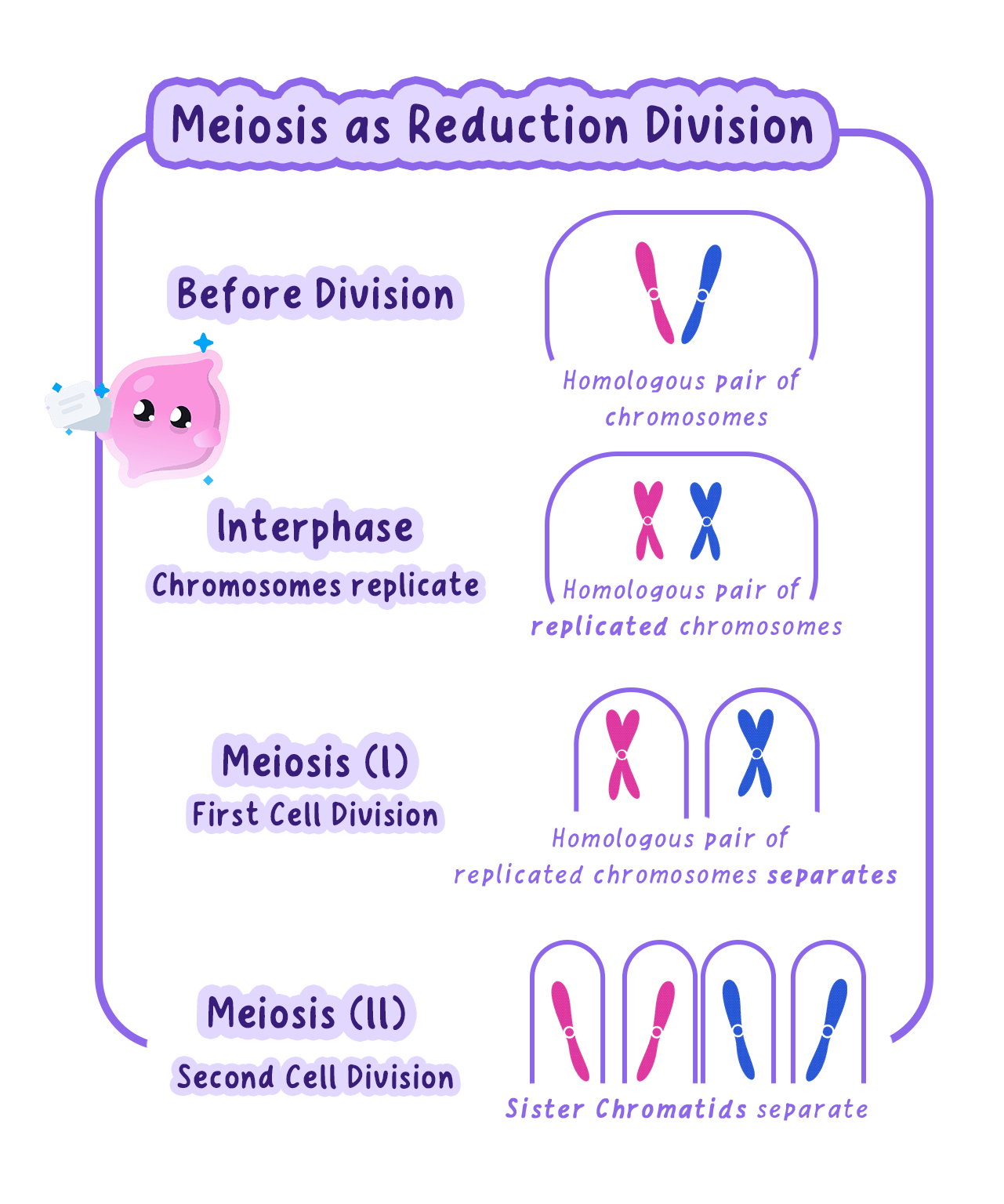
- Meiosis starts with a single diploid parent cell in which every chromosome has been copied.
- The cell then divides twice, so one parent cell gives rise to four daughter cells.
- Each daughter cell receives half the number of chromosomes of the parent cell, so each one is haploid.
- One human cell with 464646 chromosomes therefore produces four cells with 232323 chromosomes each.
- Each daughter cell is genetically different from the other three and from the parent cell it came from.
- The role of meiosis is therefore to produce genetically different haploid gametes from one diploid cell.
Common Mistake
- Do not write that meiosis produces two genetically identical cells, because that describes mitosis instead.
- Do not describe gametes as identical, because the four cells made by one meiosis differ from one another.
- Read back the word you have written, because mitosis and meiosis are marked as different answers and describing the wrong division earns nothing.
Fertilisation restores chromosome number
Definition
Fertilisation
The fusion of the nucleus of a male gamete with the nucleus of a female gamete to form a zygote.
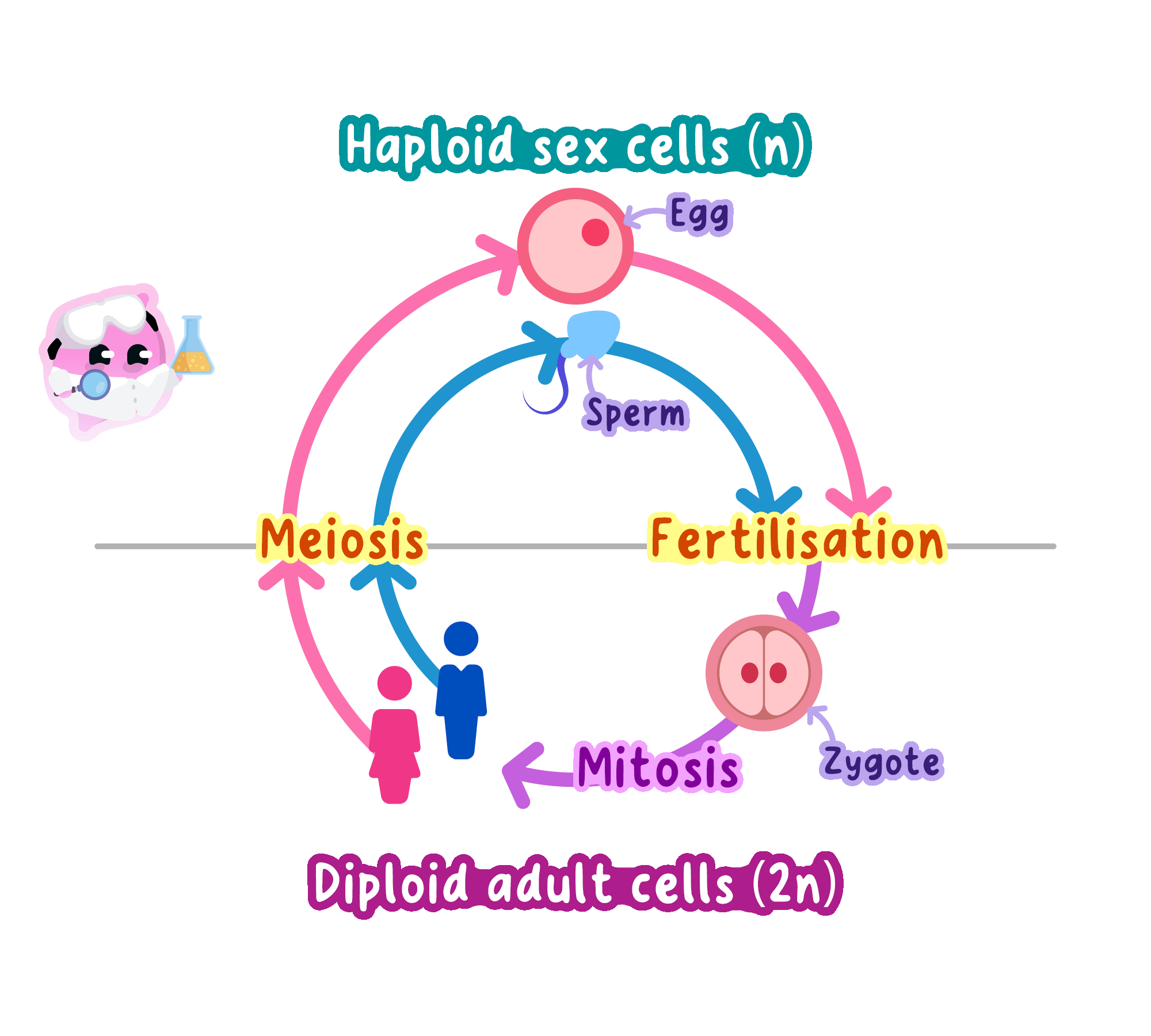
- Fertilisation is the fusion of the nucleus of a male gamete with the nucleus of a female gamete.
- Each gamete brings a single set of chromosomes, so the new cell receives 232323 chromosomes from the mother and 232323 from the father.
- The new cell therefore contains 23+23=4623 + 23 = 4623+23=46 chromosomes and is diploid, 2n=462n = 462n=46.
- The halving in meiosis and the doubling at fertilisation cancel each other out, so the chromosome number of the species stays the same from one generation to the next.
- If gametes were diploid instead, two gametes of 464646 chromosomes would fuse to give a cell with 929292 chromosomes.
- That generation would then make gametes of 929292 chromosomes and offspring of 184184184, so the number would double at every fertilisation.
- Halving the chromosome number in meiosis is what prevents this doubling and keeps the chromosome number of the species constant.
Exam technique
- When you are asked why gametes must be haploid, the mark sits on the consequence, so write that the chromosome number would double at every fertilisation if gametes were diploid.
- Answers saying only that the chromosome number would be wrong, or that the offspring would have too many chromosomes, describe the problem without explaining it and are not credited.
- The mark most often dropped is the second half of the chain: many answers stop at meiosis halving the chromosome number and never say that this keeps the number constant from generation to generation.
- If the question asks for a difference between mitosis and meiosis, give both halves of it, such as two daughter cells from mitosis against four from meiosis, since a statement about only one of the two divisions is not a difference.
Zygote growth by mitosis
Definition
Zygote
The single diploid cell produced when two gametes fuse at fertilisation.
- The diploid cell formed at fertilisation is called a zygote.
- The zygote divides repeatedly by mitosis to form a ball of cells that develops into an embryo.
- Every chromosome is copied before each of these divisions, so each new cell receives a full set of 464646 chromosomes.
- All of the body cells built in this way are diploid and genetically identical to the zygote they came from.
- The chromosome number of an organism can therefore be tracked through the whole cycle: diploid body cell, haploid gamete, diploid zygote, diploid body cell.
Example
- A body cell of a fruit fly contains 2n=82n = 82n=8 chromosomes, so meiosis halves this and a fruit fly gamete contains n=82=4n = \dfrac{8}{2} = 4n=28=4 chromosomes.
- Two of those gametes fuse at fertilisation, so the zygote contains 4+4=84 + 4 = 84+4=8 chromosomes, back to 2n=82n = 82n=8.
- A horse body cell contains 2n=642n = 642n=64 chromosomes, so a horse gamete contains 642=32\dfrac{64}{2} = 32264=32 chromosomes.
- A donkey body cell contains 2n=622n = 622n=62 chromosomes, so a donkey gamete contains 622=31\dfrac{62}{2} = 31262=31 chromosomes.
- A horse gamete fusing with a donkey gamete gives a mule with 32+31=6332 + 31 = 6332+31=63 chromosomes, so a mule has a diploid number of 2n=632n = 632n=63.
- An odd number of chromosomes cannot be sorted into matching pairs, which is why a mule cannot make working gametes and is almost always sterile.
Comparing mitosis and meiosis
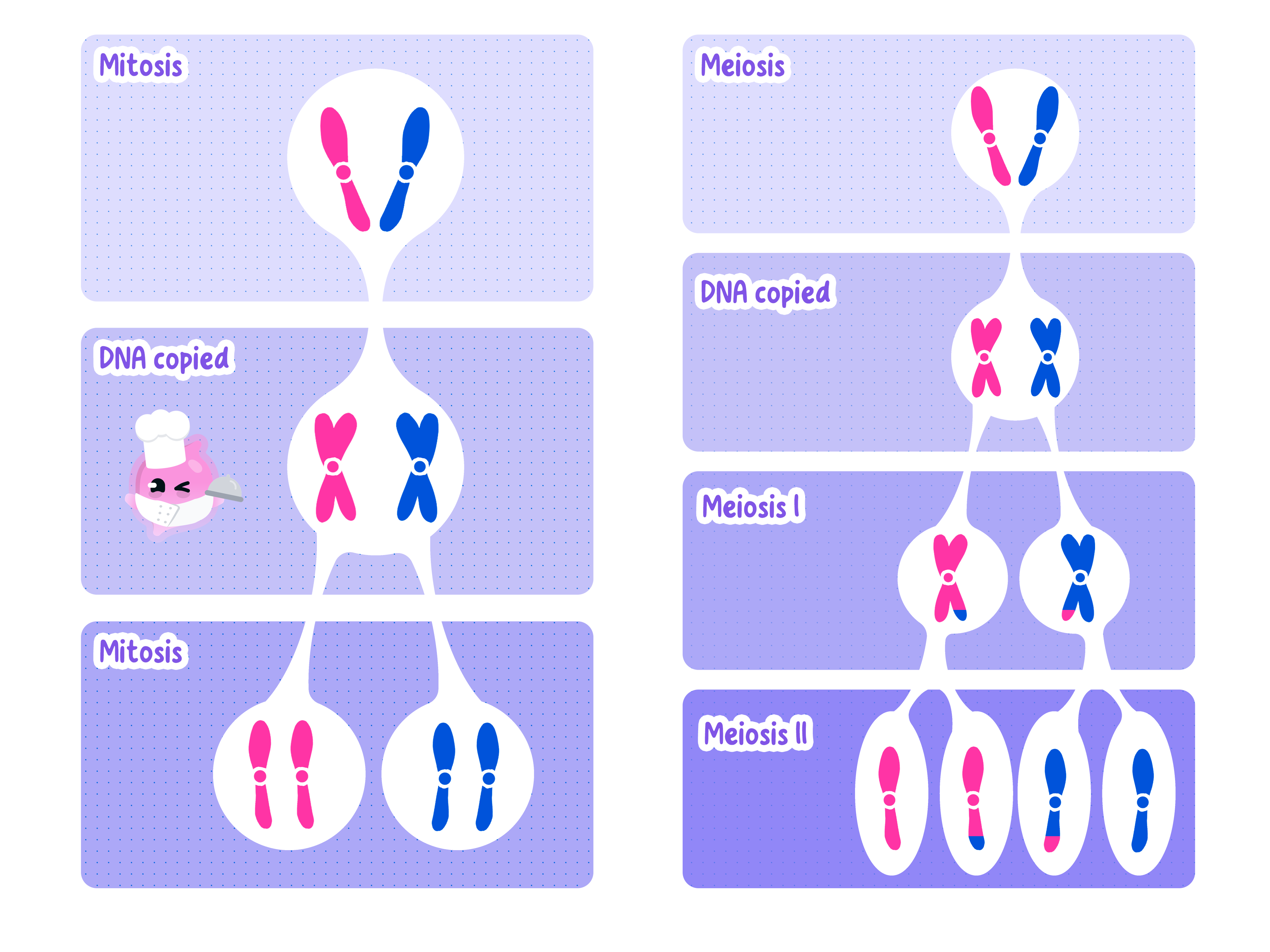
- Both divisions begin after the chromosomes have been copied, but they differ in the number of divisions, daughter cells, chromosome sets, genetic similarity and biological role.
- Number of divisions: mitosis divides the parent cell once, while meiosis divides it twice.
- Number of daughter cells: mitosis produces two daughter cells, while meiosis produces four.
- Chromosome number: the daughter cells of mitosis are diploid with 464646 chromosomes, while the daughter cells of meiosis are haploid with 232323.
- Genetic make-up: the daughter cells of mitosis are genetically identical to the parent cell and to each other, while the daughter cells of meiosis are genetically different.
- Use in the organism: mitosis is used for growth, for the repair of damaged tissue and for asexual reproduction.
- Meiosis is used only to make gametes for sexual reproduction, and it takes place only in the reproductive organs.
Hint
- Counting keeps the two apart: mitosis is one division and two identical cells, meiosis is two divisions and four different cells.
- The letters ei in meiosis can stand for eggs, and eggs are gametes, which only meiosis makes.
How meiosis creates variation
- The four gametes made by one meiosis are all genetically different from one another.
- Each gamete receives one chromosome from each pair, and which chromosome of a pair it receives varies from gamete to gamete.
- Every gamete therefore ends up with a different combination of the chromosomes the parent inherited from its own mother and father.
- Because a human cell has 232323 pairs to choose from, the number of different combinations a single person can produce is very large.
- Fertilisation is also random, because any sperm cell can fertilise any egg cell.
- Any one of a huge number of genetically different sperm cells can fuse with any one of a huge number of genetically different egg cells, so the number of possible zygotes is enormous.
- This is why offspring produced by sexual reproduction differ from each other and from both of their parents, while offspring produced by mitosis alone do not.
Self review
- How many chromosomes are there in a human body cell, and how many in a human gamete?
- How many daughter cells does one meiosis produce, and how do they compare genetically with the parent cell?
- Explain what would happen to the chromosome number of a species over several generations if its gametes were diploid.
- Give three differences between mitosis and meiosis.
- Why are the offspring of two parents genetically different from one another?
