Where DNA is found
Definition
DNA
The polymer that carries the genetic code, made of two nucleotide strands coiled into a double helix.
- DNA is the molecule that carries the genetic instructions an organism needs to build and run itself.
- In an animal or plant cell, DNA is found inside the nucleus.
- Within the nucleus the DNA is coiled up tightly and packaged into structures called chromosomes.
- Each chromosome contains one very long DNA molecule, and that coiling is what allows a molecule of such length to fit inside a nucleus.
- A DNA molecule is far too large to be a single simple unit, so its structure is best understood as one small unit repeated over and over.
DNA as a polymer
Definition
Nucleotide
The repeating unit of a DNA strand, made of a sugar and a phosphate group with one of four bases attached to the sugar.
- A polymer is a long molecule built from many small repeating units joined together in a chain.
- The repeating unit that DNA is built from is called a nucleotide, so DNA is a polymer of nucleotides.
- A single nucleotide is made of three parts joined together.
- One part is a sugar, which sits at the centre of the nucleotide.
- A phosphate group is joined to that sugar.
- A base is also attached to the same sugar.
- There are four different bases in DNA: adenine (A\text{A}A), thymine (T\text{T}T), cytosine (C\text{C}C) and guanine (G\text{G}G).
- Every nucleotide in DNA contains the same sugar and the same phosphate group.
- The only difference between one nucleotide and another is therefore which of the four bases is attached to its sugar.
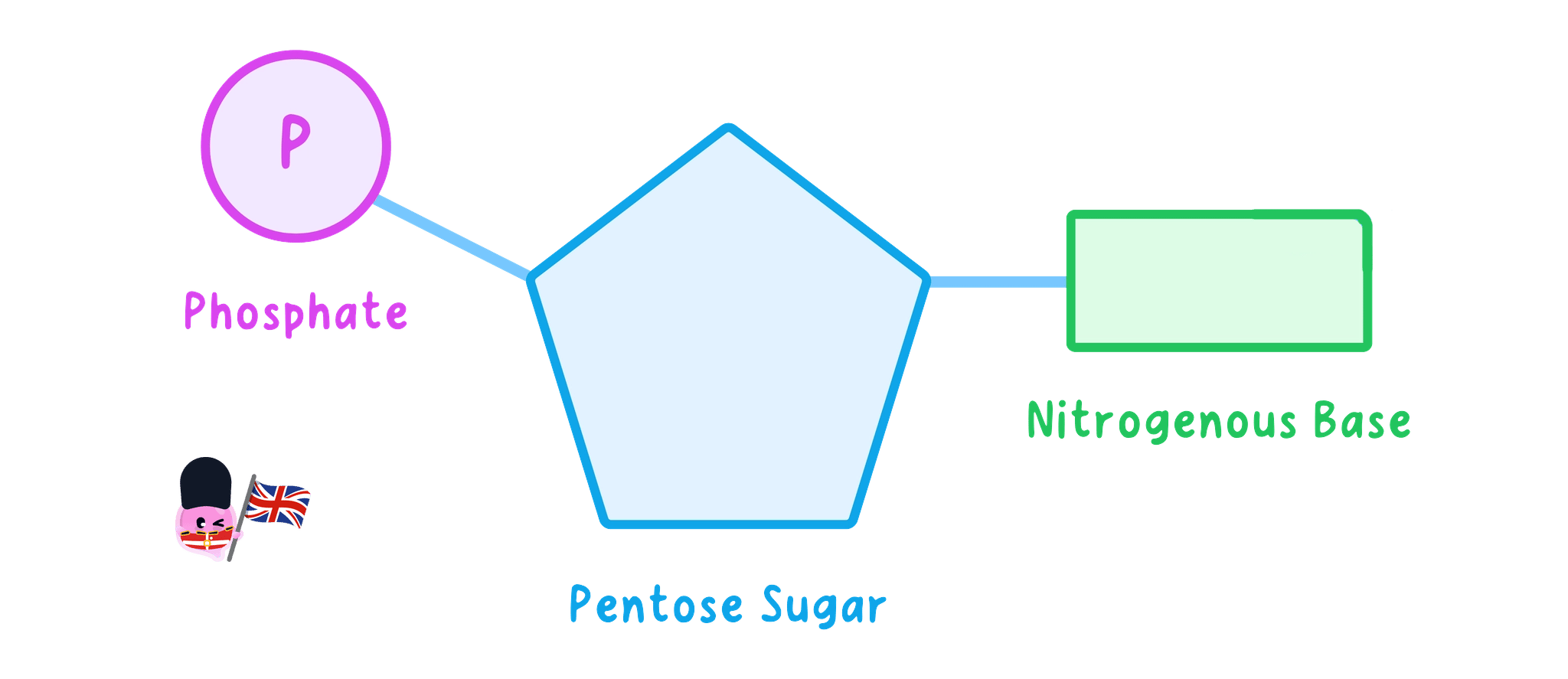
Key Idea
DNA is a polymer of nucleotides, and each nucleotide is a sugar joined to a phosphate group with one of four bases attached to that sugar.
The sugar-phosphate backbone
- Nucleotides join end to end to build a long strand of DNA.
- The phosphate group of one nucleotide joins to the sugar of the next nucleotide.
- Repeating that join thousands of times produces a chain in which sugars and phosphates alternate along the whole length of the strand.
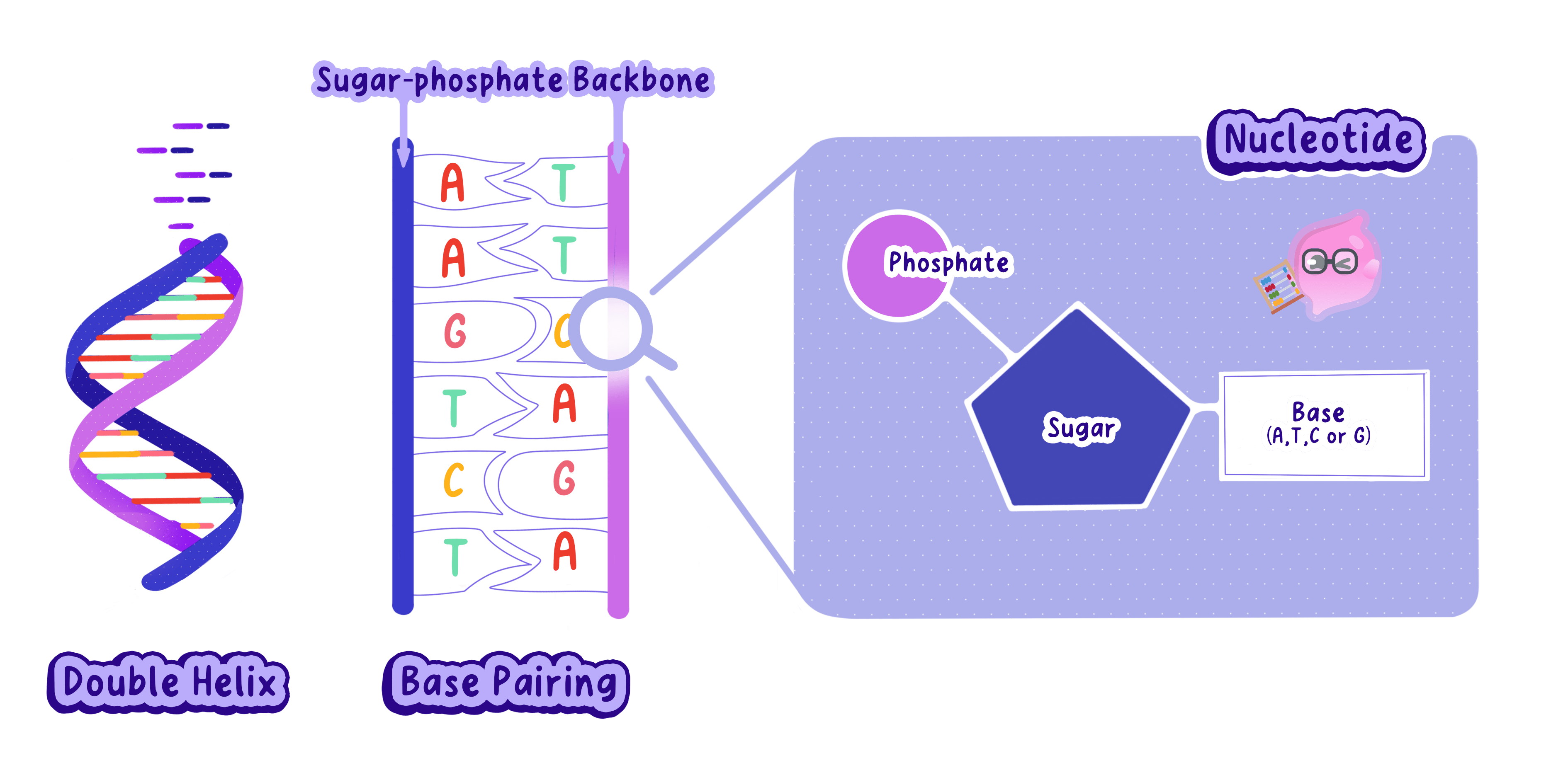
- This alternating chain of sugars and phosphates is the sugar-phosphate backbone of the strand.
- The bases are not part of the backbone, because each base stays attached to its own sugar and points inwards, away from the backbone.
- A complete DNA molecule is made of two such strands lying alongside each other, with the bases of one strand facing the bases of the other.
Complementary base pairing
Definition
Complementary base pairing
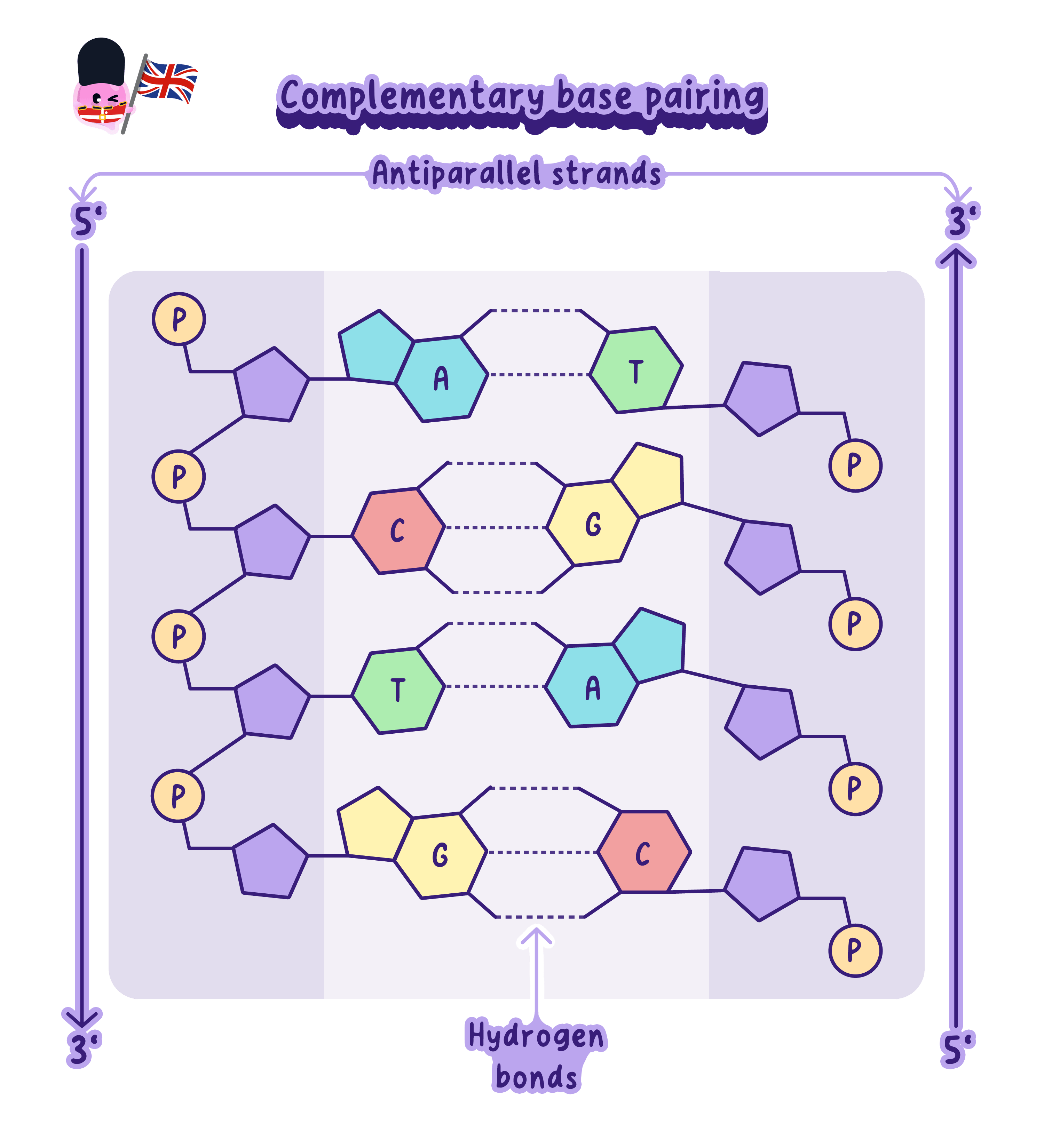
The rule that adenine always pairs with thymine and cytosine always pairs with guanine, the two bases being joined by weak hydrogen bonds.
- The two strands of a DNA molecule are held together by their bases, which pair up across the middle of the molecule.
- The pairing is fixed rather than random, because A\text{A}A always pairs with T\text{T}T, and C\text{C}C always pairs with G\text{G}G.
- Each of these joined pairs is called a base pair.
- Because the base on one strand fixes which base must sit opposite it, the two strands are described as complementary.
- This means that the sequence of bases along one strand determines the sequence of bases along the other strand.
- It also means that a DNA molecule contains equal amounts of adenine and thymine, since every A\text{A}A is matched by a T\text{T}T opposite it.
- For the same reason, a DNA molecule contains equal amounts of cytosine and guanine.
- The four bases account for every base in the molecule, so their four percentages add up to 100%100\%100%.
Example
- One strand of a DNA molecule has the base sequence A T G C C A G T\text{A}\,\text{T}\,\text{G}\,\text{C}\,\text{C}\,\text{A}\,\text{G}\,\text{T}ATGCCAGT, and the complementary strand is built one base at a time.
- A\text{A}A pairs with T\text{T}T, so the first base of the complementary strand is T\text{T}T.
- T\text{T}T pairs with A\text{A}A, so the second base is A\text{A}A.
- G\text{G}G pairs with C\text{C}C, so the third base is C\text{C}C.
- The two C\text{C}C bases that follow each pair with G\text{G}G, giving G G\text{G}\,\text{G}GG.
- The remaining A\text{A}A, G\text{G}G and T\text{T}T give T\text{T}T, C\text{C}C and A\text{A}A in turn.
- The complementary strand is therefore T A C G G T C A\text{T}\,\text{A}\,\text{C}\,\text{G}\,\text{G}\,\text{T}\,\text{C}\,\text{A}TACGGTCA.
- The same fixed pairing also fixes how much of each base is present, so a sample of DNA containing 20%20\%20% adenine can be worked through in the same way.
- Adenine pairs only with thymine, so thymine is present in the same amount: thymine=20%\text{thymine} = 20\%thymine=20%.
- Adenine and thymine together therefore account for 20%+20%=40%20\% + 20\% = 40\%20%+20%=40% of the bases.
- Every remaining base is either cytosine or guanine, so together those two make up 100%−40%=60%100\% - 40\% = 60\%100%−40%=60%.
- Cytosine and guanine are present in equal amounts, so each one is half of that total: 60%2=30%\dfrac{60\%}{2} = 30\%260%=30%.
- The sample therefore contains 20%20\%20% thymine, 30%30\%30% cytosine and 30%30\%30% guanine.
Hydrogen bonds between bases
- Each base pair is held together by weak hydrogen bonds between the two bases.
- A single hydrogen bond is easily broken, and that weakness is the useful part of the structure rather than a fault in it.
- When a cell copies its DNA or reads a section of it, the hydrogen bonds along that section are broken so that the two strands can be pulled apart and the bases exposed.
- Strong bonds would lock the strands together permanently, and the order of the bases could never be reached.
- A DNA molecule contains millions of base pairs, and every pair adds its own hydrogen bonds to the total.
- So many weak bonds acting together hold the two strands firmly, even though any single one of them gives way easily.
Common Mistake
- Do not write that the base pairs are joined by strong bonds, because the credited answer is weak hydrogen bonds, and strong bonds would stop the strands ever separating.
- Do not pair A\text{A}A with C\text{C}C or G\text{G}G with T\text{T}T, as the only pairings that exist are A\text{A}A with T\text{T}T and C\text{C}C with G\text{G}G.
- Do not describe the bases as part of the sugar-phosphate backbone, since each base is attached to a sugar and points inwards towards the base opposite it.
The double helix
Definition
Double helix
The shape of a DNA molecule, in which two nucleotide strands are coiled around each other.
- The two strands of a DNA molecule do not lie flat alongside each other.
- They are twisted around each other along their whole length, so the molecule takes the shape of a spiral.
- Two strands coiled around each other in this way form a double helix, and that is the overall shape of a DNA molecule.
- The two sugar-phosphate backbones run along the outside of the helix, and the base pairs sit on the inside, joined by their hydrogen bonds.
Exam technique
- A request to describe the structure of DNA is worth two or three marks, and each mark is tied to a named component rather than to a general impression of the molecule.
- Write weak hydrogen bonds in full, because the word bonds on its own does not earn that mark.
- State which base pairs with which, giving A\text{A}A with T\text{T}T and C\text{C}C with G\text{G}G, as writing only that the bases pair up leaves the mark unearned.
- Name the two strands, the double helix and the nucleotide as the repeating unit, so that every component you are being marked on is on the page.
Base sequence
- The order of the bases along a strand is the information that a cell reads.
- A section of DNA that codes for one protein is a gene, and the complete set of DNA in an organism is its genome.
- A single DNA molecule carries many genes, one after another along its length.
Self review
- Name the three parts of a single nucleotide, and state which of the three differs between one nucleotide and the next.
- Which base pairs with cytosine, and what type of bond holds that pair together?
- Explain why weak bonds between the base pairs are useful to a cell rather than a problem.
- A DNA sample contains 30%30\%30% thymine. What percentage of its bases is guanine?
- What does the term double helix describe?
