Asexual reproduction
Asexual reproduction
Reproduction involving only one parent and no fusion of gametes, producing offspring that are genetically identical to the parent.
- Asexual reproduction produces new individuals from a single parent.
- No sex cells are made and no two cells fuse together, so no genetic material arrives from a second organism.
- The new individuals are produced by mitosis, the cell division that copies every chromosome exactly before the cell divides.
- Each new cell therefore receives a complete copy of the parent's DNA.
- The offspring are genetically identical to the parent and to one another.
- Any differences between them come from the conditions they grow in rather than from their genes.
Clones and natural examples
Clone
An offspring that is genetically identical to its parent.
- Offspring that carry exactly the same genetic material as the parent that produced them are clones.
- Bacteria divide by binary fission, in which one cell copies its DNA and then splits into two identical daughter cells.
- A single bacterium can produce a colony of millions of clones within a day when food and warmth are available.
- A strawberry plant grows horizontal stems called runners, and a new plant with the same genes forms wherever a runner touches the soil.
- A potato plant swells the ends of underground stems into tubers, and each tuber can sprout into a new plant identical to the one that made it.
- A spider plant produces small plants on long arching stems, and each plantlet roots into a separate identical plant.
- Aphids reproduce asexually through the summer, so a single female can fill a plant with identical young without ever mating.
Every advantage and disadvantage of the two methods follows from one difference: asexual reproduction copies one set of genes unchanged, while sexual reproduction mixes two.
Asexual reproduction: advantages and disadvantages
- No mate is needed, so no time or energy is spent searching for one or competing for one.
- An organism that is isolated, or that lives in a population spread thinly over a large area, can still reproduce.
- The reproductive cycle is rapid, so numbers build up very quickly whenever conditions are favourable.
- Only one parent is needed, so a single organism arriving in a new habitat can populate that habitat on its own.
- A set of genes that already suits the habitat is passed on unchanged, so the offspring are as well suited to those conditions as the parent is.
- Less energy goes into making sex cells, into courtship displays and into caring for young, leaving more energy for growth.
- The central disadvantage is that there is no genetic variation in the population.
- Because every individual carries the same genes, a new disease affects every one of them in the same way, and the whole population can be wiped out.
- A change in conditions, such as a drop in temperature or the loss of one food source, affects every individual equally for the same reason.
- The population cannot adapt by natural selection, because there is no variation for selection to act on.
- Offspring grow close to the parent, so they compete with the parent and with each other for the same light, water, mineral ions or food.
- Questions commonly ask you to explain advantages and disadvantages, so each point needs a biological consequence rather than a label alone.
- The mark sits in the consequence, not in the label, so writing that asexual reproduction gives no variation and stopping there scores nothing.
- Adding what the lack of variation leads to, that one new disease could kill every individual because they all respond to it in the same way, is what earns the mark.
- Check each point you have written ends in a clause beginning so or because, and in a six mark answer group the advantages together and then the disadvantages, so both halves are easy to find.
Sexual reproduction
Sexual reproduction
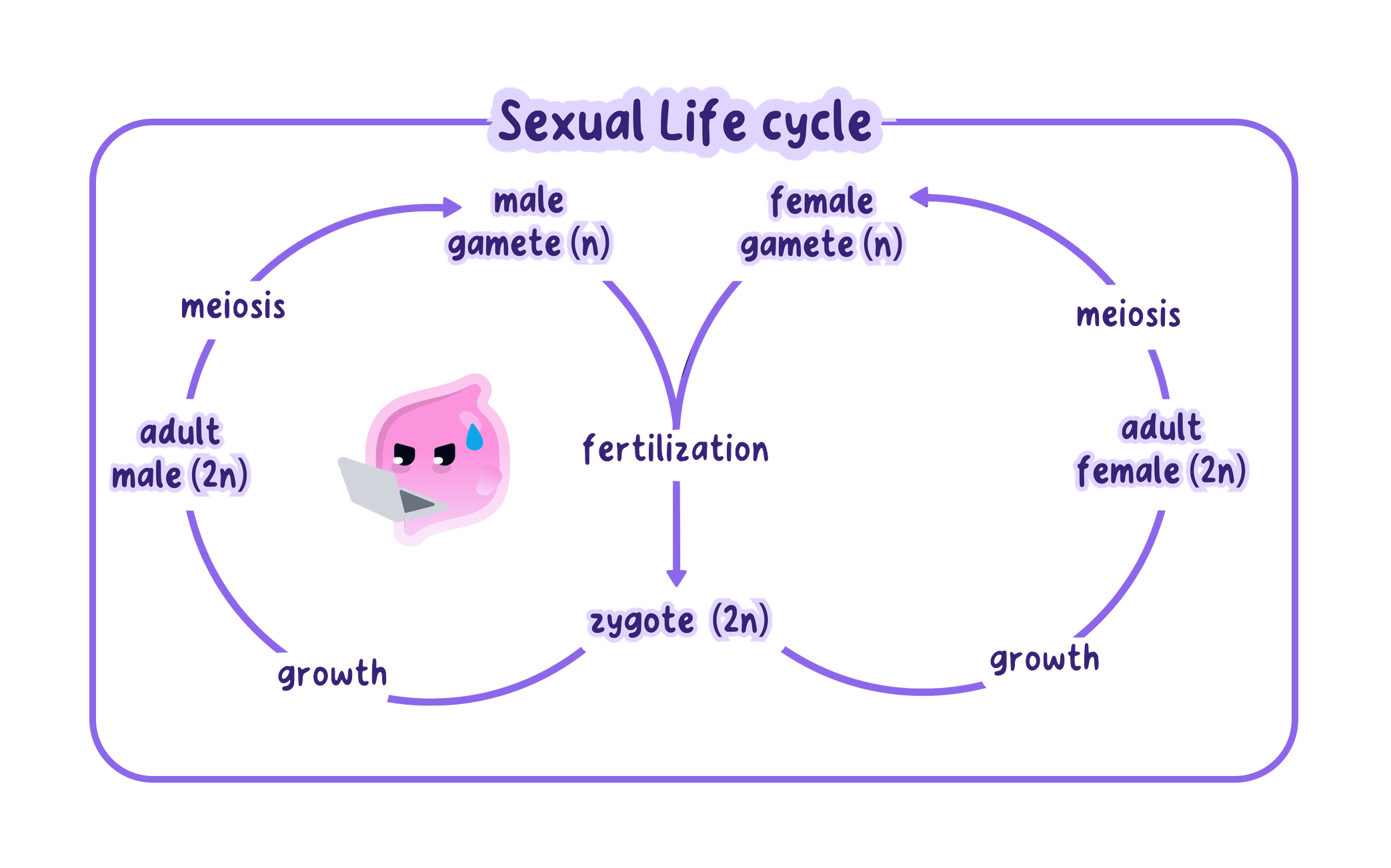
Reproduction involving the fusion of a male gamete and a female gamete at fertilisation, producing offspring that are genetically different from their parents.
- Sexual reproduction produces offspring from two parents rather than one.
- Each parent passes on half of the genetic material that the offspring will carry.
- The two parents carry different alleles, which are different versions of the same gene, so the offspring inherit a combination that neither parent had.
- The offspring are therefore genetically different from both parents and from each other.
- Brothers and sisters resemble their parents without matching them, and only identical twins share exactly the same genes.
- Do not write that sexual reproduction is simply better than asexual reproduction.
- Each method carries real costs, and which one is useful depends on the conditions the organism is living in, so an answer that ranks them loses the comparison mark.
- Do not describe asexually produced offspring as similar to the parent, because the mark is awarded for genetically identical.
Gametes and meiosis
Gamete
A sex cell that carries half the number of chromosomes of a body cell and fuses with another gamete at fertilisation.
- The sex cells that fuse in sexual reproduction are gametes.
- In animals the male gamete is the sperm cell and the female gamete is the egg cell.
- In flowering plants the male gamete is carried inside a pollen grain and the female gamete is the egg cell held in the ovule.
- Gametes are made by meiosis, the cell division that halves the chromosome number.
- A human body cell contains 2n=462n = 462n=46 chromosomes, while a human gamete contains n=23n = 23n=23.
- Every gamete a parent makes carries a different selection of that parent's alleles, which is the first source of the variation seen in the offspring.
- Meiosis is used only to make gametes; every other cell division in the body, including the growth of the offspring itself, is mitosis.
- How meiosis halves the chromosome number and produces four genetically different cells is set out in full in the next article.
Fertilisation and the zygote
Fertilisation
The fusion of the nucleus of a male gamete with the nucleus of a female gamete to form a zygote.
- Fertilisation is the fusion of the nucleus of a male gamete with the nucleus of a female gamete.
- The single cell formed by that fusion is a zygote.
- Each gamete supplied half a set of chromosomes, so the zygote carries the full number again, 2n=462n = 462n=46 in humans.
- The zygote then divides by mitosis to form an embryo, so every body cell of the new individual carries the same mixture of alleles.
- Half of those alleles came from one parent and half from the other, which is why the offspring resembles both parents without matching either of them.
Sexual reproduction: advantages and disadvantages
- Sexual reproduction produces genetic variation, because the offspring receive a mixture of alleles from two parents.
- When conditions change or a new disease appears, that variation makes it likely that some individuals already carry alleles allowing them to survive.
- Those survivors live long enough to reproduce and pass the helpful alleles on to their own offspring.
- The proportion of individuals carrying those alleles rises with each generation, so the species adapts by natural selection.
- The same variation is what makes selective breeding of crops and farm animals possible.
- The first cost is that a mate must be found, which takes time and energy and can expose an organism to predators while it searches or displays.
- An organism isolated from others of its species cannot reproduce at all.
- The reproductive cycle is slower, so fewer offspring are produced in the same length of time.
- Energy is spent building gametes, on courtship, and in many animals on feeding and protecting the young after birth.
- An aphid uses both methods within a single year, and the conditions decide which one pays.
- Through spring and summer the plant sap it feeds on is plentiful and the weather is mild, so a female produces daughters asexually.
- No male, no mate and no gametes are needed, and each daughter is a clone that can itself reproduce within days, so the colony exploits the food supply before the plant is exhausted.
- Uniformity costs the colony almost nothing while the conditions stay the same, because the parent's genes already suit them.
- In autumn the day length shortens and the plant dies back, so the conditions the clones are suited to disappear.
- Males are now produced, mating takes place and fertilised eggs are laid that survive the winter.
- Those eggs are genetically varied, so some are likely to carry alleles that let them tolerate the cold and hatch in spring.
Comparing sexual and asexual reproduction
- Asexual reproduction needs one parent, while sexual reproduction needs two.
- Asexual reproduction involves no gametes and no fertilisation, while sexual reproduction depends on both.
- Offspring produced asexually are made by mitosis and are genetically identical, while offspring produced sexually begin as a zygote and are genetically different.
- Asexual reproduction is faster and yields more offspring in a given time, while sexual reproduction is slower and yields fewer.
- Asexual reproduction gives no variation, so the population cannot adapt, while sexual reproduction gives variation, so natural selection has something to act on.
- Many organisms use both methods and switch between them as their conditions change.
- While conditions are favourable they reproduce asexually, so numbers rise quickly and the habitat is exploited.
- When conditions turn harsh they reproduce sexually, so the varied offspring include some that may survive the new conditions.
- The malarial parasite reproduces asexually inside the human host, where conditions are constant, and sexually inside the mosquito.
- A strawberry plant sends out runners through the summer and also produces flowers, whose fertilised ovules become genetically varied seeds.
- Aphids follow the same pattern, reproducing asexually in summer and sexually in autumn.
- Why are the offspring of asexual reproduction genetically identical to the parent?
- Give one advantage of asexual reproduction and state the consequence that makes it an advantage.
- Explain why a population of clones can be destroyed by a single new disease.
- How does the variation produced by sexual reproduction allow a species to adapt over generations?
- Why does an aphid switch from asexual to sexual reproduction in autumn?
