Definition
Monohybrid cross
A genetic cross that follows the inheritance of a single gene.
- A monohybrid cross follows the inheritance of a single gene.
- A genetic diagram sets out the parents' genotypes, the alleles in their gametes, and the possible offspring.
- Each parent passes just one allele of the gene into each gamete.
- A Punnett square is a grid used to combine the parents' gametes and find the offspring genotypes.
Note
Each gamete carries only one allele of each gene, because meiosis halves the number.
Hint
Work in order: write the parents' genotypes, then their gametes, then combine them.
Genotype and phenotype ratios
Definition
Phenotype
The observable characteristics of an organism, produced by its genotype and its environment.
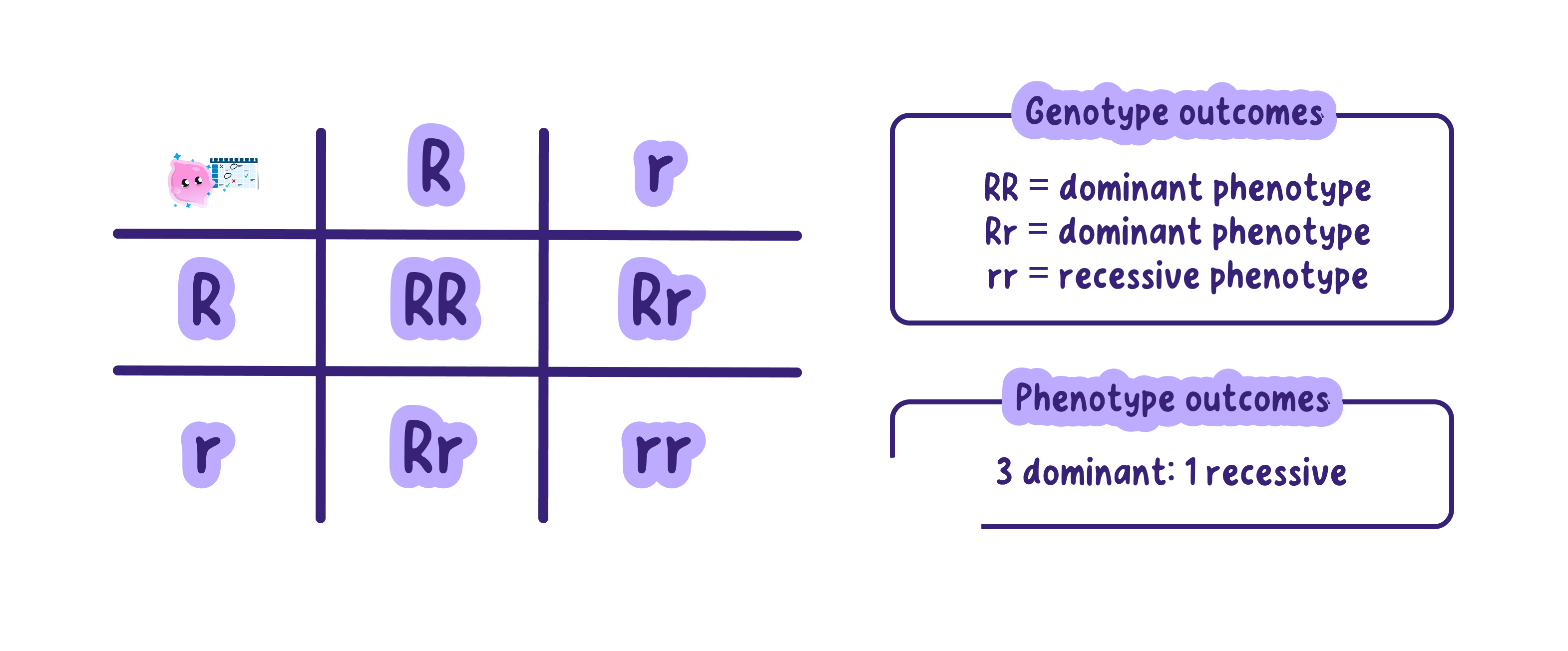
- Combining the gametes gives the possible offspring genotypes.
- From a cross of two heterozygotes (Bb×BbBb \times BbBb×Bb), the offspring are BBBBBB, BbBbBb, BbBbBb and bbbbbb.
- This is a genotype ratio of 1:2:11:2:11:2:1 and a phenotype ratio of 3:13:13:1, dominant to recessive.
- A cross of a heterozygote with a homozygous recessive (Bb×bbBb \times bbBb×bb) gives a 1:11:11:1 phenotype ratio.
Common Mistake
Do not confuse the genotype ratio (1:2:11:2:11:2:1) with the phenotype ratio (3:13:13:1).
Example
Worked cross: two heterozygous pea plants
- Parental genotypes: Tt×TtTt \times TtTt×Tt. The allele TTT is dominant for tall plants and ttt is recessive for short plants.
- Gametes: each parent produces gametes carrying either TTT or ttt.
- Punnett outcomes: TTTTTT, TtTtTt, TtTtTt and tttttt.
- Genotype ratio: 1 TT:2 Tt:1 tt1\,TT : 2\,Tt : 1\,tt1TT:2Tt:1tt.
- Phenotype ratio: 333 tall : 111 short because both TTTTTT and TtTtTt show the dominant phenotype.
- Probability: each offspring has a 34\dfrac{3}{4}43 chance of being tall and a 14\dfrac{1}{4}41 chance of being short. These are probabilities for each fertilisation, not a guarantee that every four offspring will have exactly this pattern.
Using a Punnett square
Definition
Punnett square
A grid used to predict the possible genotypes and phenotypes of offspring from a genetic cross.
- A Punnett square is a grid for combining the parents' gametes.
- Write one parent's gametes along the top and the other's down the side.
- Fill each box by combining the allele from its row with the allele from its column.
- The filled boxes show all the possible offspring genotypes.
- For Bb×BbBb \times BbBb×Bb, the four boxes give BBBBBB, BbBbBb, BbBbBb and bbbbbb.
Hint
Put single alleles on the edges of the grid, not whole genotypes.
Common Mistake
Do not put both of a parent's alleles into one gamete: each gamete gets only one.
Self review
- What is a monohybrid cross?
- What is a Punnett square used for?
- What phenotype ratio comes from crossing two heterozygotes?
- What is the difference between a genotype ratio and a phenotype ratio?
