Chromosomes and genes
Chromosome
A thread-like structure of tightly coiled DNA in the nucleus that carries many genes.
Gene
A short section of DNA that codes for a particular protein and controls a characteristic.
- The nucleus of a cell contains thread-like structures called chromosomes.
- Each chromosome is made from one very long molecule of DNA that is tightly coiled up.
- A gene is a small section of that DNA that carries the instructions for one feature.
- The genes sit along a chromosome in a fixed order, and the fixed position of a gene is called its locus.
- A single chromosome carries many hundreds or thousands of genes, one after another.
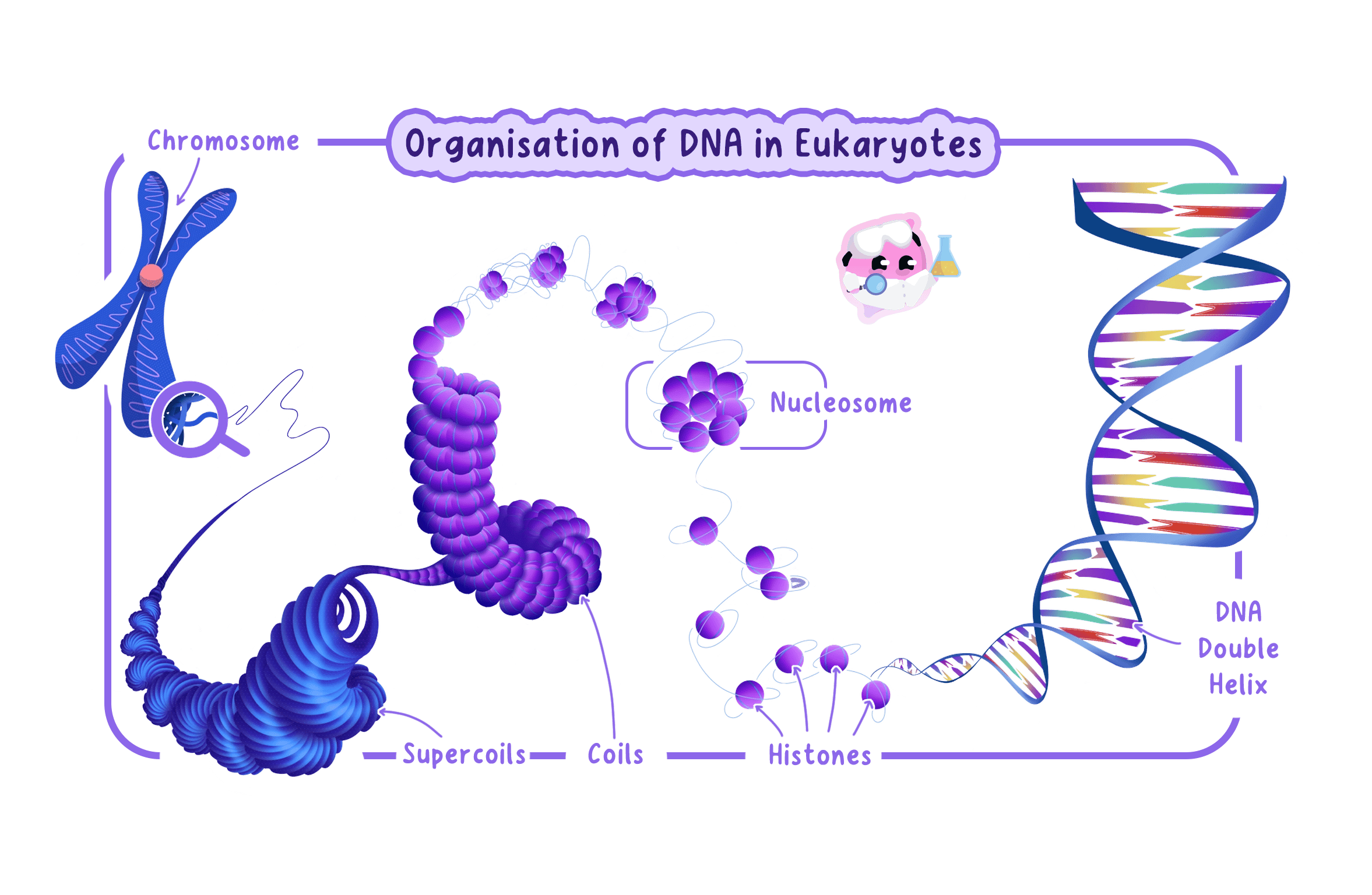
Picture a chromosome as a long shelf and the genes as books in a set order: the locus is the exact spot where one gene always sits.
Remember the nesting from large to small: nucleus holds chromosomes, a chromosome is one long DNA molecule, and a gene is a short section of that DNA.
Alleles
Allele
A different version of a gene.
- Body cells contain chromosomes in matching pairs, called homologous pairs.
- In humans there are 232323 pairs, giving 464646 chromosomes in each body cell.
- One chromosome of each pair comes from the mother and one from the father.
- The two chromosomes in a pair carry the same genes at the same loci.
- A gene can exist in different versions called alleles, and the two alleles at a locus may be the same or different.
The gene for eye colour sits at one locus: one allele may give brown eyes and a different allele blue eyes.
Do not mix up a gene and an allele: a gene is the section of DNA for a feature, while an allele is one particular version of that gene.
Dominant and recessive alleles
Dominant allele
An allele that is expressed in the phenotype even when only one copy is present.
Recessive allele
An allele that is only expressed in the phenotype when two copies are present.
- A dominant allele shows its effect even if only one copy is present.
- A recessive allele shows its effect only when two copies are present.
A dominant allele is usually written as a capital letter and its recessive partner as the same letter in lower case, such as BBB and bbb.
A dominant allele needs just one copy to show; a recessive allele needs two.
Homozygous and heterozygous
Homozygous
Having two identical alleles of a gene.
Heterozygous
Having two different alleles of a gene.
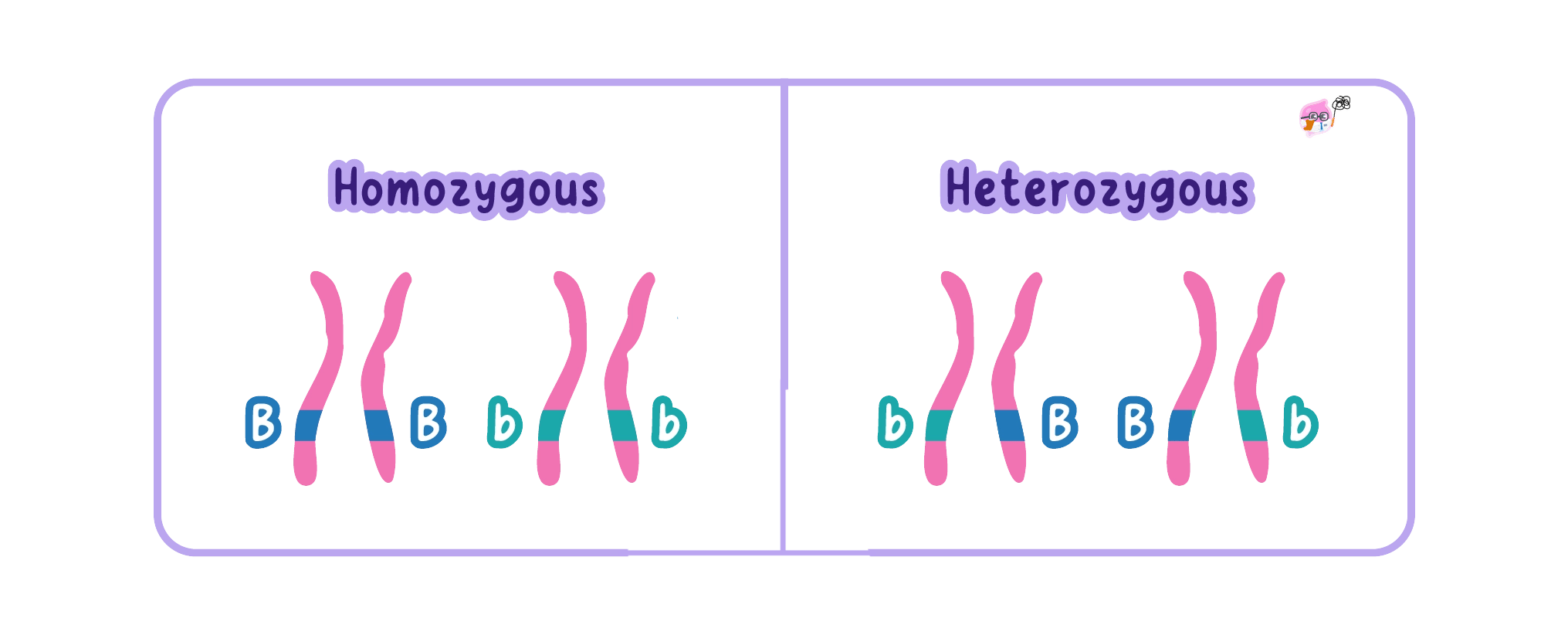
- Homozygous means the two alleles for a gene are the same, such as BBBBBB or bbbbbb.
- Heterozygous means the two alleles are different, such as BbBbBb.
- A homozygous organism is pure-breeding for that gene because every gamete receives the same allele.
Genotype and phenotype
Genotype
The combination of alleles an organism has for a characteristic.
Phenotype
The observable characteristics of an organism, produced by its genotype and its environment.
- The genotype is the alleles an organism has for a gene.
- The phenotype is the observable feature that results.
- The phenotype is set by the genotype together with the environment.
An organism with genotype BbBbBb is heterozygous, and if BBB is dominant its phenotype is the dominant feature.
Do not confuse genotype with phenotype: the genotype is the alleles, the phenotype is the feature you can observe.
Gametes and zygotes
Gamete
A sex cell that carries half the number of chromosomes of a body cell and fuses with another gamete at fertilisation.
Zygote
The single diploid cell produced when two gametes fuse at fertilisation.
- A gamete contains one allele for each gene because it is haploid and carries one chromosome from each homologous pair.
- At fertilisation, a male gamete and a female gamete fuse. The resulting zygote is diploid, so it contains two alleles for each gene, one inherited from each parent.
- Different combinations of parental alleles give offspring different genotypes, which can produce different inherited phenotypes.
- Define chromosome, gene and allele.
- Explain the difference between dominant and recessive alleles.
- Distinguish homozygous from heterozygous genotypes.
- Explain the difference between genotype and phenotype.
- What allele does each gamete carry for one gene?
- How does a zygote obtain two alleles for each gene?
