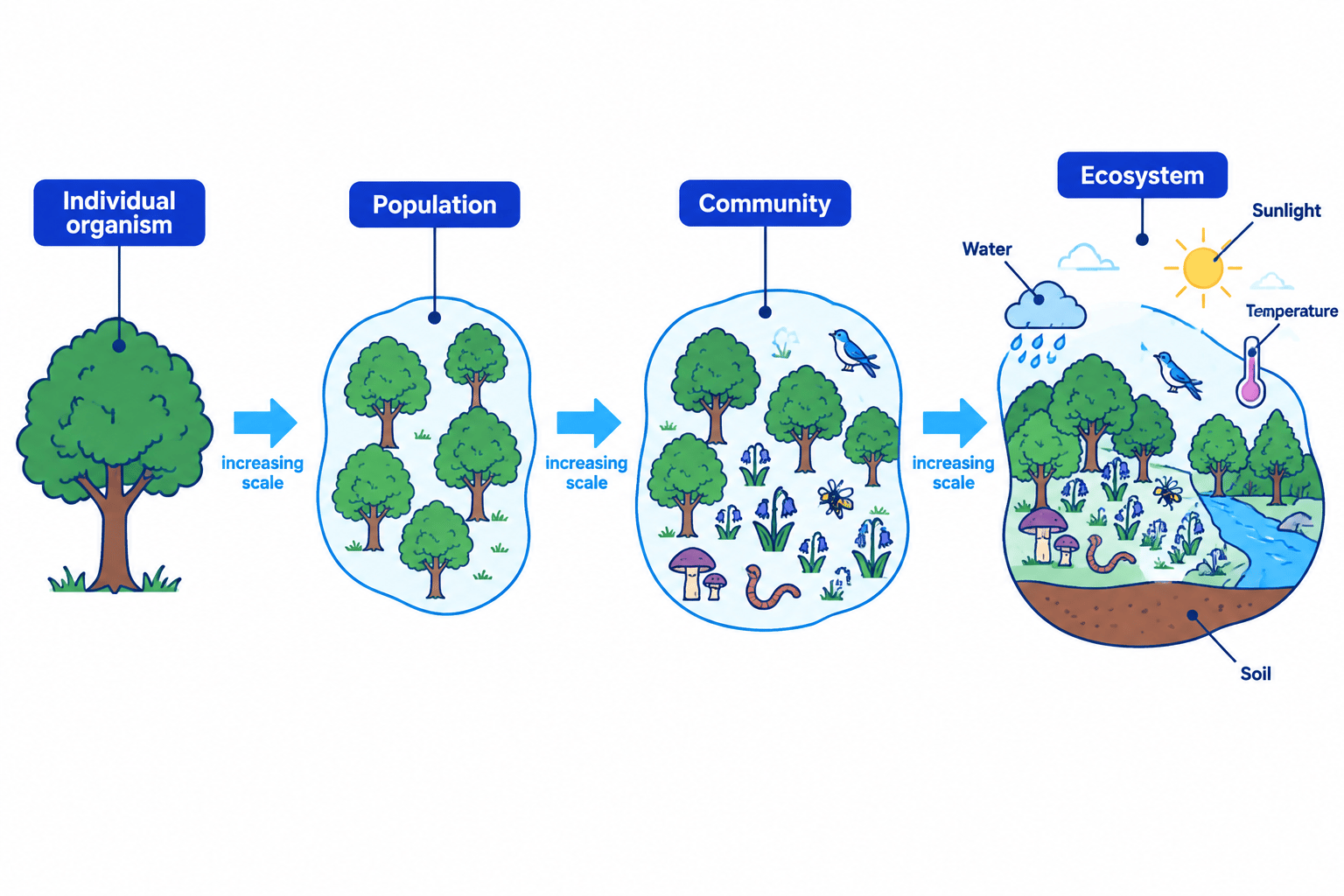
Organisation: Individuals Build Ecosystems
Definition
Population
A population is all the organisms of one species living in the same area at the same time.
- An individual organism is one living organism, such as one oak tree, one rabbit or one bacterium.
- A population is all the organisms of one species living in the same area at the same time.
- Population size changes when organisms are born, die, enter the area or leave it.
Example
One oak tree is an individual, all the oak trees in one wood form a population, and the oak population is one part of the woodland community.
Communities Contain Many Populations
Definition
Community
A community is all the populations of different species living and interacting in the same area.
- A community is all the populations of different species living and interacting in the same area.
- A woodland community may include populations of oak trees, bluebells, earthworms, fungi, insects and birds.
- One species is a population, while every species considered together is a community.
Exam technique
- When you compare population with community, state both differences: one species compared with many species, and the same area at the same time.
- Do not describe a community as a place because the habitat is the place where organisms live.
Ecosystems Include the Environment
Definition
Ecosystem
An ecosystem is a community of organisms and the non-living parts of their environment interacting together.
- An ecosystem is a community of organisms and the non-living parts of their environment interacting together.
- Biotic components are the living organisms, while abiotic components include light, temperature, water and soil conditions.
- The levels increase in scale: individual organism, population, community, then ecosystem.
- Interactions connect the levels: a change in one population can affect other populations and can alter the whole ecosystem.
Self review
- What is a population?
- How does a community differ from a population?
- What living and non-living parts make up an ecosystem?
- Put individual organism, population, community and ecosystem in order from smallest to largest.