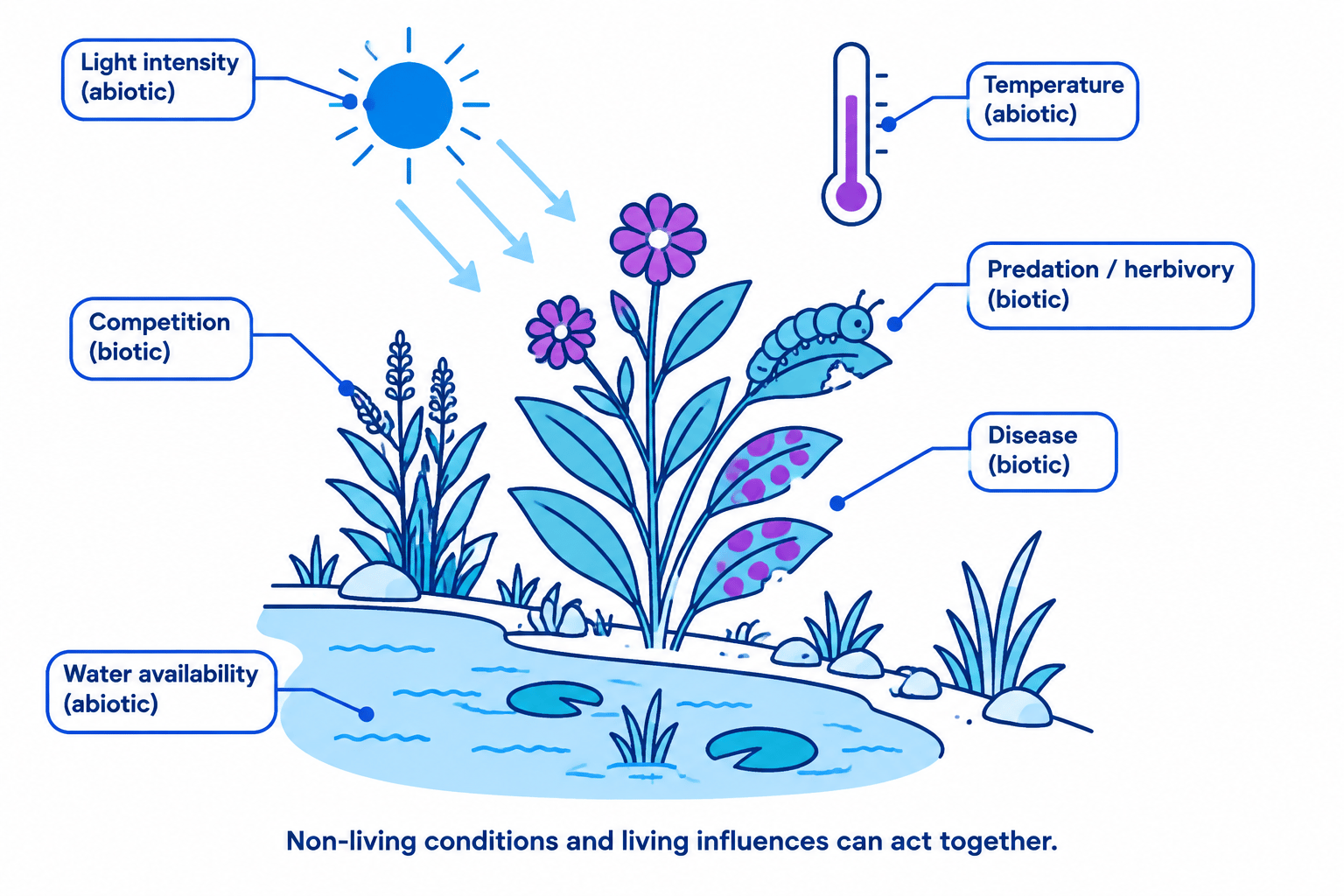
Abiotic Factors Change Communities
Definition
Abiotic factor
An abiotic factor is a non-living condition that affects the organisms in an ecosystem.
- An abiotic factor is a non-living condition that affects where organisms can live and how large their populations can become.
- Temperature affects enzyme-controlled reactions, so temperatures outside an organism's tolerated range reduce growth, reproduction or survival.
- Light intensity affects the rate of photosynthesis, so low light can reduce glucose production, plant growth and the food available to consumers.
- Water availability affects hydration, transport and photosynthesis, so drought can reduce plant growth and the populations that depend on those plants.
- A pollutant is a substance released into the environment that causes harm, and pollutants may kill organisms, reduce reproduction or change the conditions in a habitat.
- Abiotic factors affect distribution: organisms are most common where the conditions match their adaptations and tolerances.
Example
A shaded patch can contain fewer daisies because lower light intensity reduces photosynthesis, so less glucose is available for growth.
Biotic Factors Change Populations
Definition
Biotic factor
A biotic factor is a living influence that affects the organisms in a community.
- A biotic factor is a living influence that affects organisms in a community.
- Competition occurs when organisms require the same limited resource, so some obtain less and are less likely to survive or reproduce.
- Plants compete for light, water, space and mineral ions, while animals compete for food, water, territory and mates.
- Predation reduces the prey population because predators kill and eat prey.
- Predator and prey populations are linked: more prey can support more predators, then increased predation lowers prey numbers, followed by a fall in predator numbers as food becomes scarce.
- Disease can spread more readily when organisms live close together, which can increase deaths and reduce population size.
Exam technique
- For an explanation, name the factor and complete the chain to a biological effect, such as lower light, less photosynthesis, less glucose and less plant growth.
- When data are provided, quote the pattern or values first, then use biology to explain why the population changes.
Several Factors May Act Together
Definition
Limiting factor
A factor in shortest supply that restricts the rate of a process.
- A limiting factor is a factor in shortest supply that restricts population growth or distribution.
- The limiting factor can change: after rainfall increases water availability, light, minerals or competition may become the factor that restricts growth.
- Correlation does not prove cause: two factors may change together, so an investigation should measure other relevant variables before identifying one as the cause.
Self review
- What is an abiotic factor?
- How can lower light intensity reduce a plant population?
- How does competition affect survival and reproduction?
- Explain the sequence that links prey numbers to predator numbers.
- Why might the limiting factor change when environmental conditions change?