Respiration Releases Energy Continuously
Definition
Cellular respiration
The continuous exothermic reactions in living cells that break down glucose and release energy for metabolic processes.
Definition
Exothermic reaction
A chemical reaction that transfers energy to the surroundings.
- Living cells respire continuously because they need a constant transfer of energy.
- Respiration is exothermic because chemical energy from glucose is transferred to the surroundings and to processes in the cell.
- Cells use the released energy for muscle contraction, active transport and building larger molecules from smaller ones.
- Energy released by respiration also helps mammals and birds maintain a stable body temperature.
- Respiration is a series of enzyme-controlled reactions, not a single reaction and not the same process as breathing.
Aerobic Respiration Uses Oxygen
Definition
Aerobic respiration
Cellular respiration that uses oxygen to break down glucose completely, producing carbon dioxide and water and releasing a large amount of energy.
Definition
Mitochondrion
An organelle in which most aerobic respiration takes place.
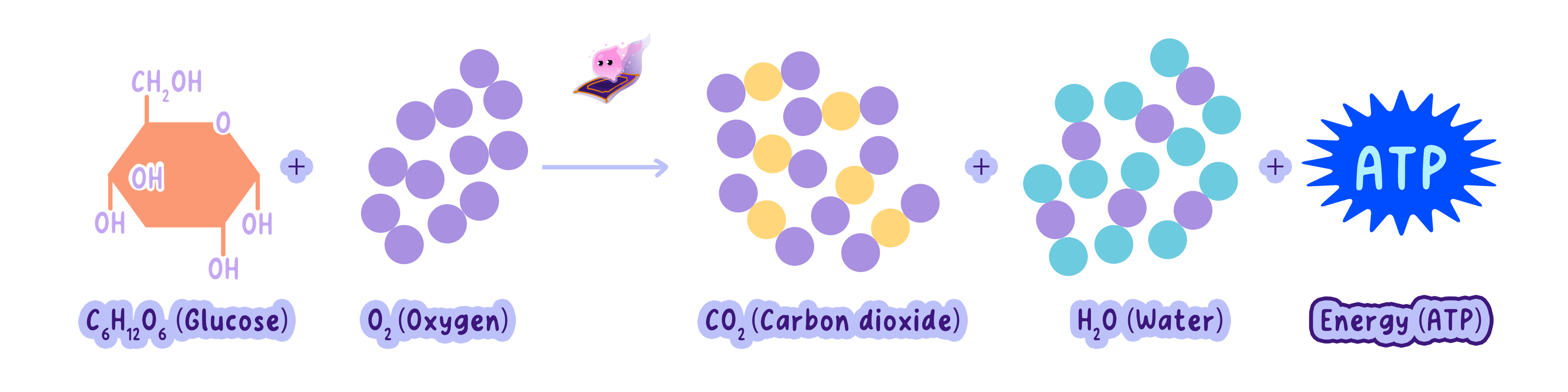
- Aerobic respiration uses oxygen and completely breaks down glucose.
- The word equation is glucose+oxygen→carbon dioxide+water\text{glucose}+\text{oxygen}\rightarrow\text{carbon dioxide}+\text{water}glucose+oxygen→carbon dioxide+water.
- The balanced symbol equation is C6H12O6+6O2→6CO2+6H2O\mathrm{C_6H_{12}O_6+6O_2\rightarrow6CO_2+6H_2O}C6H12O6+6O2→6CO2+6H2O.
- Most aerobic respiration occurs in mitochondria, so cells with high energy demands often contain many mitochondria.
- Complete breakdown of glucose releases much more energy than anaerobic respiration.
Anaerobic Respiration Uses No Oxygen
Definition
Anaerobic respiration
Cellular respiration that occurs without oxygen and breaks down glucose incompletely, releasing less energy than aerobic respiration.
Definition
Lactic acid
The product formed when animal muscle cells respire anaerobically.
- Anaerobic respiration occurs when oxygen supply cannot meet the demand for aerobic respiration.
- Glucose is broken down incompletely, so less energy is released from each molecule of glucose.
- In animal muscle cells, the word equation is glucose→lactic acid\text{glucose}\rightarrow\text{lactic acid}glucose→lactic acid.
- Lactic acid can accumulate during vigorous exercise and is associated with muscle fatigue.
- In yeast and plant cells, the word equation is glucose→ethanol+carbon dioxide\text{glucose}\rightarrow\text{ethanol}+\text{carbon dioxide}glucose→ethanol+carbon dioxide.
- Anaerobic respiration occurs in the cytoplasm rather than the mitochondria.
The Two Pathways Have Clear Differences
- Oxygen: aerobic respiration requires oxygen, while anaerobic respiration does not.
- Breakdown: aerobic respiration breaks glucose down completely, while anaerobic respiration breaks it down incompletely.
- Energy: aerobic respiration releases much more energy per molecule of glucose.
- Animal products: aerobic respiration produces carbon dioxide and water, while anaerobic respiration produces lactic acid.
- Yeast and plant products: anaerobic respiration produces ethanol and carbon dioxide.
- Location: most aerobic respiration occurs in mitochondria, while anaerobic respiration occurs in the cytoplasm.
Exam technique
- Both aerobic and anaerobic respiration use glucose, so do not claim that glucose is unique to either pathway.
- For two differences, give two independent contrasts rather than reversing the same oxygen statement twice.
- Use the correct products for the organism named, because animal muscles make lactic acid while yeast and plant cells make ethanol and carbon dioxide.
- Write that respiration releases energy, because energy is not a chemical product stored on the right side of the equation.
Exercise Can Use Both Pathways
- At the start of exercise, muscles increase their demand for energy before oxygen delivery has fully increased.
- Aerobic respiration supplies most energy when enough oxygen reaches the muscles.
- During vigorous activity, anaerobic respiration adds a faster but smaller energy release when oxygen supply is insufficient.
- Heart rate and breathing rate rise to deliver more oxygen and glucose and to remove carbon dioxide.
Self review
- What makes cellular respiration exothermic?
- Write the word equation for aerobic respiration.
- Why does aerobic respiration release more energy than anaerobic respiration?
- What is produced by anaerobic respiration in animal muscle cells?
- What products form during anaerobic respiration in yeast?
