Substances move into and out of organisms
- Cells need a continuous supply of useful substances and must remove substances that would otherwise build up.
- Oxygen enters animals for aerobic respiration and leaves photosynthesising tissues when it is produced faster than it is used.
- Carbon dioxide leaves respiring cells as a waste product and enters photosynthesising cells as a raw material.
- Water is needed as a solvent, as a reactant and for transport, so it moves into, through and out of organisms.
- Dissolved food molecules, including glucose and amino acids, move from exchange surfaces to cells for respiration, growth and repair.
- Mineral ions enter plants through their roots and are transported to tissues where they are used to make essential substances.
- Urea is carried from the liver to the kidneys so that it can be removed from the blood and excreted.
Common Mistake
Transport includes movement into and out of organisms, so name the substance, its direction and why it must move.
Size changes exchange needs
Definition
Surface area to volume ratio
The surface area to volume ratio is the total surface area of an organism or object divided by its volume.
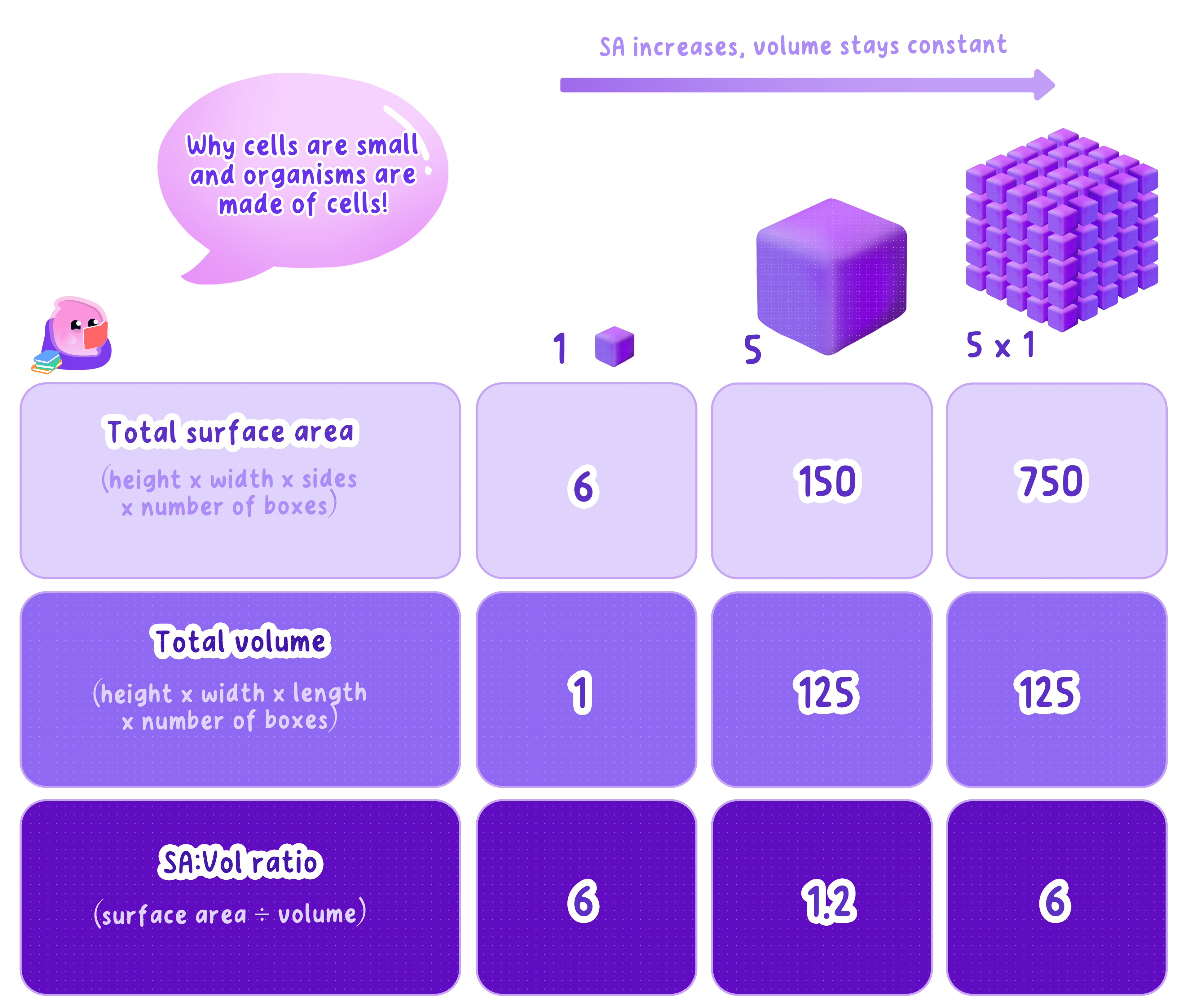
- A small organism has a large surface area to volume ratio, so it has a large exchange surface compared with the amount of living tissue it must supply.
- Its cells are close to the outside, giving a short diffusion distance for oxygen, nutrients and waste products.
- As length increases, surface area rises with the square of length while volume rises with the cube of length.
- A large organism therefore has a smaller surface area to volume ratio and many cells that are far from the body surface.
- Diffusion across the outer surface cannot move enough material over these longer distances to meet the demands of all the cells.
Key Idea
Large active organisms need specialised exchange surfaces and transport systems because they have a small surface area to volume ratio, long diffusion distances and a high demand for materials.
Calculate surface area to volume ratio
- Calculate the ratio using surface area to volume ratio=surface areavolume\text{surface area to volume ratio}=\dfrac{\text{surface area}}{\text{volume}}surface area to volume ratio=volumesurface area.
- For a cube with side length lll, use surface area=6l2\text{surface area}=6l^2surface area=6l2 and volume=l3\text{volume}=l^3volume=l3.
- Write the result as surface area:volume\text{surface area}:\text{volume}surface area:volume and simplify both parts to the lowest convenient whole-number ratio when possible.
Example
- A species has a surface area of 9000 μm29000\,\mu\mathrm{m}^29000μm2 and a volume of 6000 μm36000\,\mu\mathrm{m}^36000μm3.
- surface area:volume=9000:6000\text{surface area}:\text{volume}=9000:6000surface area:volume=9000:6000
- Dividing both values by 300030003000 gives 3:2\boxed{3:2}3:2, which can also be written as 1.5:11.5:11.5:1.
Exchange surfaces speed transfer
Definition
Exchange surface
An exchange surface is a boundary across which substances move between an organism and its environment.
- An exchange surface provides a specialised boundary where substances enter or leave an organism.
- A large surface area allows more particles to cross at the same time, while a thin barrier gives a short diffusion distance.
- A blood supply, water flow or air flow carries substances away and replaces them, which maintains a concentration gradient.
- Examples include alveoli in lungs, gills in fish, root hair cells in roots and the small intestine in mammals.
Exam technique
- For an explanation, link the feature to the process and then to the result.
- For example, a larger surface area means more oxygen molecules diffuse at the same time, so oxygen enters the organism faster.
Transport systems connect surfaces and cells
Definition
Transport system
A transport system is a network that carries substances between exchange surfaces and cells throughout a multicellular organism.
- A transport system moves substances rapidly between exchange surfaces and cells, reducing the distance over which diffusion must act.
- In mammals, the circulatory system carries oxygen and dissolved food molecules to cells and carries carbon dioxide and urea away.
- In plants, xylem carries water and mineral ions from roots, while phloem transports dissolved sugars and other organic substances.
- Transport maintains concentration gradients at exchange surfaces because arriving fluid supplies materials and departing fluid removes them.
Self review
- Why must oxygen, carbon dioxide and urea be transported?
- Why does surface area to volume ratio decrease as an organism gets larger?
- How do you calculate and simplify a surface area to volume ratio?
- Why can a large multicellular organism not rely on diffusion across its outer surface?
- How do an exchange surface and a transport system work together?
