Alveoli exchange two respiratory gases
Definition
Alveolus
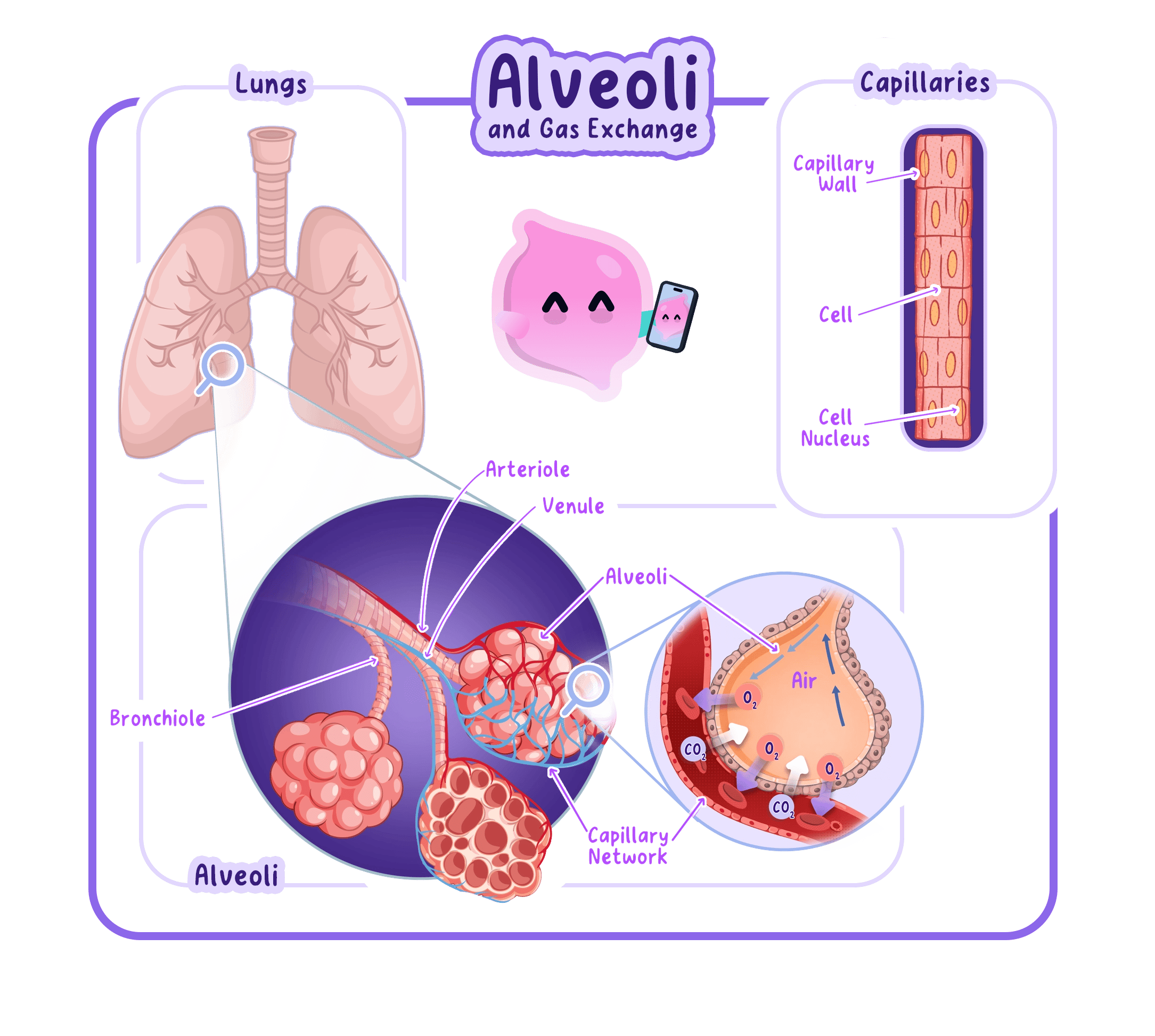
An alveolus is a microscopic air sac in the lungs where oxygen and carbon dioxide are exchanged by diffusion between air and the blood.
- Air reaching the alveoli contains a higher concentration of oxygen than the deoxygenated blood arriving in nearby capillaries.
- Oxygen dissolves in the moist lining and diffuses through the alveolar and capillary walls into the blood.
- The arriving blood contains a higher concentration of carbon dioxide than the air in the alveoli.
- Carbon dioxide diffuses from the blood into the alveoli and is removed from the lungs when you breathe out.
Large area increases gas exchange
Definition
Diffusion
The net movement of particles from a region of higher concentration to a region of lower concentration, down a concentration gradient.
- Each lung contains millions of tiny alveoli, which together create a very large surface area.
- A larger area allows more oxygen and carbon dioxide molecules to cross the exchange surface at the same time.
- The result is a higher rate of diffusion than a single smooth lung surface could provide.
Example
- Feature: millions of alveoli provide a large total surface area.
- Mechanism: more gas molecules can diffuse across the walls at the same time.
- Result: oxygen enters the blood and carbon dioxide leaves the blood faster.
Thin moist walls shorten the path
Definition
Diffusion distance
Diffusion distance is the distance that particles must travel between two regions during diffusion.
- The wall of each alveolus is one cell thick, and the wall of the neighbouring capillary is also one cell thick.
- These thin walls give oxygen and carbon dioxide a very short diffusion distance.
- The alveolar surface is moist so oxygen and carbon dioxide dissolve before crossing the cell membranes.
- The walls are permeable to the respiratory gases, so dissolved oxygen and carbon dioxide can pass through them.
Exam technique
- Do not stop after naming a feature such as thin walls.
- State that thin walls shorten the diffusion distance, so the respiratory gases diffuse faster.
- For a longer response, apply the same feature, mechanism and consequence chain to several adaptations and to both gases.
Airflow and blood flow maintain gradients
Definition
Concentration gradient
The difference in the concentration of a substance between two regions.
- Ventilation replaces alveolar air, keeping oxygen concentration high and carbon dioxide concentration low inside the alveoli.
- The capillary network brings deoxygenated blood with little oxygen and more carbon dioxide close to every alveolus.
- Blood flow carries absorbed oxygen away and continually brings more carbon dioxide to the lungs.
- Oxygen binding to haemoglobin helps keep the concentration of dissolved oxygen low in the blood beside the alveolus.
- Together, ventilation and blood flow maintain steep concentration gradients for oxygen into the blood and carbon dioxide into the alveoli.
Self review
- In which direction does oxygen diffuse at an alveolus?
- In which direction does carbon dioxide diffuse at an alveolus?
- How does a large alveolar surface area increase gas exchange?
- Why do thin and moist alveolar walls increase diffusion?
- How do ventilation and blood flow maintain concentration gradients?
