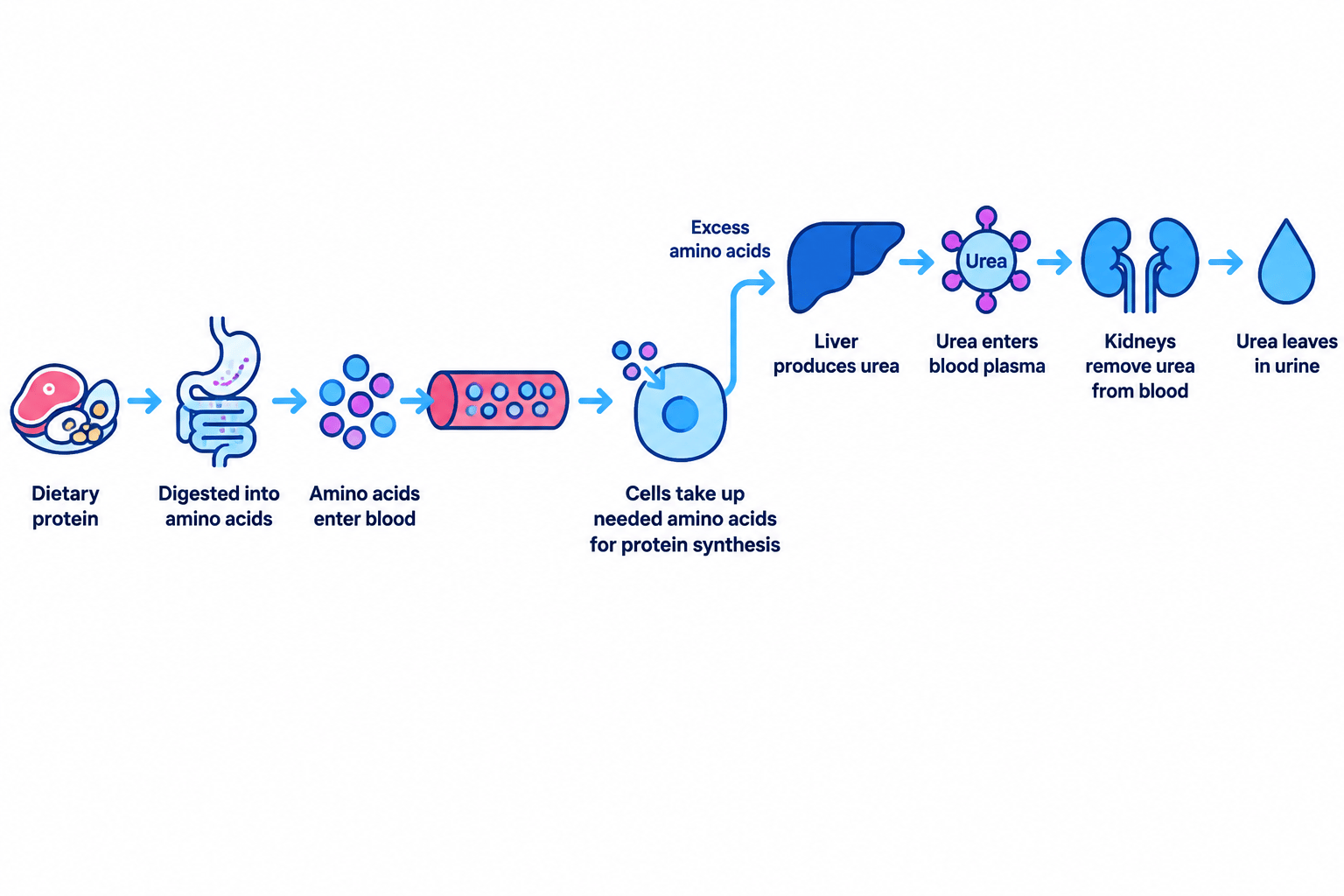
The liver makes urea
Definition
Urea
A nitrogen-containing waste substance produced in the liver from the breakdown of excess amino acids and removed from the blood by the kidneys.
- Urea is a nitrogen-containing waste substance produced in the liver from the breakdown of excess amino acids.
- The liver is the production organ while the kidneys remove urea from the blood.
- Urea enters the blood after it is produced and travels dissolved in the plasma.
- The kidneys filter urea into the nephron so it can leave the body in urine.
- The route can be written as excess amino acids→liverurea→bloodkidneys→urine\text{excess amino acids} \xrightarrow{\text{liver}} \text{urea} \xrightarrow{\text{blood}} \text{kidneys} \rightarrow \text{urine}excess amino acidsliverureabloodkidneys→urine.
Excess amino acids cannot be stored
Definition
Amino acid
The small molecule that is the building block of a protein, of which there are twenty different kinds.
- An amino acid is a small molecule used to build proteins.
- Dietary proteins are digested into amino acids that are absorbed into the blood.
- Cells use amino acids to make the proteins required for growth, repair, enzymes and other cell structures.
- Excess amino acids cannot be stored as amino acids, so the liver breaks them down.
- Nitrogen-containing waste from this breakdown is converted into urea for transport to the kidneys.
Example
Following excess dietary protein
- Digestion: protein in a meal is broken down into amino acids and the amino acids enter the blood.
- Use: cells take the amino acids needed for protein synthesis.
- Excess: amino acids that are not needed cannot be stored, so the liver breaks them down and produces urea.
- Excretion: blood carries the urea to the kidneys and it leaves the body in urine.
The liver and kidneys have different roles
- The liver produces urea from excess amino acids.
- The blood transports urea dissolved in plasma from the liver to the kidneys.
- The kidneys remove urea from the blood and include it in urine.
- The urinary system then carries, stores and releases the urine.
Common Mistake
Do not write that the kidneys make urea, because urea is made in the liver and removed by the kidneys.
Exam technique
Explaining urea production
- Use the correct starting substance: excess amino acids, not glucose, lipids or mineral ions.
- Use the correct production organ: the liver.
- Use the correct removal organ: the kidneys filter urea from the blood.
- Keep the sequence clear: production happens before transport in plasma and excretion in urine.
Self review
- What substance is broken down to produce urea?
- In which organ is urea produced?
- Why are excess amino acids broken down?
- How does urea travel to the kidneys?
- What is the difference between the liver and kidney roles in urea excretion?