ART uses treatment to support pregnancy
Definition
Assisted Reproductive Technology (ART)
Medical treatments that help a person become pregnant by stimulating ovulation or by handling eggs, sperm or embryos as part of fertility treatment.
- Assisted Reproductive Technology uses fertility drugs or procedures involving eggs, sperm or embryos to increase the chance of pregnancy.
- The choice of treatment depends on the cause of infertility, such as failure to ovulate, blocked oviducts or difficulty with fertilisation.
- Hormones used in treatment act on the same ovaries and follicles as the hormones of the natural menstrual cycle.
Clomifene increases FSH and LH
Definition
Clomifene
A fertility drug that stimulates the pituitary gland to release more FSH and LH, increasing the chance that an egg matures and is released.
- Clomifene is taken as a fertility drug when ovulation is absent or irregular.
- It stimulates the pituitary gland to release more FSH and LH.
- The higher FSH concentration increases follicle development and egg maturation.
- The higher LH concentration increases the chance that a mature egg is released by ovulation.
- If intercourse occurs around ovulation, the egg may then be fertilised inside the body.
Common Mistake
- Clomifene may cause more than one follicle to mature.
- Releasing more than one egg increases the chance of twins or other multiple births.
IVF fertilises eggs outside the body
Definition
IVF (in vitro fertilisation)
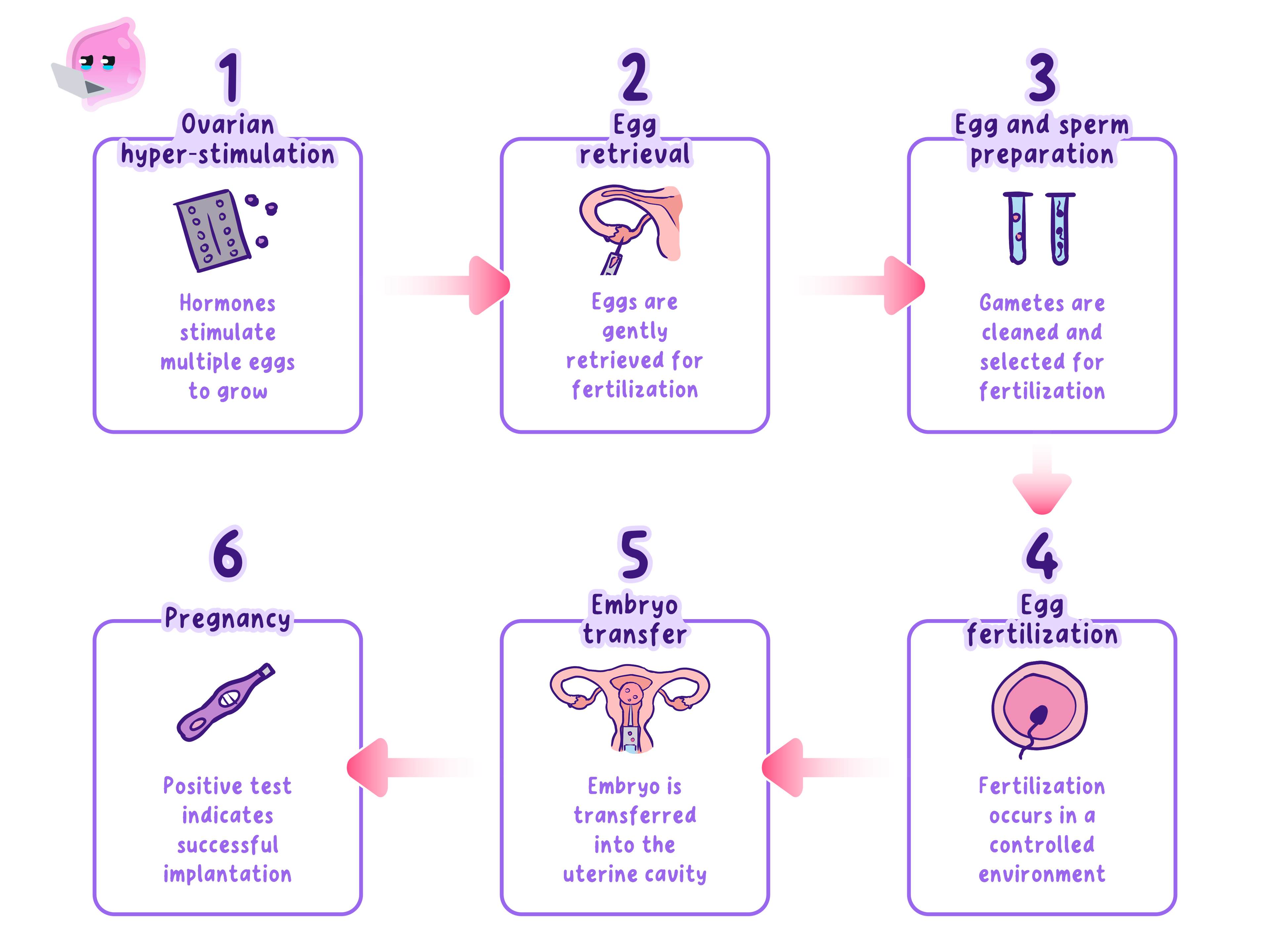
A fertility treatment in which eggs are collected and fertilised by sperm outside the body, and one or more resulting embryos are placed into the uterus.
- First, FSH and LH are given so several follicles develop and several eggs mature.
- The mature eggs are collected from the ovaries, and a sperm sample is collected.
- Eggs and sperm are mixed in a laboratory dish, or one sperm is injected into an egg when needed.
- Fertilised eggs divide by mitosis and develop into embryos.
- One or more selected embryos are transferred into the uterus.
- A pregnancy begins only if an embryo implants successfully in the uterus lining.
Example
- A woman ovulates normally but both oviducts are blocked.
- Clomifene would not remove the blockage, whereas IVF allows fertilisation outside the body and places an embryo directly into the uterus.
Clomifene and IVF solve different problems
- Clomifene mainly treats infertility caused by failure to ovulate because it increases FSH and LH release.
- IVF can help when fertilisation inside the oviduct is unlikely, including when an oviduct is blocked.
- IVF also allows several eggs to be collected, increasing the chance that at least one embryo develops for transfer.
Exam technique
- Keep egg, fertilised egg and embryo distinct when describing IVF.
- Write the stages in order and state that fertilisation occurs outside the body before an embryo is transferred to the uterus.
Embryo transfer does not guarantee pregnancy
- An embryo must implant in the uterus lining and continue developing for IVF to result in pregnancy.
- IVF may need more than one attempt because fertilisation, embryo development, transfer or implantation can fail.
- Transferring more than one embryo can increase the chance of a multiple pregnancy, which carries greater risks for the pregnant person and babies.
Self review
- How does clomifene increase the chance of ovulation?
- Why are FSH and LH used before eggs are collected for IVF?
- Put the main stages of IVF in order.
- Why can IVF help when an oviduct is blocked?
