The genome
Definition
Genome
The entire DNA of an organism.
- The genome of an organism is the entire DNA that the organism contains.
- That total includes every chromosome, every gene carried on those chromosomes, and the DNA that lies between and around the genes.
- The human genome is about three billion base pairs long, which is written as 3×1093 \times 10^{9}3×10⁹ base pairs.
- Spread through that length are roughly 20 00020\,00020000 genes.
- A complete copy of the genome sits in the nucleus of almost every body cell, so a liver cell and a skin cell hold the same instructions as each other.
- A large part of the genome does not code for a protein at all, so the genome is far more than a list of genes.
- This non-coding DNA still has effects on how the genes are used, and a later article deals with what it does.
Key Idea
The genome is all of an organism's DNA taken together, not only the parts of it that make up genes.
Organising genetic material
Definition
Chromosome
A long molecule of coiled DNA found in the nucleus, carrying many genes in a fixed order.
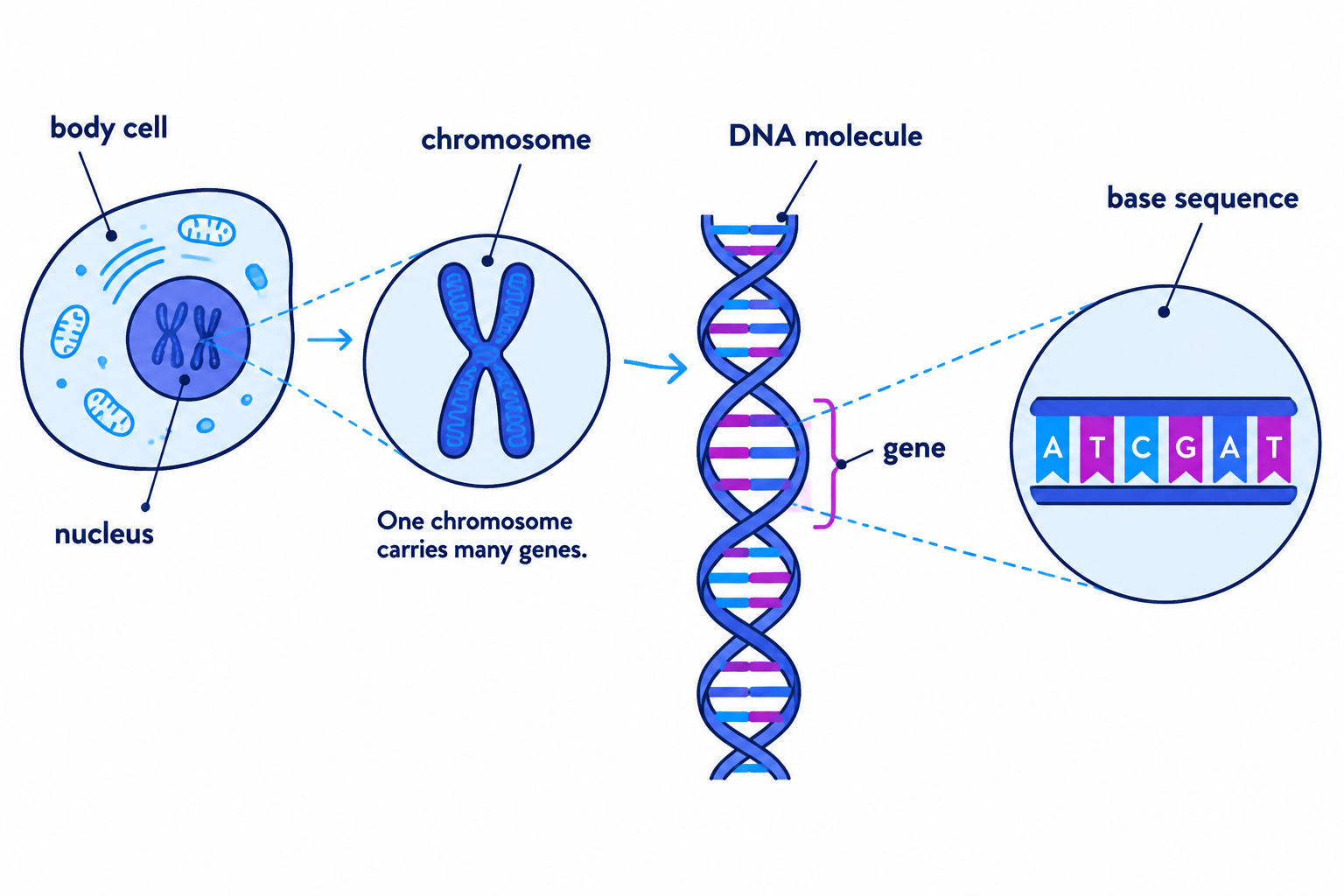
- In a body cell the DNA is held inside the nucleus.
- Inside the nucleus the DNA is packaged into chromosomes, and a human body cell contains 464646 chromosomes arranged as 232323 pairs.
- Each chromosome is one very long DNA molecule, coiled up tightly so that its full length fits into the nucleus.
- A gene is one section of that molecule, picked out by where it begins and ends along the strand rather than by being a separate molecule of its own.
- Within that section the bases lie in a particular order, and this base sequence is what carries the coded instruction.
- The levels therefore run in this order: nucleus, then chromosome, then the DNA molecule the chromosome is made of, then a gene as one section of that molecule, then the sequence of bases inside the gene.
- One chromosome carries many genes, set out one after another along its length.
- Every gene sits at a fixed position on one particular chromosome.
- Because that position is fixed, the same gene is found in the same place on the same chromosome in every member of a species.
Hint
Picture the genome as a complete set of instruction manuals, each chromosome as one manual in that set, and each gene as a single instruction printed on one page of one manual.
Genes code for proteins
Definition
Gene
A section of a DNA molecule that codes for a specific protein.
- A gene is a section of a DNA molecule that codes for a specific protein.
- Proteins are built from amino acids, small molecules joined end to end into a long chain.
- The phrase codes for has an exact meaning here: the order of the bases along the gene determines the order of the amino acids in the protein made from it.
- The order in which the amino acids are joined decides how the finished chain folds, and therefore which protein it becomes.
- A different gene has a different base sequence, so it sets a different order of amino acids and produces a different protein.
- The protein itself is assembled outside the nucleus, and later articles set out the steps by which the coded instruction is read and used.
Example
- In a cell of the salivary gland, the nucleus holds all 464646 chromosomes of that cell.
- One of those chromosomes is a single long DNA molecule, and one section of that molecule is the gene for amylase.
- Inside that section the bases sit in one particular order, and that order is the coded instruction for amylase and for no other protein.
- The cell joins amino acids together in the order that base sequence specifies, and the chain that results is amylase.
- Amylase is an enzyme, and its job is to break starch down into smaller sugar molecules.
- Read the same route in reverse and the levels run base sequence, gene, DNA molecule, chromosome, nucleus.
Functions of proteins
- Genes matter because proteins do the work of the body, and different genes code for different proteins.
- Amylase is an enzyme that digests starch, breaking it down into sugars small enough to be absorbed.
- Haemoglobin is the protein inside red blood cells that binds oxygen in the lungs and carries it to the tissues.
- Keratin is a structural protein that makes hair and nails tough and hard-wearing.
- Antibodies are proteins made by white blood cells, and they bind to pathogens as part of the immune response.
- Each of these four proteins is coded for by its own gene, with its own base sequence, in a fixed position on a chromosome.
- Because the genome carries the code for every protein an organism can make, it controls how that organism is built and how its body works.
Common Mistake
- Do not write that a gene codes for a characteristic, because a gene codes for a protein and it is the protein that goes on to produce the characteristic.
- Do not write genome when you mean gene, since the genome is the whole of an organism's DNA while a gene is one section of it.
- Do not describe the genome as only the genes, because it also includes all the DNA lying between and around them.
Exam technique
- Both of these definitions turn up as one-mark questions, and the mark is awarded on the wording you choose.
- For the genome, the wording that earns the mark is the entire DNA of an organism.
- For a gene, the wording that earns the mark is a section of DNA that codes for a specific protein, so keep the word protein in your sentence.
- An answer such as a gene decides your eye colour drops the mark, because it names something the gene eventually affects instead of saying what the gene is.
Chromosomes, genes and genomes
Definition
DNA
The polymer that carries the genetic code, made of two nucleotide strands coiled into a double helix.
- A chromosome is a whole DNA molecule, coiled up, carrying many genes along its length.
- A gene is one section of that molecule, and it codes for one specific protein.
- The genome is all of an organism's DNA taken together, which means every chromosome and every gene along with the DNA between them.
- The three terms name three different scales of the same material rather than three different substances.
- Different versions of the same gene are called alleles, and they are covered in the inheritance articles.
Self review
- What is meant by the genome of an organism, and what does it include besides the genes?
- What does the order of bases along a gene determine?
- How many chromosomes does a human body cell contain, and how are they arranged?
- Name two proteins and state the job each one does in the body.
- Why does saying that a gene decides eye colour fail to define what a gene is?