Endocrine glands release hormones
Endocrine system
The network of endocrine glands that secrete hormones directly into the blood to coordinate processes in the body.
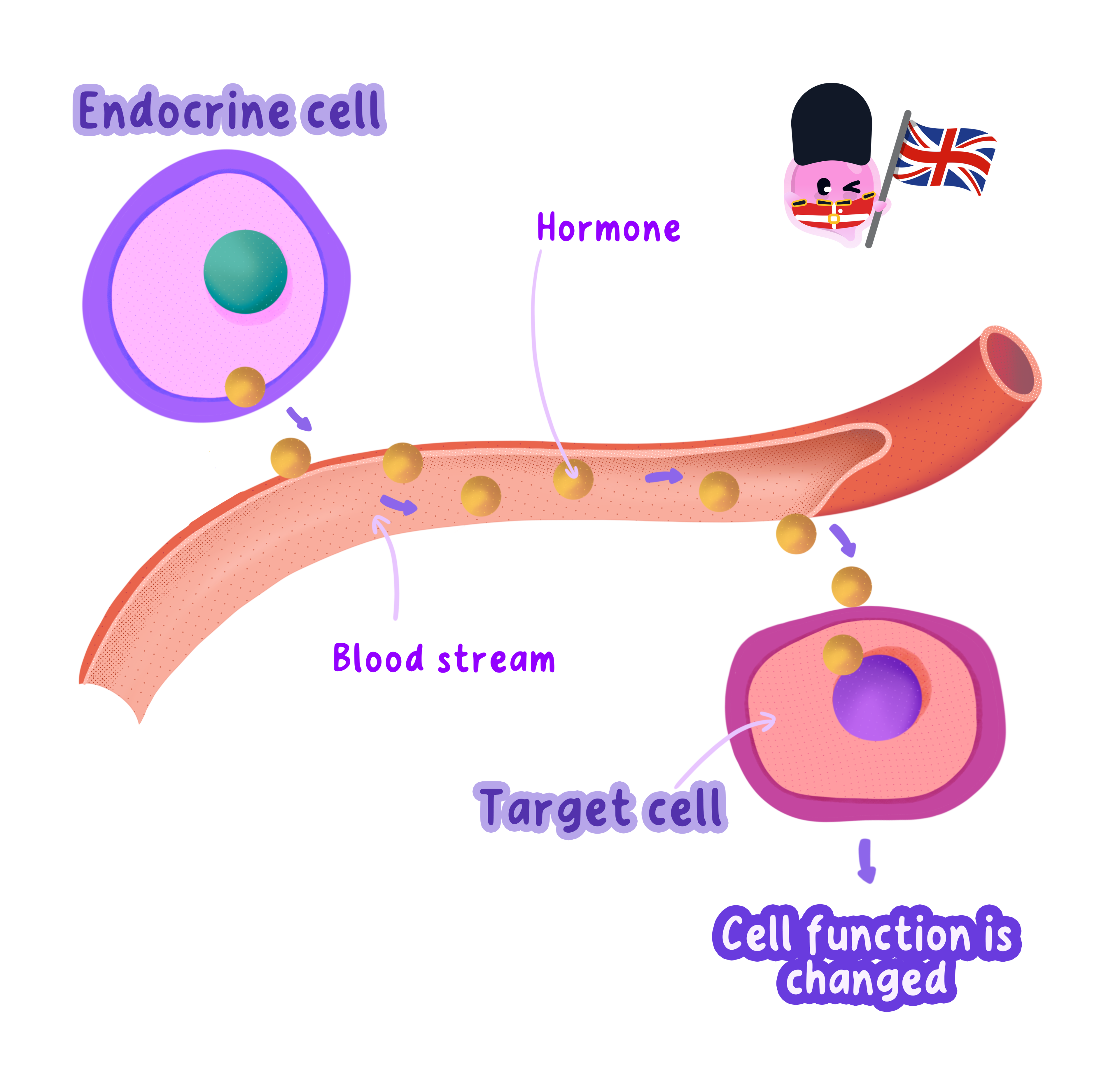
- An endocrine gland is a gland that secretes hormones directly into the blood.
- A hormone is a chemical messenger produced by an endocrine gland and carried in the blood to a target organ, where it causes a response.
- A target organ is an organ containing cells that respond to a particular hormone.
- Endocrine glands have no ducts, so their hormones enter nearby capillaries and join the circulation.
Writing hormone transport
For a one-mark transport question, write that the hormone is carried dissolved in the blood plasma, not inside red blood cells.
Hormones reach their target organs
Hormone
A chemical messenger produced by an endocrine gland and carried in the blood to a target organ, where it causes a response.
- The bloodstream carries a hormone away from the gland and around the body.
- Hormones travel dissolved in the blood plasma, rather than inside red blood cells.
Target organs respond to hormones
Target organ
An organ containing cells that respond to a particular hormone.
- Blood delivers each hormone to its target organ, where it produces its specific effect.
- A hormone can circulate around the whole body, but only its target organs respond to it.
Following insulin through the body
- The pancreas secretes insulin directly into the blood.
- Blood plasma carries insulin to target organs such as the liver.
- The target organs respond by helping to lower the blood glucose concentration.
Nervous system vs Endocrine system
Nervous system
The system formed by the brain, spinal cord and nerves that detects stimuli and coordinates rapid responses using electrical impulses.
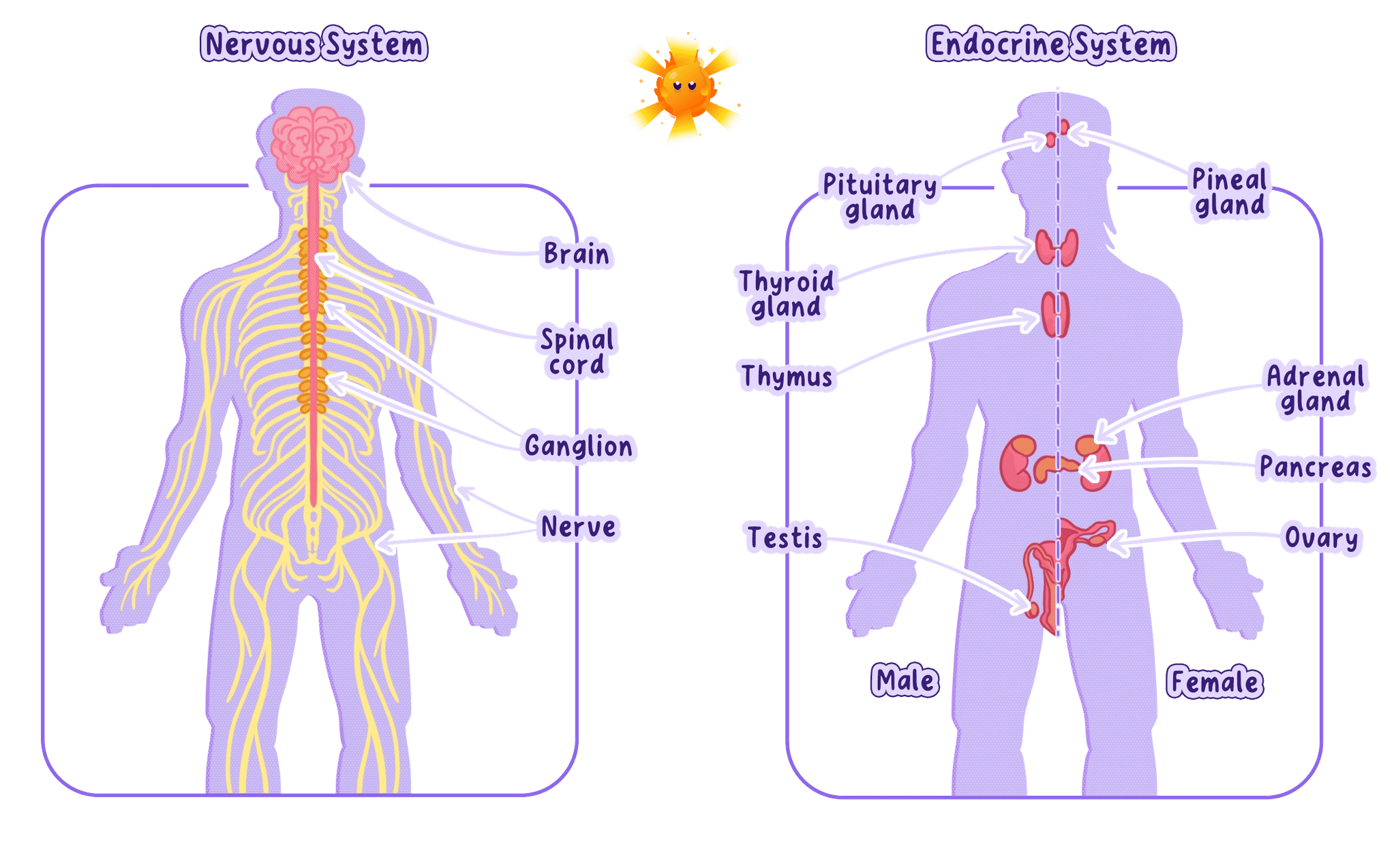
- The nervous system is formed by the brain, spinal cord and nerves, and it coordinates rapid responses using electrical impulses.
- Nervous control sends electrical impulses along neurones, whereas hormonal control sends chemical hormones through the blood.
- Nervous responses are usually very fast because impulses travel directly along neurones to an effector.
- Hormonal responses are usually slower because hormones must be secreted and carried through the circulation.
- Nervous effects are usually short-lived because the impulses stop once the response is no longer required.
- Hormonal effects can be long-lasting because hormones remain in the blood and may continue to affect target organs.
- A nervous impulse travels to a specific effector, while a hormone circulates widely but affects only organs that respond to that hormone.
- Nervous control is suited to immediate actions such as muscle contraction, while hormonal control is suited to longer processes such as growth, puberty and metabolic control.
Compare one feature at a time
Use paired statements such as 'nervous control is fast, whereas hormonal control is slower' so each difference compares the same feature.
Choose control by speed and duration
Nerve impulse
An electrical signal that travels along a neurone.
- A nerve impulse is an electrical signal that travels along a neurone.
- Touching a hot surface needs nervous control because the response must reach the arm muscles quickly and stop after the hand moves away.
- Growth during puberty needs hormonal control because it develops slowly and continues over a long period.
Choosing the control system
- A goalkeeper sees a ball change direction and dives within a fraction of a second.
- The response is controlled by the nervous system because electrical impulses reach the muscles rapidly and produce a brief, precise movement.
- A teenager develops changes during puberty over several years.
- The changes are controlled by hormones because the response is slower, widespread and long-lasting.
Main glands and their hormones
Endocrine gland
A gland that secretes hormones directly into the blood.
- The pituitary gland lies at the base of the brain and releases hormones that regulate several other endocrine glands.
- The thyroid gland lies in the neck and secretes thyroxine.
- The pancreas lies in the upper abdomen and secretes insulin and glucagon.
- The adrenal glands sit above the kidneys and secrete adrenaline.
- The ovaries lie in the pelvis and secrete oestrogen and progesterone.
- The testes lie in the scrotum and secrete testosterone.
- What is an endocrine gland?
- How is a hormone transported from a gland to a target organ?
- How do nervous and hormonal control differ in signal type and speed?
- Why are hormonal effects usually longer-lasting than nervous effects?
- Which control system is better suited to a rapid muscle response, and why?
