Auxins support crop production
Definition
Auxin
A plant hormone that controls growth by causing cells to elongate, bringing about tropisms in shoots and roots.
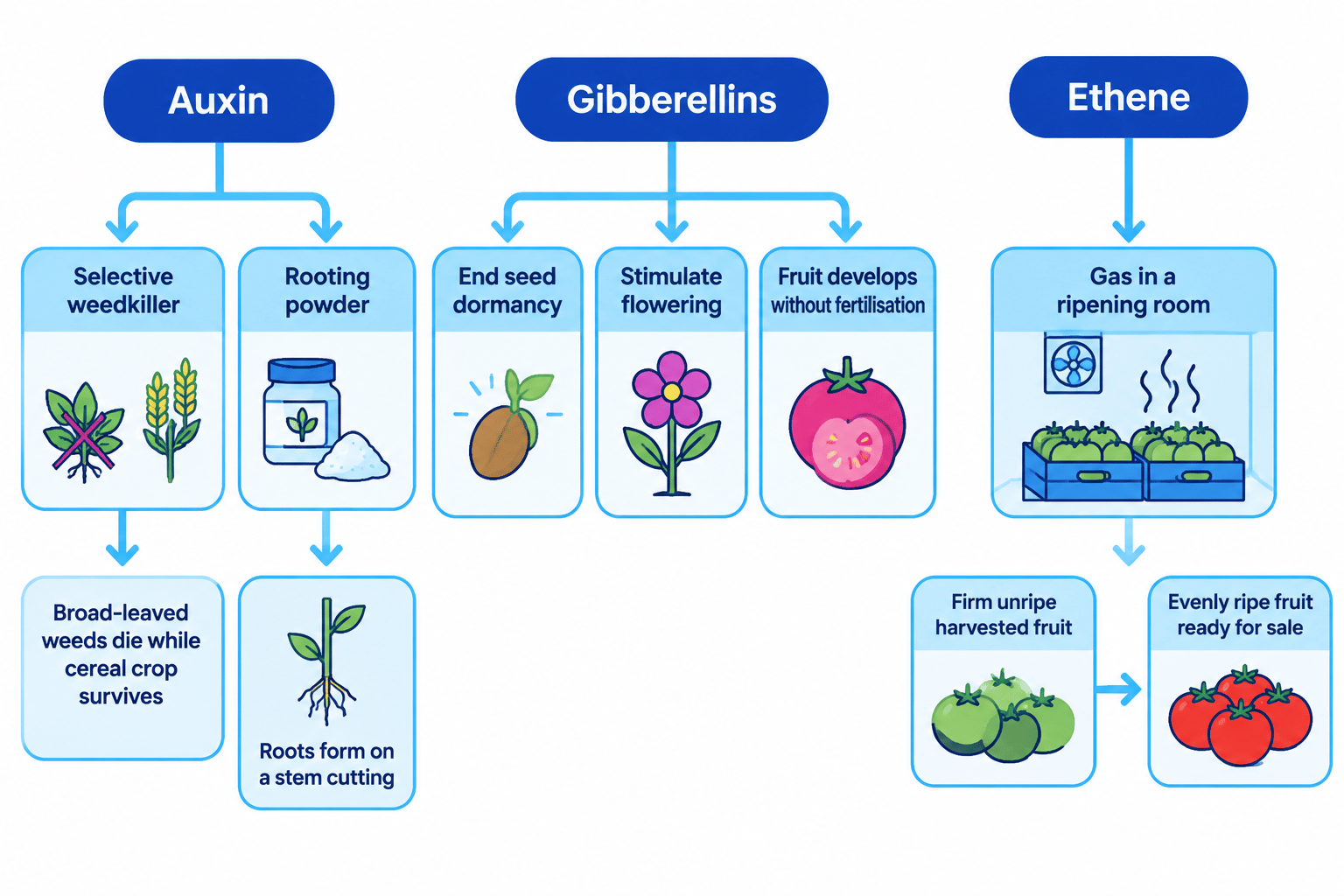
- Synthetic auxins are used in selective weedkillers that affect broad-leaved weeds more than narrow-leaved grasses and cereal crops.
- The auxin disrupts normal growth and makes susceptible weeds grow uncontrollably, so they die while the crop remains.
- Killing weeds reduces competition with the crop for light, water, mineral ions and space, which can increase crop yield.
- Auxin in rooting powder stimulates root formation at the cut end of a stem cutting.
- Once roots form, the cutting can grow independently and produces a new plant genetically identical to the parent.
Gibberellins control development
Definition
Gibberellins
Plant hormones that promote seed germination, stem growth, flowering and fruit development.
- Gibberellins can end seed dormancy and start germination when growers want a crop to develop.
- During germination, gibberellins stimulate enzymes that break stored starch into sugars, which provide a substrate for respiration and growth.
- Growers can use gibberellins to stimulate flower formation and to promote fruit formation.
- Applying gibberellins before pollination can start fruit development without fertilisation, producing seedless fruit.
- Gibberellins can also increase fruit size, which is useful when producing larger seedless grapes.
Ethene controls fruit ripening
Definition
Ethene
A gaseous plant hormone that controls fruit ripening.
- Ethene is a gaseous plant hormone that triggers and coordinates changes during fruit ripening.
- Fruit can be harvested while it is unripe and firm, so it is less likely to be bruised during storage and transport.
- The fruit is exposed to ethene in a ripening room shortly before sale, which produces a more even and predictable stage of ripeness.
- Controlled ripening lets growers and retailers time supply, extend transport time and reduce losses from fruit becoming overripe too early.
Link each hormone to an outcome
Match the hormone to the use
- Auxins are used for selective weed control and root formation in cuttings.
- Gibberellins are used for germination, flowering, fruit development and seedless fruit.
- Ethene is used to control when harvested fruit ripens.
Self review
- Why can an auxin weedkiller kill broad-leaved weeds without killing a cereal crop?
- How does rooting powder help a stem cutting form a new plant?
- How do gibberellins support germination?
- How can gibberellins produce seedless fruit?
- Why is ethene applied after fruit has been transported?