What denaturation is
Definition
Denaturation
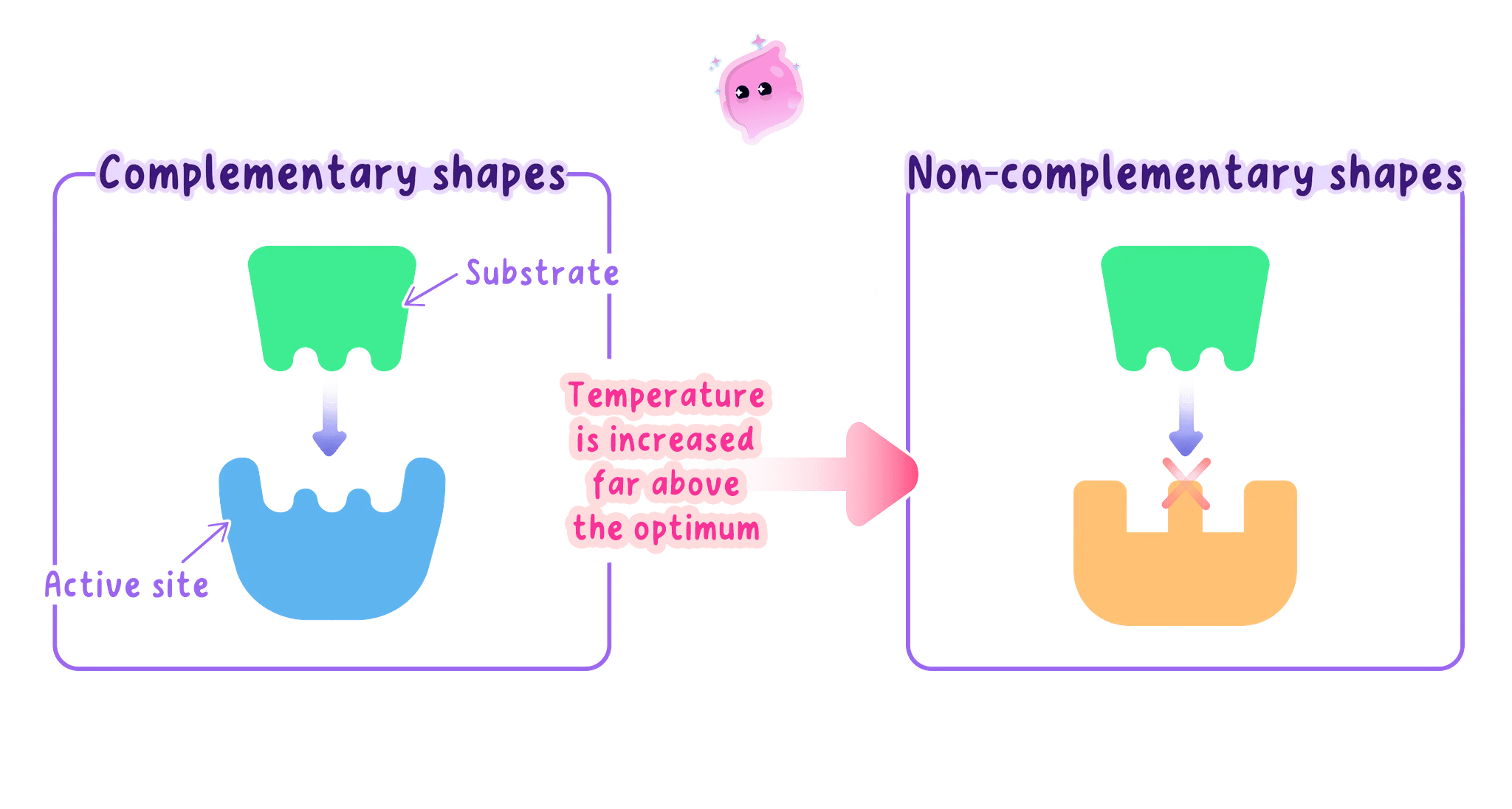
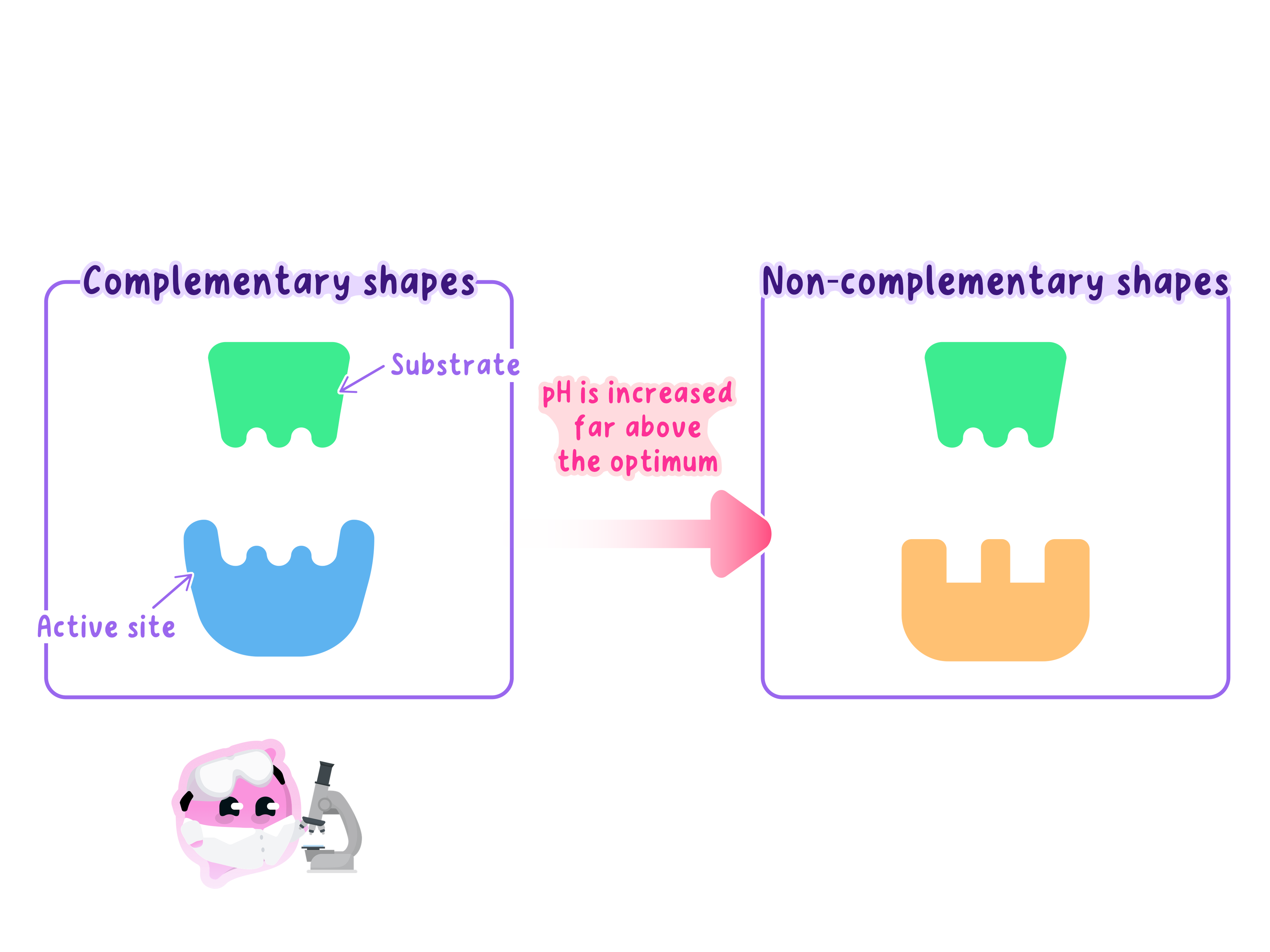
A permanent change in the shape of an enzyme's active site, caused by high temperature or extreme pH, so that the substrate no longer fits.
- An enzyme holds its folded shape because of bonds formed between different parts of its amino acid chain.
- In denaturation those bonds are broken, so the chain unfolds and takes up a different shape.
- The part of the molecule that matters is the active site, and it changes shape along with the rest.
- The substrate is no longer complementary to the altered active site, so it cannot bind.
- No enzyme-substrate complex can form, so the reaction is no longer catalysed and the rate falls to zero.
Key Idea
A full denaturation answer runs bonds break, active site changes shape, substrate no longer fits, no complex forms, so the reaction stops.
Denaturation by heat
- Raising the temperature gives the enzyme molecule more kinetic energy, so it vibrates more.
- Beyond the optimum temperature the vibration is violent enough to break the bonds holding the folded shape together.
- The active site distorts, and every molecule that distorts is permanently out of action, so the rate drops away steeply.
- Most human enzymes have an optimum of about 37 ∘C37\,^{\circ}\text{C}37∘C and are badly denatured by around 50 ∘C50\,^{\circ}\text{C}50∘C.
- Boiling denatures almost every enzyme, which is why boiled enzyme solution is used as a negative control in experiments.
Note
On a temperature graph the rise before the optimum is gradual while the fall after it is sudden, because the rise comes from faster collisions and the fall comes from molecules being destroyed.
Denaturation by pH
- Every enzyme also has an optimum pH at which its active site holds exactly the right shape.
- Away from that pH there are too many hydrogen ions or too many hydroxide ions in the solution.
- These ions interfere with the bonds between the charged parts of the amino acid chain, so the folded shape is pulled out of position.
- The active site changes shape once more, and the same chain of consequences follows as with heat.
- Optimum pH depends on where the enzyme works, so the protease in the stomach works best at about pH 222 while amylase in the mouth works best near pH 777.
- A small shift either side of the optimum slows the enzyme down, and a large shift denatures it completely.
Common Mistake
An enzyme with a low optimum pH is not denatured by acid at all, so never write that acid always denatures enzymes when stomach protease needs acid to work.
Why denaturation is permanent
- Once the bonds have broken, the chain does not refold into its original arrangement when conditions return to normal.
- Cooling a denatured enzyme, or returning it to its optimum pH, therefore does not bring the activity back.
- This is different from an enzyme kept in a fridge, which is only slowed down and works normally again once it warms up.
- At low temperature the molecules simply have less kinetic energy, so collisions are less frequent and no bonds are broken.
- Cooking an egg shows the same change in a protein you can see, because the clear albumen turns solid and white and never turns back.
Exam technique
- Write that the enzyme is denatured, never that it is killed or dead, because an enzyme is a protein rather than a living organism.
- The mark most often dropped is the middle step, so always state that the active site changes shape rather than jumping from heat straight to no reaction.
- If a question asks whether an effect is reversible, say that cooling reverses a slow-down but does not reverse denaturation.
Spotting denaturation in data
- On a rate graph, denaturation appears as the rate falling steeply towards zero beyond the optimum.
- A rate that stays at zero after conditions are restored is the clearest evidence that denaturation, rather than a slow-down, has happened.
- In an enzyme investigation, a tube of boiled enzyme should give no reaction at all, and that result confirms the reaction seen elsewhere was caused by the enzyme.
- A reading that is much lower than its neighbours at a mild pH or temperature is more likely to be an anomaly than denaturation, so check the pattern before concluding.
Self review
- Describe what happens to an enzyme molecule when it is denatured.
- Explain in full why a denatured enzyme cannot catalyse its reaction.
- Name the two conditions that cause denaturation.
- Why does cooling an enzyme that has been boiled fail to restore its activity?
- Give one reason why it is wrong to say a denatured enzyme has been killed.
