What an enzyme is
Enzyme
A protein that acts as a biological catalyst, speeding up a specific reaction without being used up or changed by it.
- Every enzyme is a protein, made on the ribosomes from a chain of amino acids.
- An enzyme works as a biological catalyst, speeding a reaction up without being used up or changed by it.
- Because it is not used up, a single enzyme molecule catalyses the same reaction thousands of times over.
- Without enzymes the reactions inside a cell would run far too slowly at body temperature to keep an organism alive.
- Some enzymes act inside cells, such as those that catalyse respiration, and others are released to act outside cells, such as the digestive enzymes in the gut.
- Enzyme names usually end in -ase and are built from the substrate, so lactase acts on lactose.
A catalyst lowers the energy a reaction needs to get started, which is why an enzyme lets a reaction run quickly at 37 ∘C37\,^{\circ}\text{C}37∘C instead of needing high heat.
The active site
Active site
The part of an enzyme with a specific shape into which the substrate fits.
- The chain of amino acids in an enzyme folds into a precise three-dimensional shape, held in place by bonds between different parts of the chain.
- That folding leaves a small groove on the surface of the molecule, and this groove is the active site.
- The shape of the active site is complementary to the shape of one particular substrate.
- Complementary means the two shapes match each other, in the same way a hand matches a glove, rather than being identical.
- Everything an enzyme does depends on that shape being maintained, which is why heat and pH matter so much.
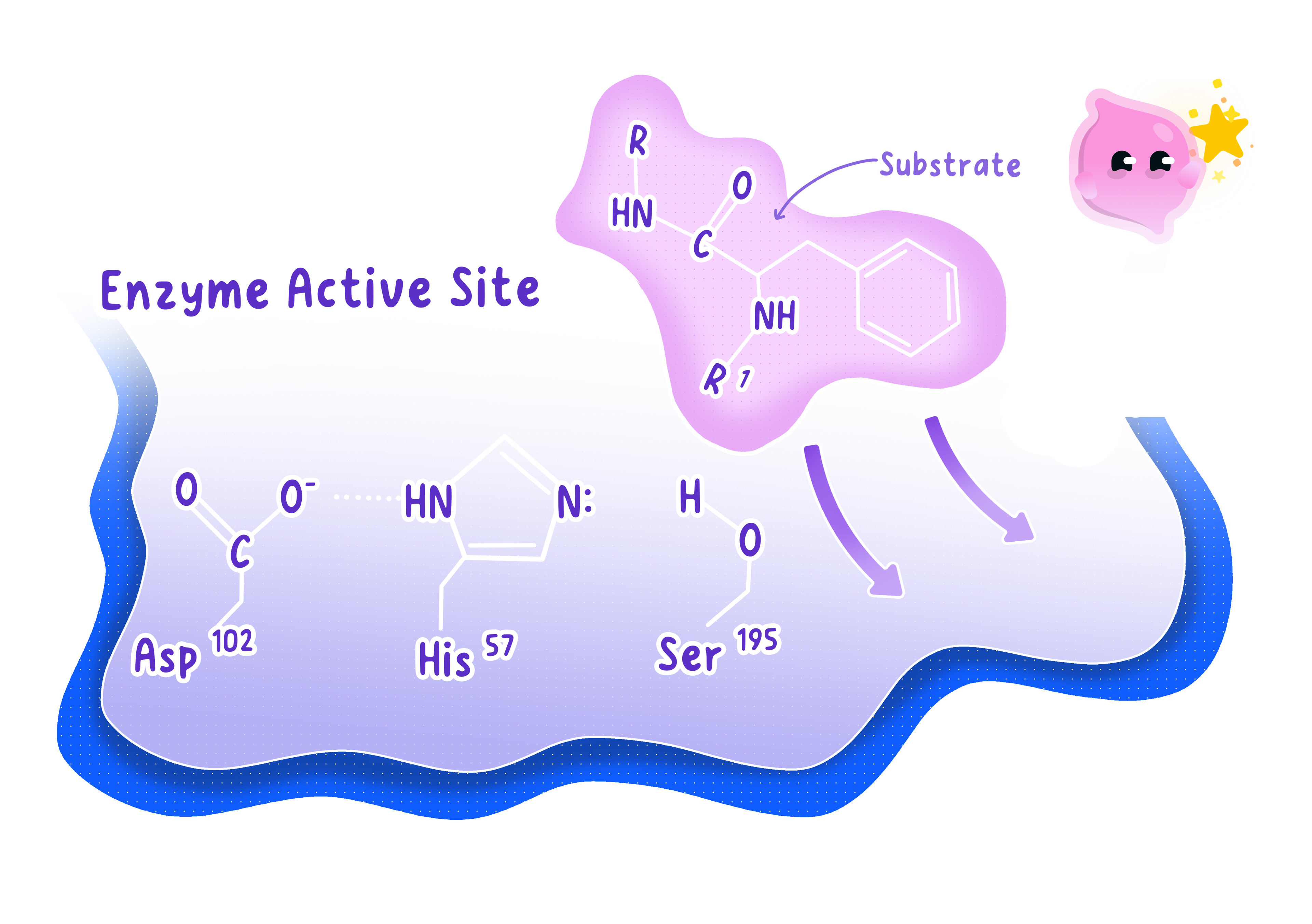
The shape of the active site is the whole explanation for how an enzyme works, why it works on only one substrate, and why it stops working when conditions change.
The lock and key model
Substrate
The molecule on which an enzyme acts.
- The substrate moves randomly through the solution until it collides with the enzyme.
- If the collision happens at the active site and in the right orientation, the substrate fits into it and binds.
- The structure formed at that moment is the enzyme-substrate complex.
- Holding the substrate in the active site makes the reaction happen much more readily, so the substrate is either split apart or joined to another molecule.
- The products no longer fit the active site, so they leave it.
- The active site is then empty and unchanged, ready for the next substrate molecule.
- This description is called the lock and key model, because only one key has the shape that opens a given lock.
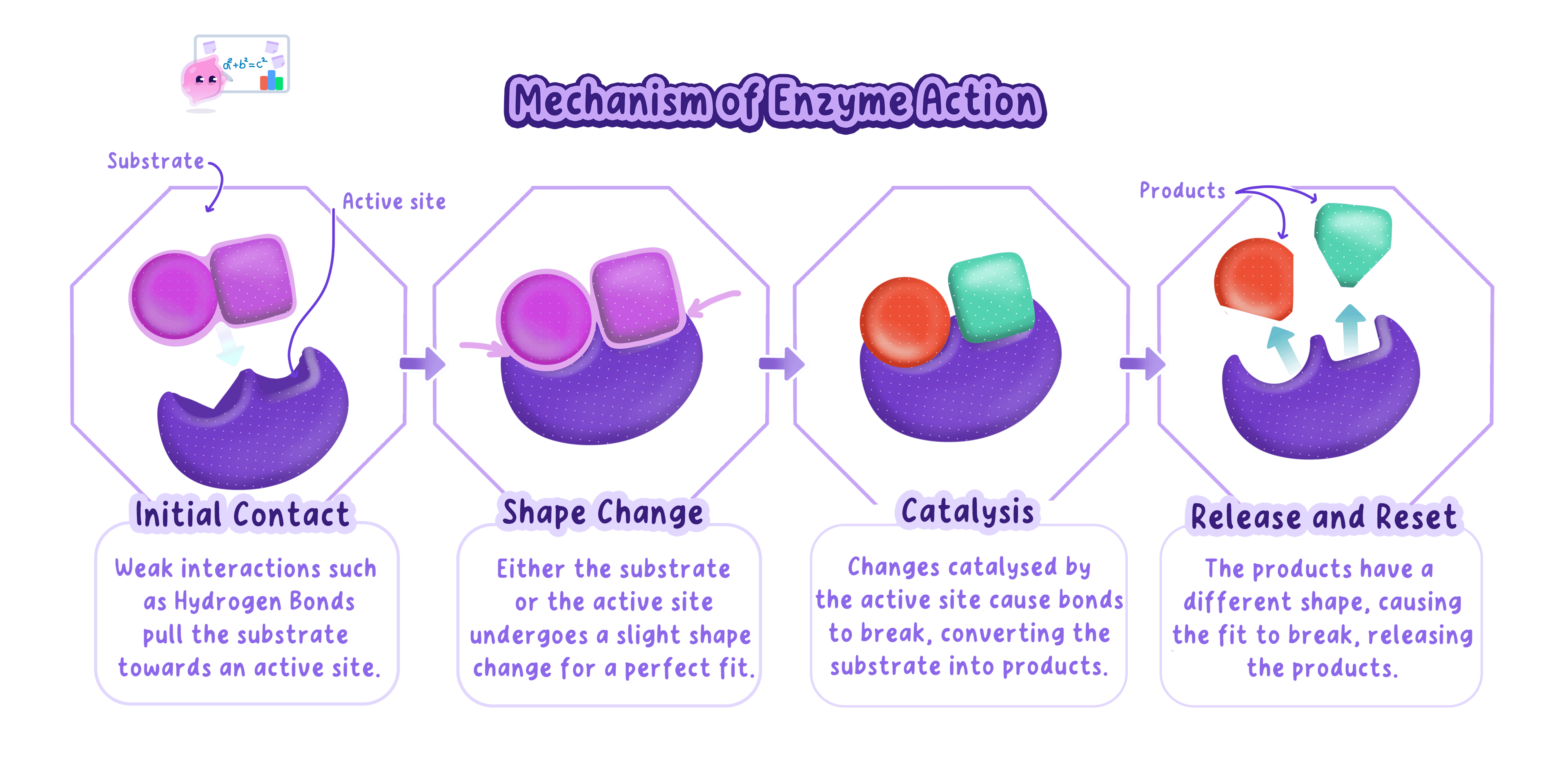
Enzyme-substrate complex
The structure formed when a substrate binds to the active site of an enzyme.
A six-step description of collide, fit, form the complex, react, release the products and free the active site will cover almost any mark scheme on enzyme action.
Why enzymes are specific
- Specificity means that one enzyme catalyses one reaction and no others.
- The reason is the shape of the active site, which is complementary to just one substrate.
- A molecule with a different shape cannot bind, so no enzyme-substrate complex forms and the reaction is not catalysed.
- Amylase, for example, breaks down starch but has no effect at all on protein, even in the same test tube.
- Specificity is what allows a cell to control which reactions happen, because it makes only the enzymes it needs.
Enzymes are molecules and not living things, so write that an enzyme is specific to its substrate rather than saying it chooses, wants or recognises one.
Enzymes that build large molecules
- In a synthesis reaction an enzyme holds two small molecules together so that they join, releasing water.
- Glucose molecules are joined into the carbohydrates starch in plants, glycogen in animals, and cellulose for plant cell walls. many glucose→starch, glycogen or cellulose\text{many glucose} \rightarrow \text{starch, glycogen or cellulose}many glucose→starch, glycogen or cellulose
- Amino acids are joined in a particular order to build proteins, which include enzymes themselves. many amino acids→protein\text{many amino acids} \rightarrow \text{protein}many amino acids→protein
- One glycerol molecule is joined to three fatty acids to make a lipid. glycerol+3 fatty acids→lipid\text{glycerol} + 3\ \text{fatty acids} \rightarrow \text{lipid}glycerol+3 fatty acids→lipid
Synthesis reactions are how a growing organism turns absorbed nutrients into its own tissue, so this is the chemistry behind growth.
Enzymes that break molecules down
- In a breakdown reaction an enzyme splits a large molecule into its smaller subunits by adding water.
- Carbohydrases break carbohydrates into sugars, and amylase breaking starch into maltose is the example Edexcel uses. starch→ amylase sugars\text{starch} \xrightarrow{\ \text{amylase}\ } \text{sugars}starch amylase sugars
- Proteases break proteins into amino acids. protein→ protease amino acids\text{protein} \xrightarrow{\ \text{protease}\ } \text{amino acids}protein protease amino acids
- Lipases break lipids into fatty acids and glycerol. lipid→ lipase fatty acids+glycerol\text{lipid} \xrightarrow{\ \text{lipase}\ } \text{fatty acids} + \text{glycerol}lipid lipase fatty acids+glycerol
- Breakdown matters in digestion because large food molecules are insoluble and too big to pass through the gut wall.
- The small soluble products can be absorbed into the blood and then reassembled into whatever the body needs.
- Learn the three enzyme groups with both their substrate and their products, since questions swap freely between naming the enzyme and naming the product.
- The mark most often dropped on digestion questions is the reason, so add that the products are small and soluble enough to be absorbed.
- If a question invents an enzyme name, use the -ase rule to work out its substrate rather than assuming it is off the specification.
- An enzyme is not used up in the reaction, so never write that it is broken down or consumed.
- The active site is complementary to the substrate, not the same shape as it.
- Enzymes speed up a reaction that would happen anyway, rather than causing a reaction that could never occur.
- Substrate and product are different things, so keep the two words apart when describing the complex.
- Define an enzyme in one sentence.
- Describe the lock and key model from the collision to the release of the products.
- Explain why amylase cannot break down protein.
- Name the products formed when a protease and a lipase act on their substrates.
- Which three molecules are joined together to make a lipid?
