Heart Rate Means Beats per Minute
Definition
Heart rate
The number of times the heart beats each minute.
- Heart rate is measured in beats min−1\mathrm{beats\,min^{-1}}beatsmin−1, often written as bpm\mathrm{bpm}bpm.
- Each pressure wave felt in an artery is a pulse produced by one heartbeat.
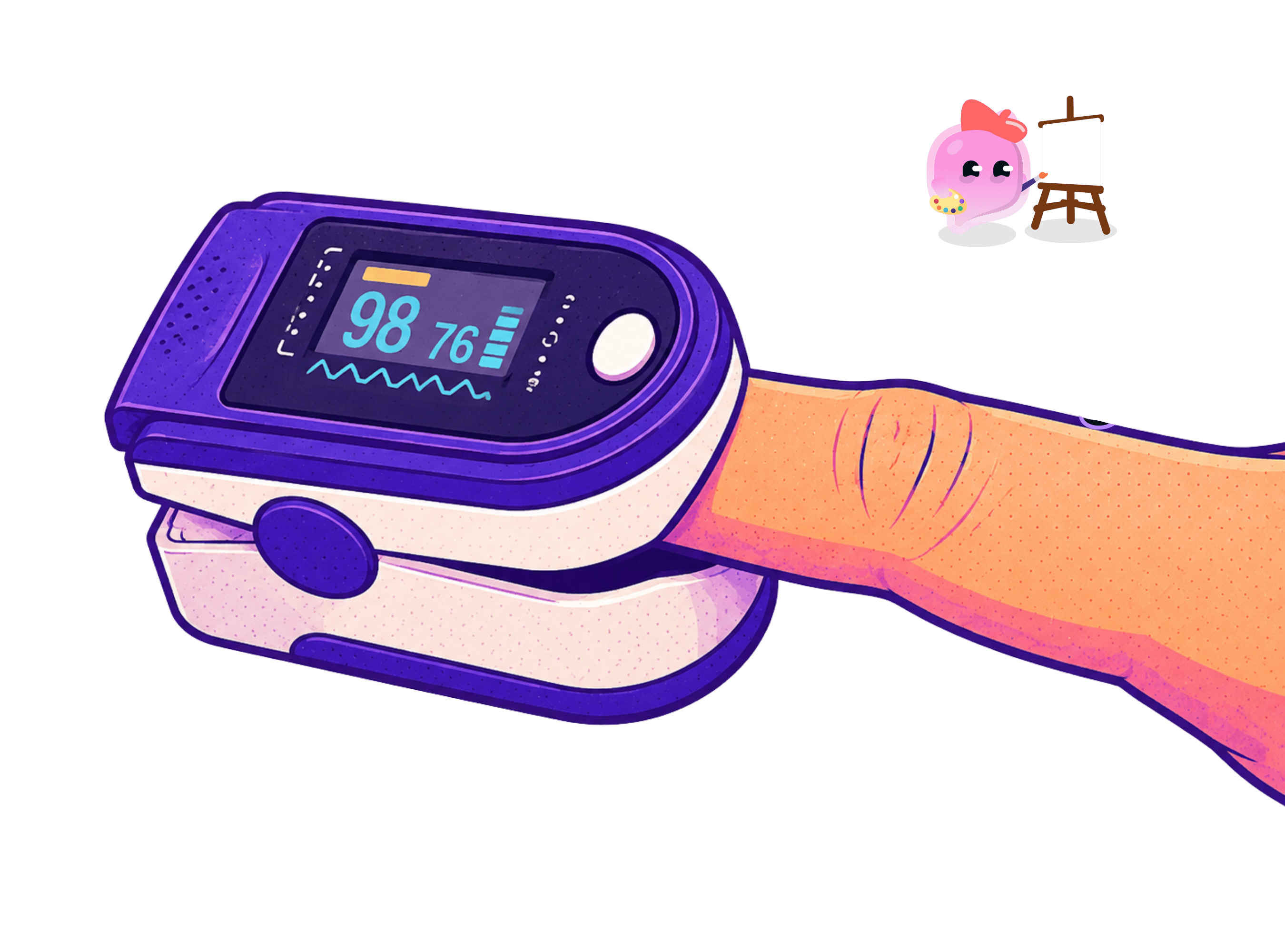
- A pulse oximeter can display heart rate electronically, while a pulse can also be counted at the wrist or neck.
Practical
Measuring Heart Rate
- Aim: Measure resting heart rate, then determine how a fixed period of exercise changes heart rate and recovery.
- Apparatus: Stop clock, chair, clear floor space or a low exercise step, and a pulse oximeter if available.
- Method:
- Sit quietly for 5 min5\,\mathrm{min}5min so your heart rate settles.
- Place your index and middle fingers lightly over the radial artery on the thumb side of the wrist.
- Count beats for 60 s60\,\mathrm{s}60s, or for 30 s30\,\mathrm{s}30s and multiply by 222.
- Repeat three times and calculate a mean resting heart rate.
- Complete the same stepping exercise for 2 min2\,\mathrm{min}2min at a fixed pace.
- Measure heart rate immediately, then at fixed 1 min1\,\mathrm{min}1min intervals until it approaches the resting value.
- Variables: Change whether the measurement is taken before or after exercise, measure heart rate, and keep the exercise duration, pace, counting interval, posture, person and room conditions constant.
- Results: Heart rate rises after exercise and then falls during recovery because active muscles need faster delivery of oxygen and glucose and faster removal of carbon dioxide and lactic acid.
- Maths: For a 30 s30\,\mathrm{s}30s count, heart rate=beats counted×2\text{heart rate}=\text{beats counted}\times2heart rate=beats counted×2; for repeats, mean heart rate=sum of heart ratesnumber of readings\text{mean heart rate}=\frac{\text{sum of heart rates}}{\text{number of readings}}mean heart rate=number of readingssum of heart rates.
- Watch out: Do not use your thumb because its own pulse can be counted, measure immediately after exercise because recovery begins at once, and repeat readings to reduce random error.
- Safety: Use moderate exercise in a clear space, stop if you feel pain or dizziness, and never press both carotid arteries at the same time.
Stroke Volume Is Blood per Beat
Definition
Stroke volume
The volume of blood pumped from a ventricle in one heartbeat.
- Stroke volume is usually measured in cm3 beat−1\mathrm{cm^3\,beat^{-1}}cm3beat−1.
- A stronger ventricular contraction ejects a larger stroke volume.
- During exercise, increased venous return and stronger contractions can raise stroke volume.
Cardiac Output Is Blood per Minute
Definition
Cardiac output
The volume of blood pumped by a ventricle each minute.
- Cardiac output combines how often the heart beats with how much blood leaves a ventricle on each beat.
- The equation is cardiac output=stroke volume×heart rate\text{cardiac output}=\text{stroke volume}\times\text{heart rate}cardiac output=stroke volume×heart rate.
- In symbols, Q=SV×HRQ=SV\times HRQ=SV×HR.
- Useful rearrangements are SV=QHRSV=\frac{Q}{HR}SV=HRQ and HR=QSVHR=\frac{Q}{SV}HR=SVQ.
- If stroke volume is in cm3 beat−1\mathrm{cm^3\,beat^{-1}}cm3beat−1 and heart rate is in beats min−1\mathrm{beats\,min^{-1}}beatsmin−1, cardiac output is in cm3 min−1\mathrm{cm^3\,min^{-1}}cm3min−1.
Exercise Raises Cardiac Output
- Contracting muscles use more oxygen and glucose for aerobic respiration.
- A higher heart rate and stroke volume increase cardiac output, delivering these reactants faster.
- The faster blood flow also removes more carbon dioxide and lactic acid from muscle tissue.
- The increased rate of aerobic respiration releases more energy for muscle contraction.
Exam technique
- Write the equation before substituting values, then give the final unit.
- Convert dm3\mathrm{dm^3}dm3 to cm3\mathrm{cm^3}cm3 before combining values expressed in different volume units.
- A correct numerical answer needs a sensible scale, so a resting adult value is usually several dm3 min−1\mathrm{dm^3\,min^{-1}}dm3min−1, not several cm3 min−1\mathrm{cm^3\,min^{-1}}cm3min−1.
Check Units Before Calculating
- The word per represents division, so cm3 beat−1\mathrm{cm^3\,beat^{-1}}cm3beat−1 means cubic centimetres for each beat.
- Multiplying cm3 beat−1\mathrm{cm^3\,beat^{-1}}cm3beat−1 by beats min−1\mathrm{beats\,min^{-1}}beatsmin−1 cancels beats and leaves cm3 min−1\mathrm{cm^3\,min^{-1}}cm3min−1.
- Use 1 dm3=1000 cm31\,\mathrm{dm^3}=1000\,\mathrm{cm^3}1dm3=1000cm3 when converting cardiac output.
Self review
- What is heart rate?
- What is stroke volume?
- Write the equation for cardiac output.
- What unit results from multiplying cm3 beat−1\mathrm{cm^3\,beat^{-1}}cm3beat−1 by beats min−1\mathrm{beats\,min^{-1}}beatsmin−1?
- Why does cardiac output rise during exercise?
