Diffusion is net particle movement
Definition
Diffusion
The net movement of particles from a region of higher concentration to a region of lower concentration, down a concentration gradient.
- Particles move randomly in gases and liquids, crossing an exchange surface in both directions.
- If more particles cross from the more concentrated side to the less concentrated side, there is a net movement down the concentration gradient.
- Diffusion is passive, so it does not require energy released by respiration.
Four factors change diffusion rate
Definition
Rate of diffusion
The rate of diffusion is the amount of a substance that moves by diffusion across a surface in a given time.
- A steeper concentration gradient increases the net movement of particles because the difference between the two sides is greater.
- A higher temperature increases particle kinetic energy, so particles move faster and cross the surface more frequently.
- A larger surface area allows more particles to cross at the same time.
- A shorter diffusion distance reduces the distance particles must travel, so they cross the barrier sooner.
A gradient compares two regions
Definition
Concentration gradient
The difference in the concentration of a substance between two regions.
- A concentration gradient describes the difference in concentration between two places, not the concentration in one place alone.
- Increasing the difference makes the gradient steeper and increases the rate of diffusion.
- As diffusion continues in a closed system, the difference becomes smaller, so the net rate falls until there is no concentration gradient.
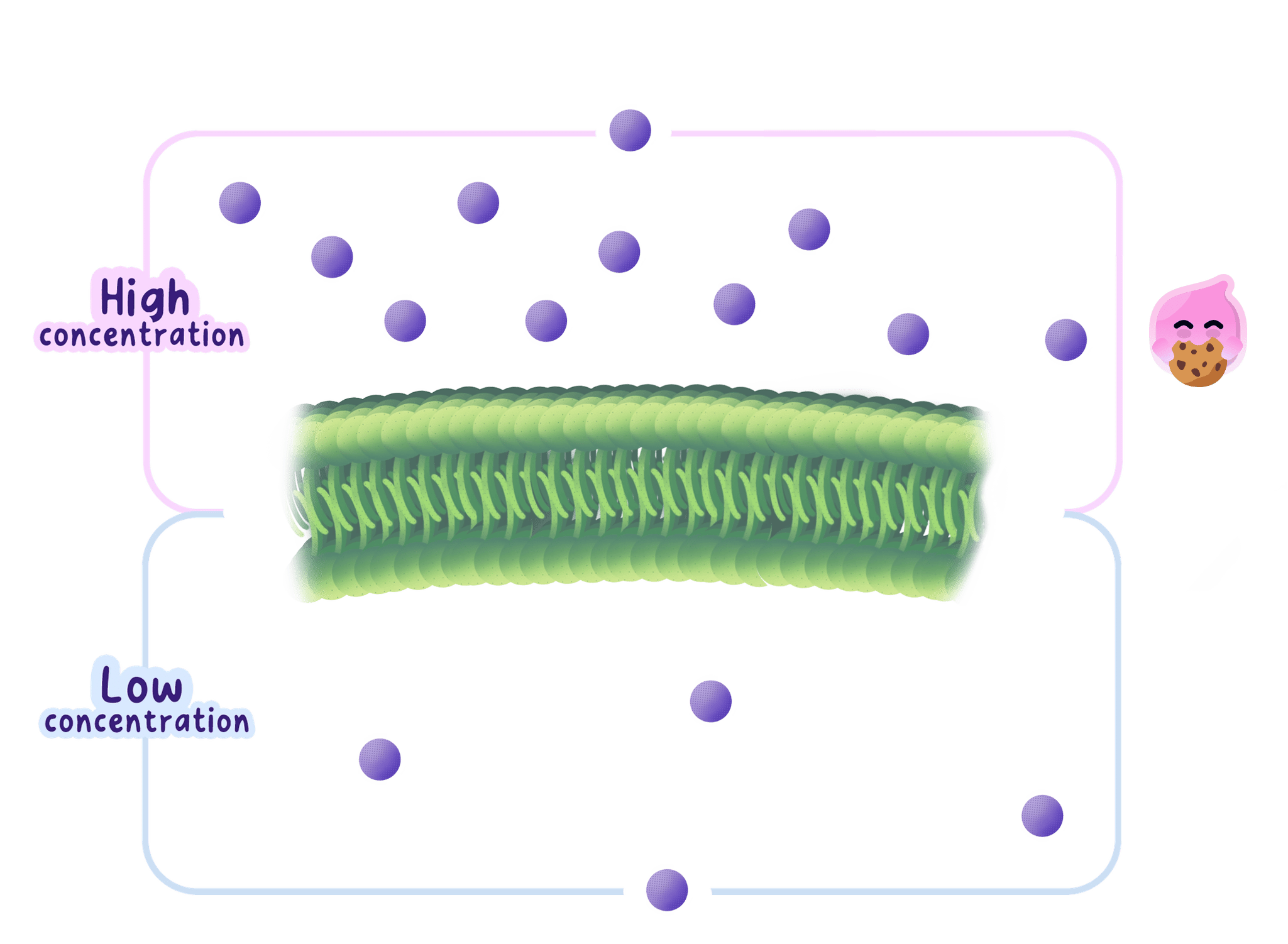
Example
- Water surrounding an aquatic organism contains less carbon dioxide than the organism's cells.
- Carbon dioxide therefore diffuses from the cells into the water down a concentration gradient.
- Replacing the surrounding water keeps its carbon dioxide concentration low, maintains the gradient and keeps diffusion rapid.
Area and distance control the route
Definition
Diffusion distance
Diffusion distance is the distance that particles must travel between two regions during diffusion.
- Folding or dividing a surface increases its area without requiring the whole structure to become much larger.
- A thin membrane gives a short diffusion distance because particles cross less material.
- A thick membrane gives a longer diffusion distance and therefore a lower rate of diffusion when the other factors stay constant.
Exam technique
- Write concentration gradient, rather than concentration alone, when the question asks for a factor that affects diffusion.
- When you explain a change, name the factor, state whether it rises or falls and give the effect on diffusion rate.
Apply each factor to the context
- In lungs, gills and intestines, folded surfaces increase area, thin walls shorten the path and fluid flow maintains concentration gradients.
- When temperature rises, explain the faster rate through increased kinetic energy and faster particle movement.
- Use comparative words such as larger, steeper, shorter and faster so the direction of each change is unambiguous.
Self review
- What is diffusion?
- What is meant by the rate of diffusion?
- Which four factors can change the rate of diffusion?
- Why is concentration alone not the same as a concentration gradient?
- Why does a shorter diffusion distance increase the rate?
