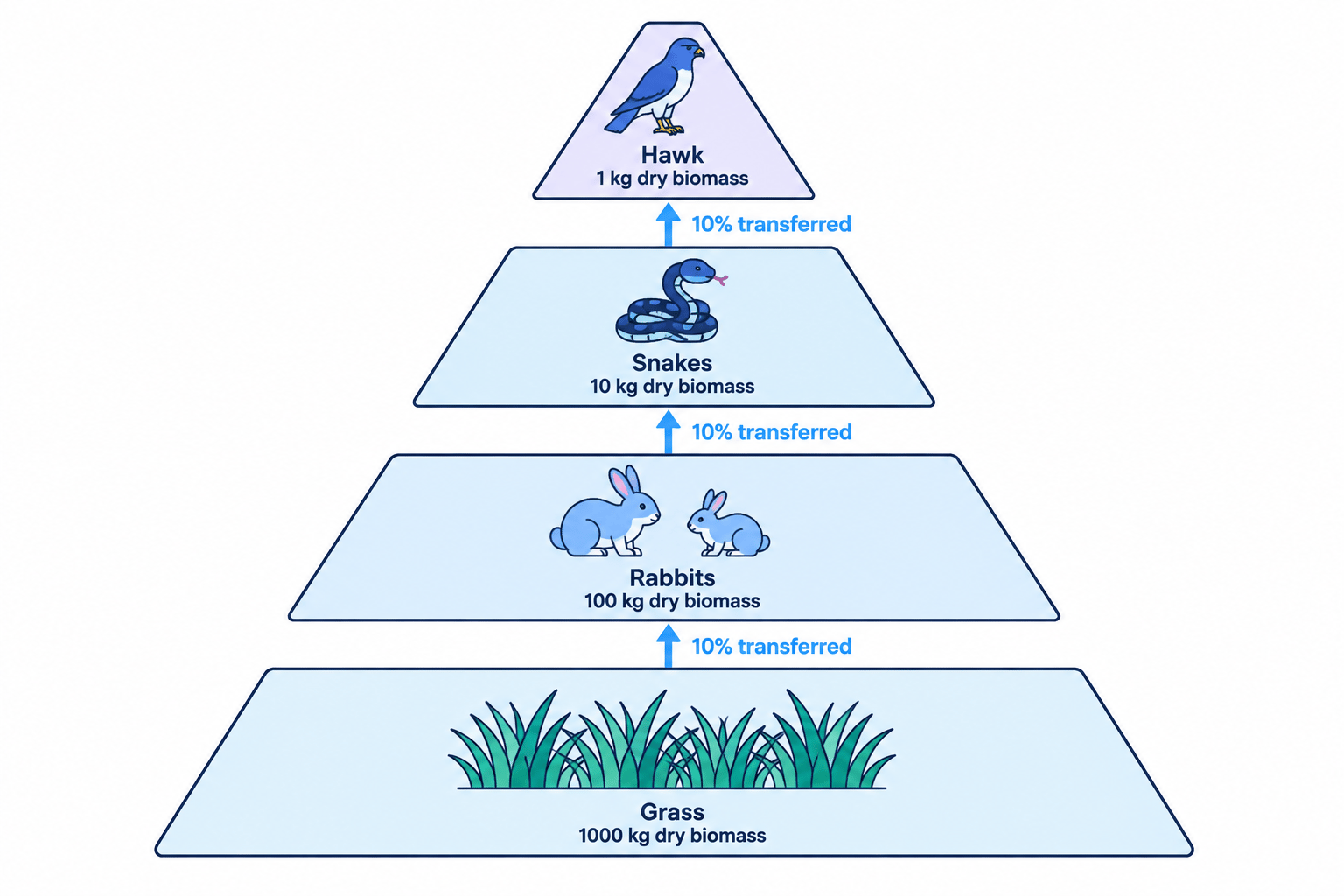
Biomass is lost between levels
Definition
Biomass
The mass of living material, usually measured as dry mass, present in an organism or at a trophic level.
- Only about 10% of the biomass at one trophic level is passed on to the next.
- The other 90% is lost, which is why food chains rarely have more than four or five levels.
Key Idea
About 10% of biomass moves up to the next level, so there is far less biomass at the top of a food chain than at the bottom.
Why biomass is lost
- Not all of an organism is eaten, because parts such as bones, roots and hard shells are left behind.
- Not all the food is digested, so some is egested as faeces.
- Biomass is used in respiration to release energy, and it leaves the body as carbon dioxide and water.
- Mammals and birds lose a lot of biomass keeping their bodies warm.
- Waste such as urea is lost in urine.
Calculating the efficiency of transfer
Definition
Biomass transfer efficiency
The percentage of the biomass at one trophic level that is passed on to the next, found by dividing the biomass transferred by the biomass available and multiplying by 100.
- The efficiency of biomass transfer is the percentage of biomass passed on to the next level.
- Work it out with efficiency=biomass transferred to the next levelbiomass available at the level×100\text{efficiency} = \dfrac{\text{biomass transferred to the next level}}{\text{biomass available at the level}} \times 100efficiency=biomass available at the levelbiomass transferred to the next level×100.
- For example, if 100 kJ of biomass is available and 12 kJ is passed on, the efficiency is 12100×100=12%\dfrac{12}{100} \times 100 = 12\%10012×100=12%.
Self review
- About what percentage of biomass passes to the next trophic level?
- Give three ways biomass is lost between trophic levels.
- Why do food chains rarely have more than five levels?
- If 500 kJ is available and 50 kJ is passed on, what is the efficiency of transfer?