Definition
Biomass
The mass of living material, usually measured as dry mass, present in an organism or at a trophic level.
Definition
Pyramid of biomass
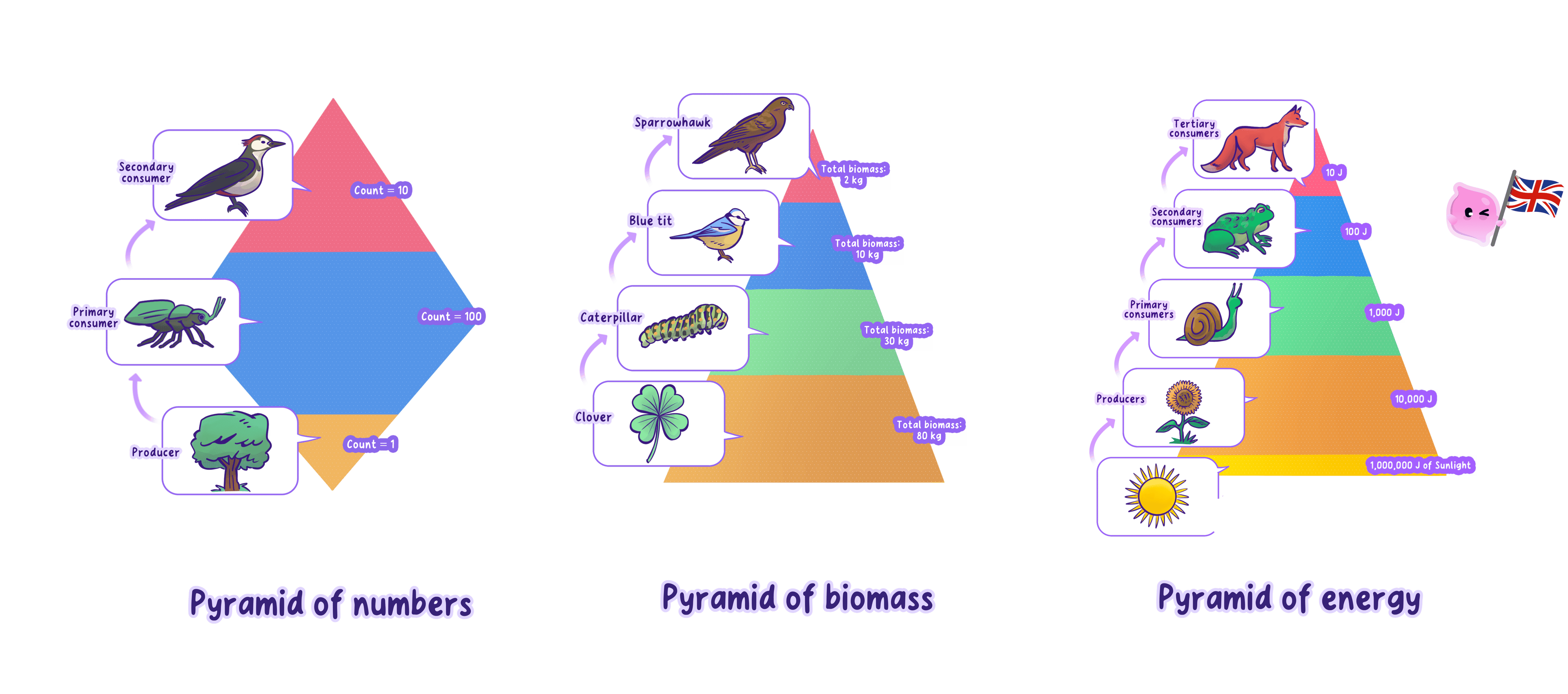
A diagram in which the width of each bar, drawn to scale, shows the biomass at each trophic level in a food chain.
- A pyramid of biomass shows the mass of living material at each trophic level in a food chain.
- Each bar is drawn to scale, so its width shows how much biomass is at that level.
- The producers form the wide bar at the bottom, and each level above is narrower.
Key Idea
Biomass gets smaller at each level up, so a pyramid of biomass is almost always widest at the bottom.
Drawing and reading a pyramid
- To draw one, put the producers at the bottom and stack each trophic level above in order.
- Make the width of each bar match the biomass at that level, using the same scale for every bar.
- To read one, compare the widths to see how the biomass falls from one level to the next.
Common Mistake
- Do not draw the bars by the number of organisms.
- A pyramid of biomass uses the mass of living material at each level, drawn to scale.
Why the pyramid narrows
- Biomass decreases at each level up, which is why the bars get narrower towards the top.
- The reasons for this loss of biomass are covered in the next article, on the transfer of biomass.
Self review
- What does a pyramid of biomass show?
- Why is each bar drawn to scale?
- Which trophic level forms the widest bar, and why?
- What happens to biomass as you move up the trophic levels?
