2.2.1a The human digestive system
Digestion Breaks Large Food Molecules Into Small, Absorbable Ones
Digestion
The breakdown of large, insoluble food molecules into small, soluble molecules that can be absorbed into the blood.
- The food you eat contains large, insoluble molecules such as starch, proteins and fats that are far too big to pass through the gut wall into your blood.
- Digestion breaks these down into small, soluble molecules such as glucose, amino acids, fatty acids and glycerol.
- These small molecules are then absorbed through the wall of the small intestine and into the bloodstream.
- The blood carries them to your cells, where they release energy in respiration or are used to build new molecules for growth and repair.
The whole point of digestion is to turn food you cannot absorb into small, soluble molecules you can.
The Digestive System Is an Organ System Where Organs Work Together
Digestive system
The organ system that takes in food, breaks it down and absorbs the useful molecules into the blood; it includes the mouth, oesophagus, stomach, small and large intestines, pancreas and liver.
- The digestive system is an organ system: several organs work together to digest food and absorb the products.
- Cells that share a job form a tissue, different tissues form an organ, and organs working together form an organ system.
- The stomach shows this well: muscular tissue churns the food, glandular tissue releases enzymes and acid, and epithelial tissue lines and protects it.
- No single organ digests a whole meal on its own, which is why the system is studied as a group.
The levels of organisation run cells, then tissues, then organs, then organ systems, then the whole organism.
Food Travels Along the Alimentary Canal in One Direction
Alimentary canal
The long muscular tube that food passes through, running from the mouth to the anus, where digestion and absorption take place.
- The alimentary canal is the muscular tube that food passes through, from the mouth to the anus.
- Food moves in one direction: mouth, oesophagus, stomach, small intestine, large intestine, rectum, anus.
- Muscles in the wall of the canal squeeze the food along, so it does not have to rely on gravity.
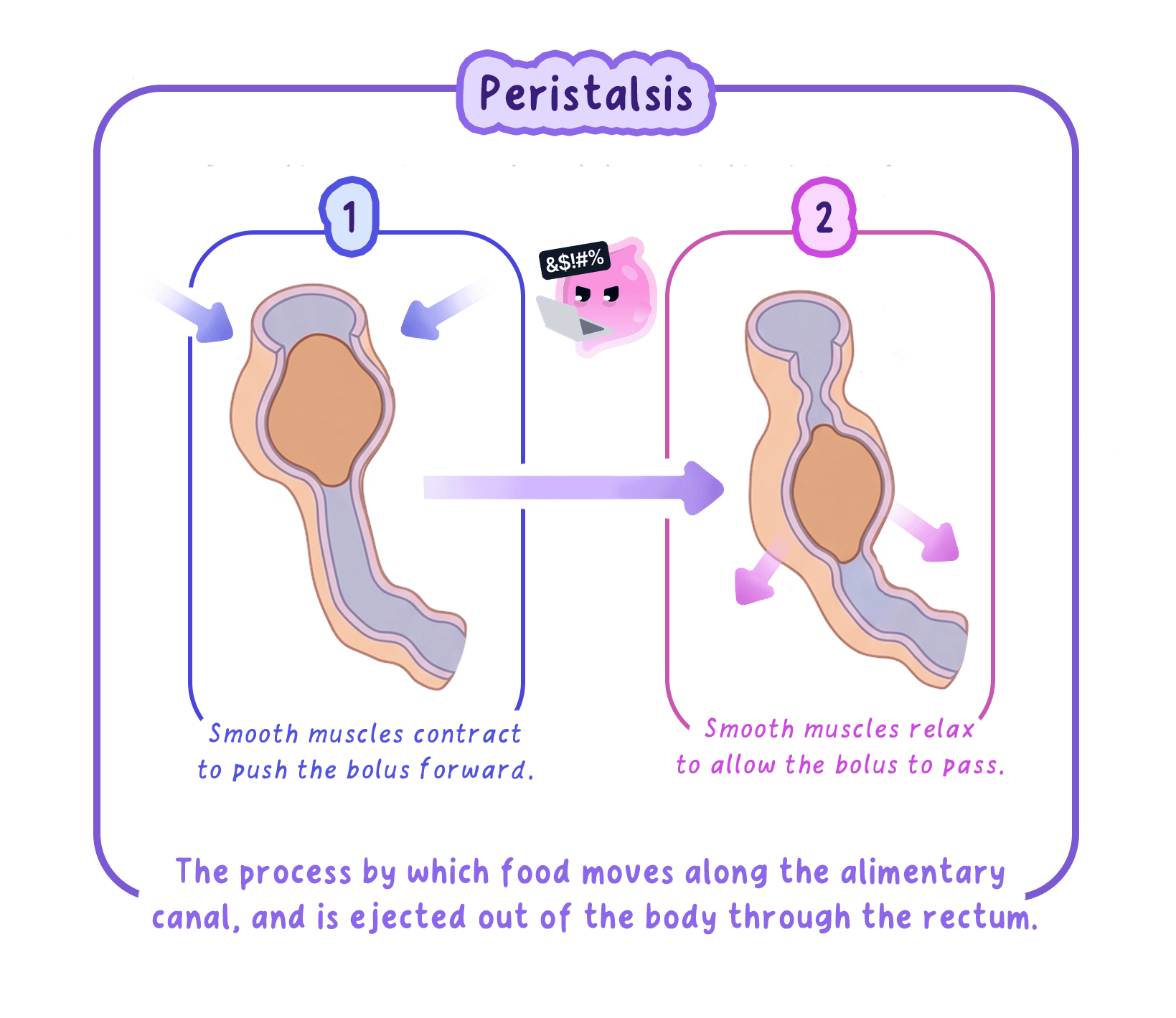
Trace a single mouthful to recall the order: it is chewed in the mouth, pushed down the oesophagus, churned in the stomach, digested and absorbed in the small intestine, then the leftovers pass into the large intestine to form faeces.
Accessory Organs Add Enzymes and Bile Without Carrying Food
Accessory organ
An organ that aids digestion by making substances such as enzymes or bile but that food does not pass through directly, for example the pancreas, liver and salivary glands.
- Some organs help digestion but food never passes through them; these are the accessory organs.
- The salivary glands release saliva, which contains amylase, into the mouth.
- The pancreas makes all three types of digestive enzyme and releases them into the small intestine.
- The liver makes bile, which is stored in the gall bladder and released into the small intestine.
Accessory organs join the canal through tubes called ducts, but food does not flow through the organs themselves.
What Each Organ Does in Digestion
- Mouth and salivary glands
- Teeth carry out mechanical digestion, chewing food into smaller pieces to increase its surface area.
- Amylase in saliva starts to digest starch, and the tongue shapes the food into a ball, ready to swallow.
- Oesophagus
- A muscular tube that pushes the food down from the mouth to the stomach using wave-like contractions.
- Stomach
- Muscular walls churn the food while protease enzymes digest protein.
- It also makes hydrochloric acid, which kills most bacteria in food and gives the low pH the stomach protease needs to work.
- Small intestine
- Enzymes from the pancreas and the intestine itself finish digestion in slightly alkaline conditions.
- It is lined with tiny villi that give a large surface area, so the products of digestion are absorbed quickly into the blood.
- Large intestine, rectum and anus
- Water is absorbed from the undigested food, leaving semi-solid faeces.
- The faeces are stored in the rectum and then removed through the anus.
- Pancreas, liver and gall bladder
- The pancreas makes amylase, protease and lipase and releases them in an alkaline fluid into the small intestine.
- The liver makes bile, and the gall bladder stores it before releasing it into the small intestine.
- Mechanical digestion (chewing and churning) physically breaks food into smaller pieces.
- Chemical digestion (enzymes) breaks the molecules apart, and both together speed up digestion.
Absorption Moves the Products Into the Blood
Absorption
The movement of small, soluble products of digestion out of the small intestine and into the bloodstream.
- Once food has been digested, the small soluble molecules are absorbed across the wall of the small intestine into the blood.
- The blood then carries these molecules to cells all over the body.
- Do not say food is absorbed straight into cells from the gut; it is absorbed into the blood, which delivers it to cells.
- Do not confuse egestion, which removes undigested food as faeces, with excretion, which removes waste made by the body's own reactions.
The Products of Digestion Are Used by the Body's Cells
- Glucose is used in respiration to release energy for the cell's activities.
- Amino acids are used to build new proteins, such as enzymes and antibodies, for growth and repair.
- Fatty acids and glycerol are used to build new cell membranes and to make some hormones.
- Using these absorbed molecules inside the body's cells is called assimilation.
- Why must large food molecules be digested before your body can use them?
- Name the parts of the alimentary canal in order from mouth to anus.
- What is an accessory organ? Give two examples and say what each adds.
- Where is water absorbed, and where are the products of digestion absorbed?
- Give one use each for glucose, amino acids, and fatty acids and glycerol after absorption.
2.2.1b Enzymes and Digestion
Digestion Is the Chemical Breakdown of Large Food Molecules
Enzyme
A biological catalyst, made of protein, that speeds up a specific chemical reaction in a living organism without being used up or changed.
- The large molecules in food are chains of smaller units joined by bonds: carbohydrates such as starch are chains of simple sugars, proteins are chains of amino acids, and lipids are fatty acids joined to glycerol.
- These bonds must be broken to release the small, soluble units, and this chemical breakdown is called digestion.
- Without help these reactions would be far too slow, so enzymes are used to speed them up at body temperature.
- Digestive enzymes are unusual because they work outside cells, released into the gut by glands and by the lining of the digestive system.
Enzymes carry out the chemical digestion of food, cutting large molecules into small, soluble ones that the body can absorb.
Enzymes Are Biological Catalysts With a Specific Active Site
Active site
The region of an enzyme with a specific shape that the substrate fits into, where the reaction is catalysed.
- An enzyme is a biological catalyst: it speeds up a reaction without being used up, so it can be used over and over again.
- Enzymes are large protein molecules, and their long chains of amino acids fold into a precise three-dimensional shape.
- Part of this shape is the active site, where the reacting molecule binds.
- Each enzyme is specific: only a substrate with a complementary shape fits its active site, so one enzyme usually catalyses only one reaction.
- Together, enzymes control metabolism, the sum of all the chemical reactions in a cell or the whole body.
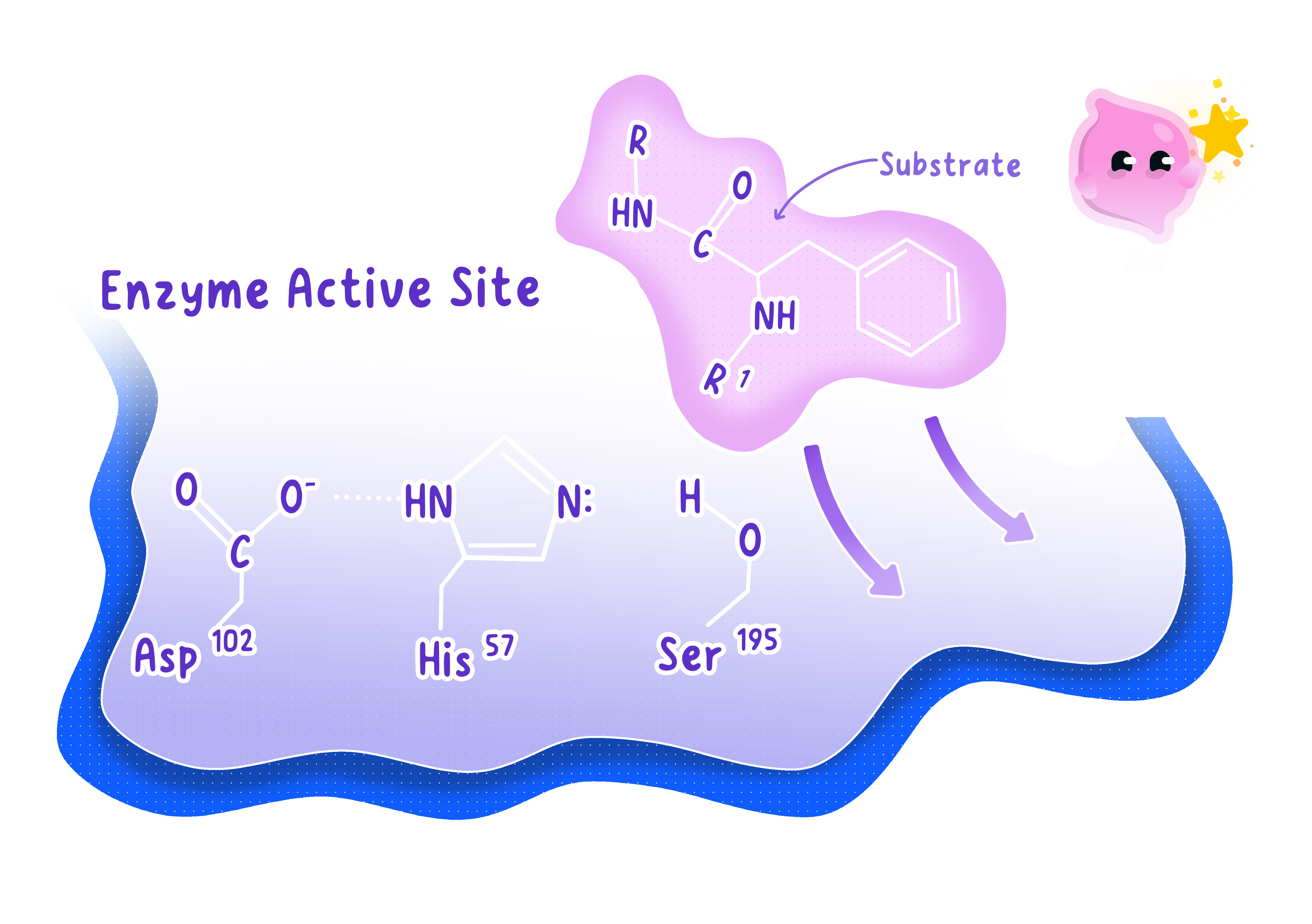
Because a catalyst is not changed by the reaction, one enzyme molecule can process many substrate molecules, one after another.
The Lock and Key Model Explains How Enzymes Work
Substrate
The molecule that an enzyme acts on; it has a shape complementary to the enzyme's active site.
- The lock and key model is a simple way to picture enzyme action: the enzyme is the lock and the substrate is the key.
- The substrate collides with the enzyme and fits into the active site because their shapes are complementary, forming an enzyme-substrate complex.
- The reaction then takes place and the product or products are released from the active site.
- The enzyme is left unchanged, so it can bind another substrate and catalyse the reaction again.
Amylase and starch are complementary, so amylase can break starch down; but amylase cannot digest protein, because protein does not fit its active site.
Temperature and pH Change the Rate of Enzyme Reactions
Denatured
A permanent change to the shape of an enzyme's active site, caused by high temperature or an extreme pH, so the substrate no longer fits and the enzyme stops working.
The effect of temperature
- As the temperature rises from low values, the rate increases, because the molecules gain kinetic energy, move faster and collide more often.
- The rate is fastest at the optimum temperature, which is about 37 ∘C37\ ^{\circ}\text{C}37 ∘C for human enzymes.
- Above the optimum, the higher temperature breaks the bonds that hold the enzyme's shape, so the active site changes shape.
- The substrate no longer fits, the enzyme is denatured, and the rate drops sharply.
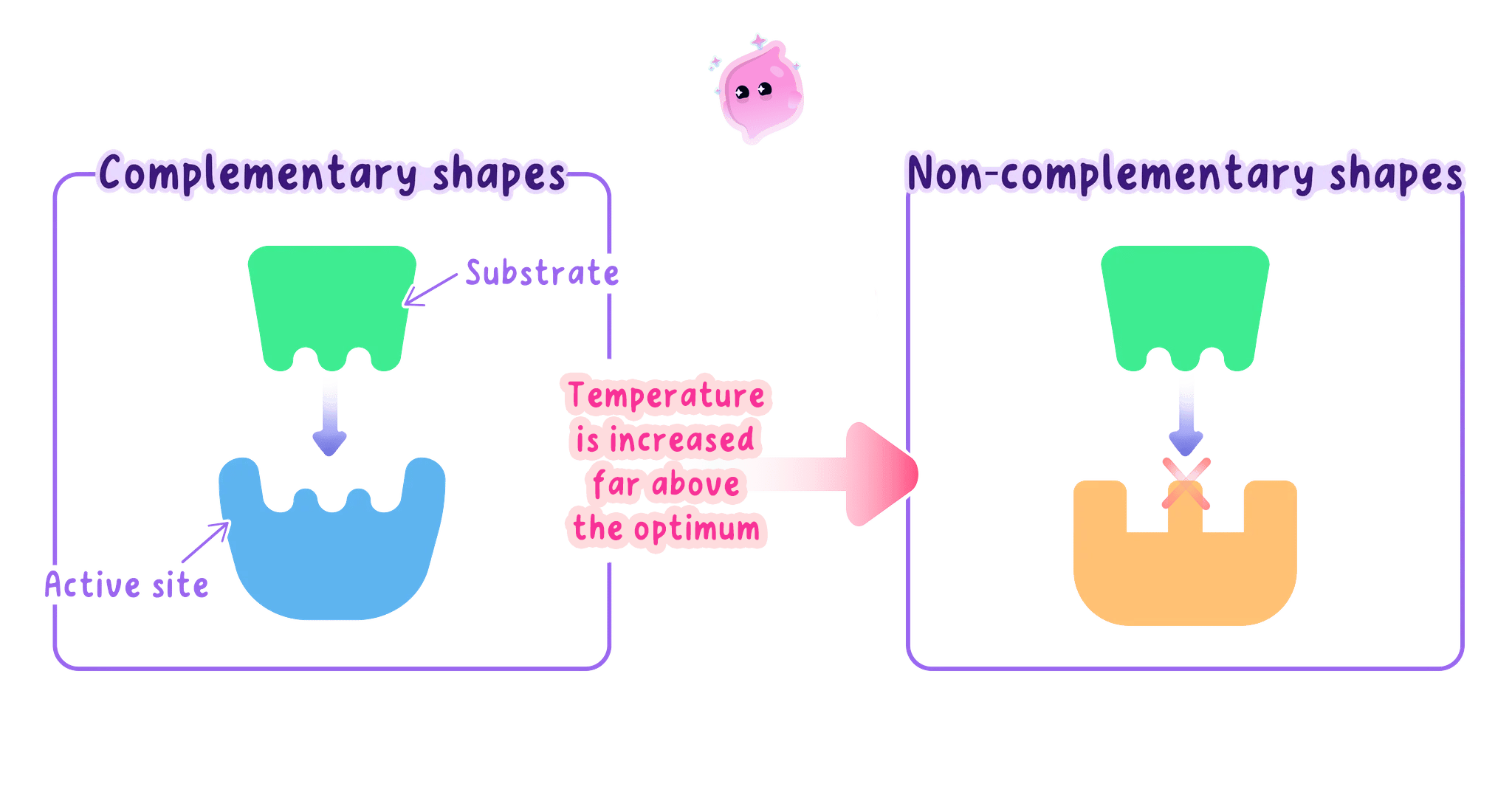
The effect of pH
- Each enzyme has an optimum pH at which it works fastest.
- Stomach protease works best in acidic conditions of about pH 2, while enzymes in the small intestine work best in alkaline conditions of about pH 8.
- If the pH moves too far from the optimum, the bonds holding the shape are affected, the active site changes shape and the enzyme is denatured.
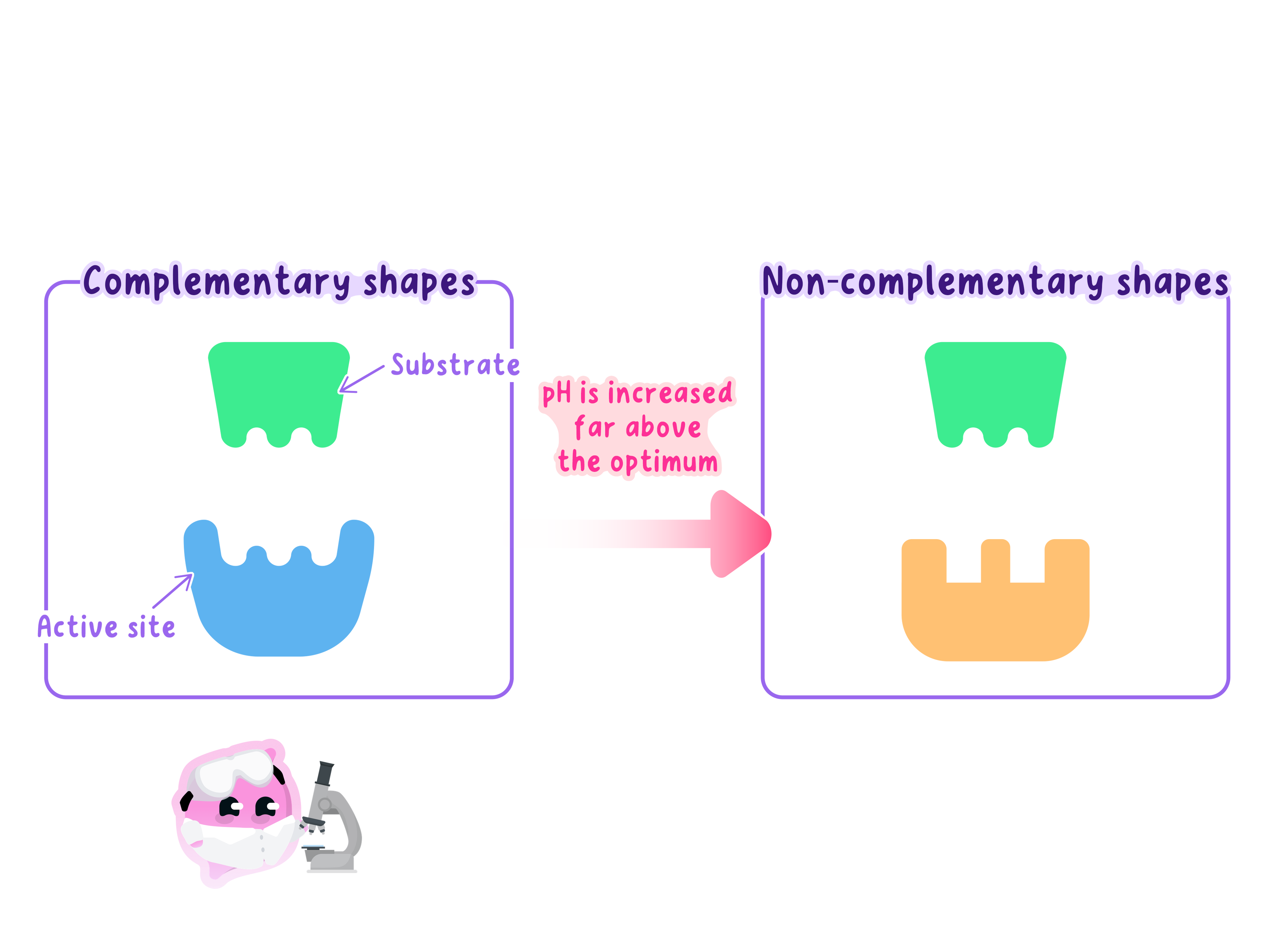
Say the enzyme is denatured, not that it is killed; an enzyme is a molecule, not a living thing, so it cannot die.
The Effect of pH on Amylase
- Mix amylase with a buffer solution of a chosen pH, then add starch and start a timer.
- Every 30 seconds, drop a sample onto iodine solution on a spotting tile.
- Iodine stays blue-black while starch is present and turns orange-brown once all the starch has been digested.
- The shorter the time taken to reach orange-brown, the faster amylase is working at that pH.
- Use a water bath to keep the temperature constant, so pH is the only variable being changed.
Digestive Enzymes: Carbohydrases, Proteases and Lipases
Carbohydrase
An enzyme that breaks down carbohydrates into simple sugars; amylase is a carbohydrase that breaks down starch into maltose.
- Carbohydrases
- Break down carbohydrates into simple sugars.
- Amylase is a carbohydrase that breaks starch into maltose (a sugar); it is made in the salivary glands, the pancreas and the small intestine.
- Word summary: starch is broken down to sugars.
- Proteases
- Break down proteins into amino acids.
- Made in the stomach, the pancreas and the small intestine, so protein digestion happens in the stomach and small intestine.
- Word summary: protein is broken down to amino acids.
- Lipases
- Break down lipids (fats and oils) into fatty acids and glycerol.
- Made in the pancreas and the small intestine.
- Word summary: lipid is broken down to fatty acids and glycerol.
For each enzyme, learn three things: where it is made, what it breaks down (its substrate), and what it produces.
Bile Speeds Up the Digestion of Fats
Bile
An alkaline liquid made in the liver and stored in the gall bladder that neutralises stomach acid and emulsifies fats to speed up their digestion by lipase.
- Bile is made in the liver, stored in the gall bladder, and released into the small intestine.
- Bile is alkaline, so it neutralises the hydrochloric acid from the stomach and gives the alkaline pH that the small-intestine enzymes need.
- Bile also emulsifies fats, breaking large drops of fat into many tiny droplets.
- This gives the fat a much larger surface area, so lipase can break it down into fatty acids and glycerol faster.
Bile is not an enzyme; it does not break the chemical bonds in fat, it only physically breaks large fat drops into smaller droplets to increase the surface area.
The Products of Digestion Are Reused by the Body
- The small molecules made by digestive enzymes are absorbed and used to build new carbohydrates, lipids and proteins that the body needs.
- Some glucose from carbohydrate digestion is used in respiration to release energy.
- Describe the lock and key model, using the words active site, substrate and complementary.
- Explain what happens to an enzyme, and to the rate of reaction, above its optimum temperature.
- Name the three types of digestive enzyme and give the products each one makes.
- Where is amylase made and what does it break starch down into?
- Give the two roles of bile and explain how each one helps lipase work faster.
