5.2.3 The eye
The Eye Is a Sense Organ That Detects Light
Retina
The light-sensitive layer at the back of the eye, containing receptor cells sensitive to light intensity and colour.
- The eye is a sense organ containing receptors sensitive to light intensity and colour.
- These receptors are found in the retina at the back of the eye.
- Light is focused onto the retina, which sends impulses along the optic nerve to the brain.
Every part of the eye works to focus a sharp image onto the retina, where light receptors turn it into nerve impulses.
The Main Structures of the Eye
Cornea
The transparent front of the eye that lets light in and does most of the refraction (bending) of the light.
- Sclera
- The tough white outer layer that protects the eyeball.
- Cornea
- The transparent front of the eye that lets light in and does most of the refraction (bending) of the light.
- Iris
- The coloured ring of muscle that controls the size of the pupil and so the amount of light entering.
- Lens
- A transparent disc that changes shape to fine-focus the light onto the retina.
- Ciliary muscles and suspensory ligaments
- The ciliary muscles are a ring of muscle that changes the lens shape; the suspensory ligaments attach the lens to them.
- Retina and optic nerve
- The retina is the light-sensitive layer of receptor cells; the optic nerve carries the impulses to the brain.
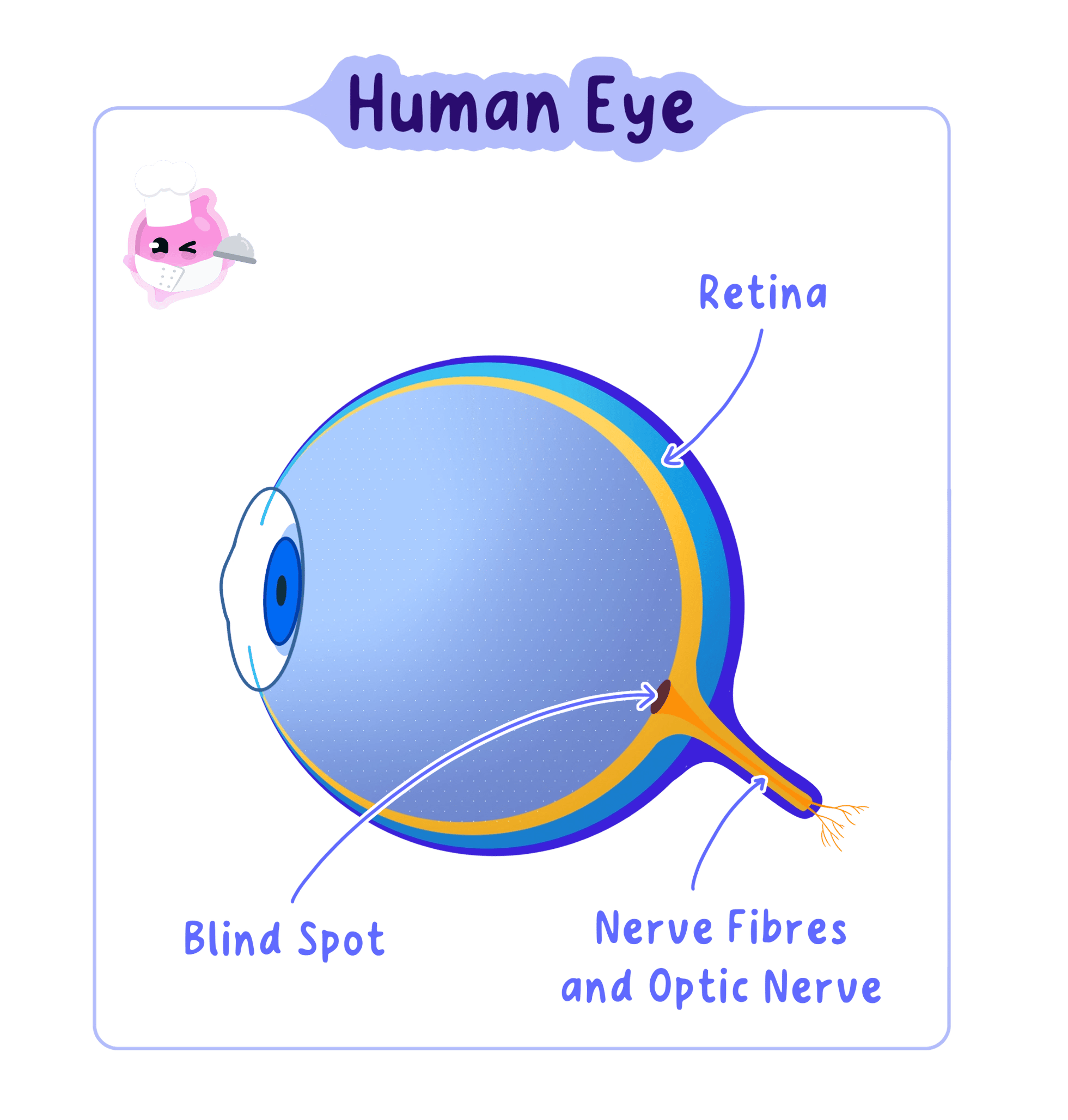
The cornea does most of the focusing, while the lens fine-tunes it so both near and distant objects can be seen clearly.
Adapting to Dim and Bright Light: The Pupil Reflex
Iris
The coloured ring of muscle that controls the size of the pupil and so the amount of light entering the eye.
- Changing the pupil size is a reflex that protects the retina and helps you see in different light levels.
- In dim light the radial muscles contract and the circular muscles relax, so the pupil dilates (widens) and more light enters.
- In bright light the circular muscles contract and the radial muscles relax, so the pupil constricts (narrows) and less light enters, protecting the retina.
Very bright light can damage the light receptors, so narrowing the pupil protects the delicate retina.
Accommodation: Focusing on Near and Distant Objects
Accommodation
The process of changing the shape of the lens to focus light from near or distant objects onto the retina.
Focusing on a near object
- The ciliary muscles contract.
- The suspensory ligaments loosen.
- The lens becomes thicker and more curved, so it refracts light rays strongly.
Focusing on a distant object
- The ciliary muscles relax.
- The suspensory ligaments are pulled tight.
- The lens is pulled thin, so it only slightly refracts the light rays.
Staring at your finger held close to your eye soon feels tight, because the ciliary muscles are contracted to keep the near object in focus.
Myopia: Short-Sightedness
Myopia
Short-sightedness, where distant objects look blurred because light is focused in front of the retina; corrected with a concave lens.
- In myopia (short-sightedness), distant objects look blurred but near objects are clear.
- The light is focused in front of the retina, because the eyeball is too long or the lens is too curved.
- It is corrected with a concave (diverging) lens, which spreads the light out before it enters the eye so it focuses on the retina.
Myopia is corrected with a concave lens and hyperopia with a convex lens; do not mix these up.
Hyperopia and New Technologies
Hyperopia
Long-sightedness, where near objects look blurred because light is focused behind the retina; corrected with a convex lens.
- In hyperopia (long-sightedness), near objects look blurred but distant objects are clear.
- The light is focused behind the retina, because the eyeball is too short or the lens is too flat.
- It is corrected with a convex (converging) lens, which brings the light rays together before they enter the eye.
- New treatments
- Hard and soft contact lenses sit on the surface of the eye and are useful for sport.
- Laser surgery changes the shape of the cornea to alter how much it refracts light.
- A replacement lens can be put into the eye to correct the defect.
- Name the light-sensitive layer of the eye and say what its receptors detect.
- What do the cornea and the lens each do to the light?
- Describe the pupil in bright light and say which muscles cause the change.
- Describe what happens to the ciliary muscles, suspensory ligaments and lens when focusing on a near object.
- Compare myopia and hyperopia, and state the type of lens used to correct each.
