5.2.4a Control of body temperature
The Thermoregulatory Centre Monitors Body Temperature
Thermoregulatory centre
The part of the brain that monitors and controls body temperature; it contains receptors sensitive to the temperature of the blood.
- The body is kept at about 37 ∘C37\ ^{\circ}\text{C}37 ∘C, the temperature at which enzymes work best.
- The thermoregulatory centre in the brain monitors and controls body temperature.
- It contains receptors sensitive to the temperature of the blood flowing through the brain.
- The skin also contains temperature receptors that send nervous impulses to the thermoregulatory centre.
The brain checks the temperature of the blood and information from the skin, then triggers responses that return the body to about 37 ∘C37\ ^{\circ}\text{C}37 ∘C.
Cooling Down When the Body Is Too Hot
Vasodilation
The widening of the blood vessels that supply the skin capillaries, so more blood flows near the surface and more heat is lost.
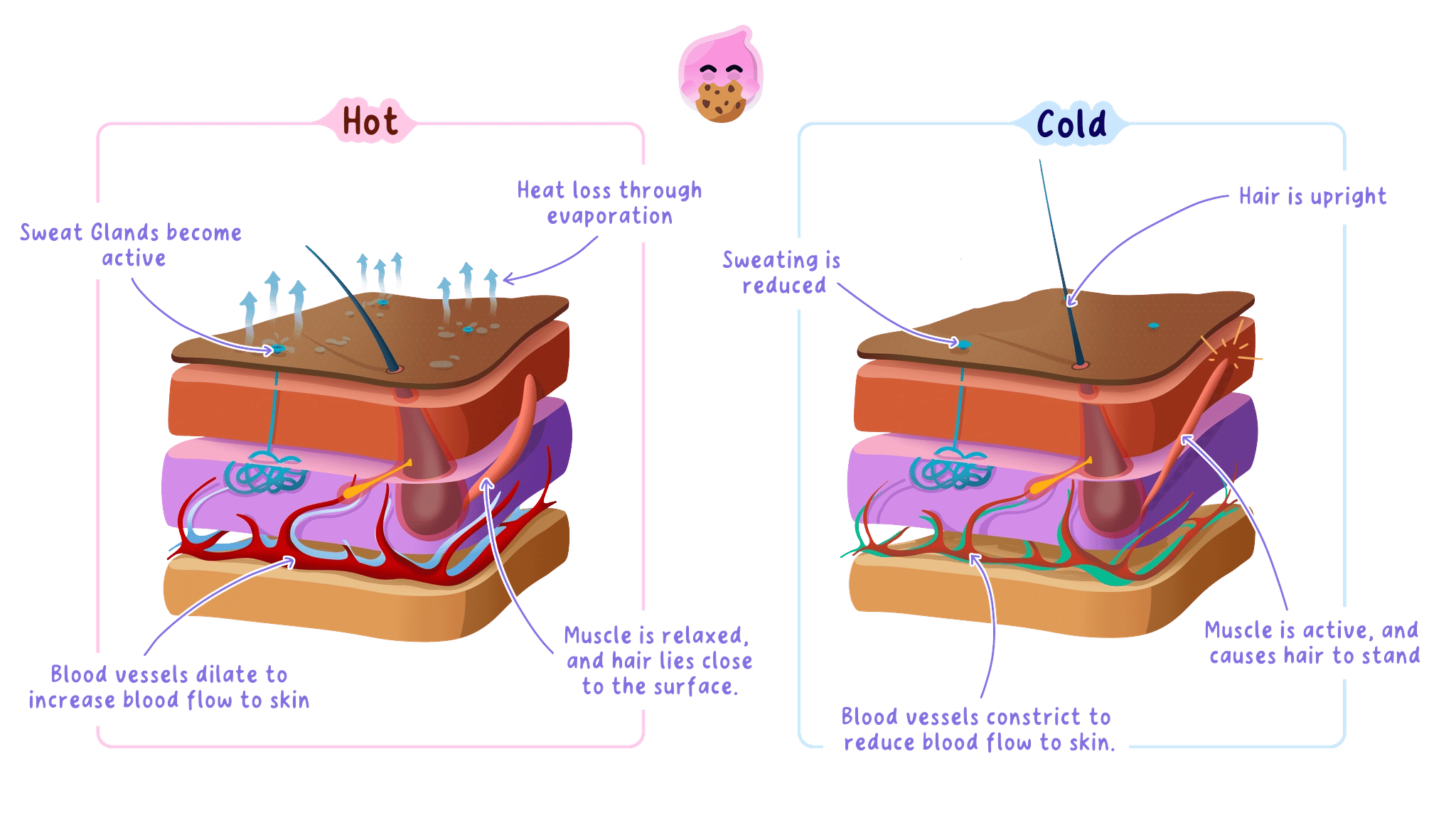
- If body temperature is too high, the blood vessels supplying the skin capillaries dilate; this is vasodilation.
- More blood flows near the skin surface, so more energy is transferred from the skin to the environment.
- Sweat is produced from the sweat glands; as it evaporates it transfers energy away from the skin, cooling the body.
Warming Up When the Body Is Too Cold
Vasoconstriction
The narrowing of the blood vessels that supply the skin capillaries, so less blood flows near the surface and less heat is lost.
- If body temperature is too low, the blood vessels supplying the skin capillaries constrict; this is vasoconstriction.
- Less blood flows near the skin surface, so less energy is transferred to the environment.
- Sweating stops, so less energy is lost by evaporation.
- Skeletal muscles contract and relax rapidly (shivering); this needs respiration, which releases energy and warms the body.
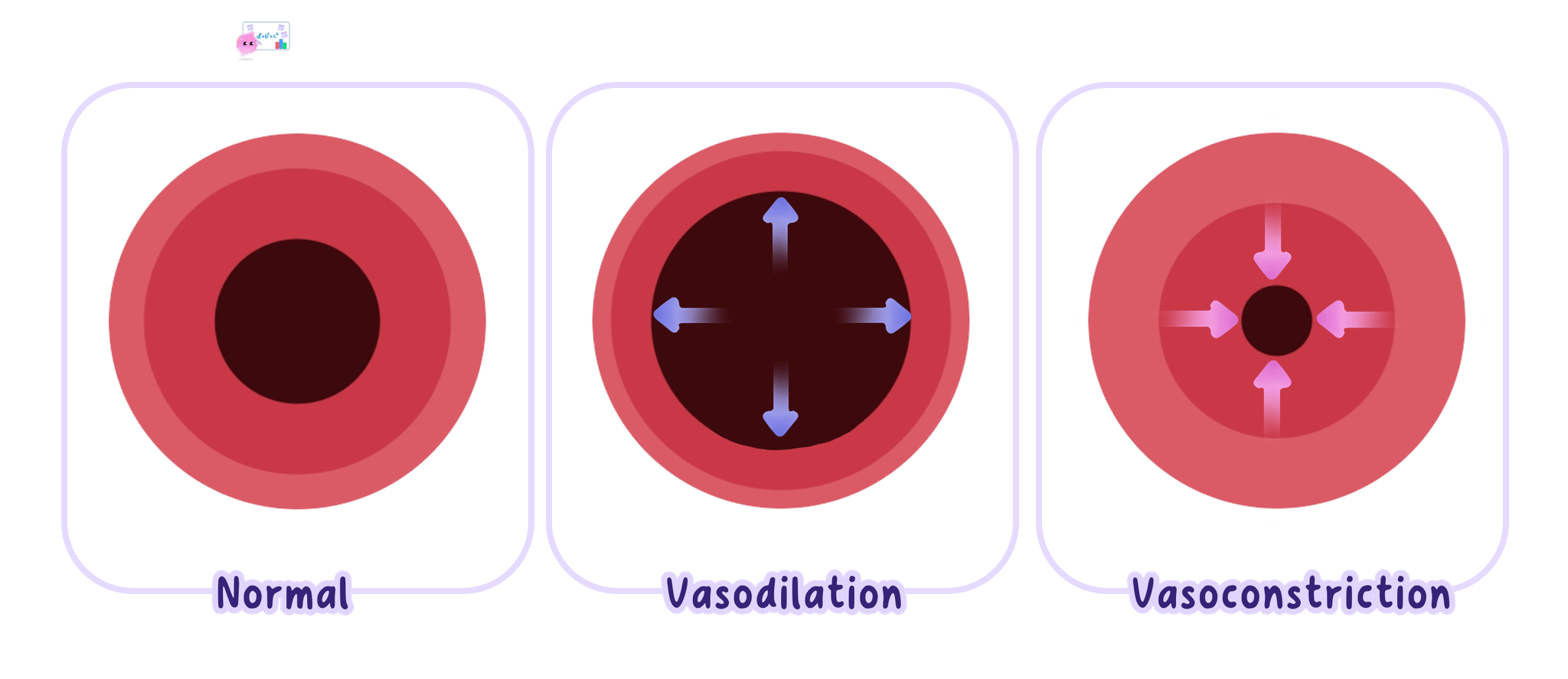
Never say the capillaries dilate or constrict; they have no muscle. It is the blood vessels supplying them that widen or narrow.
Comparing the Responses to Hot and Cold
- When too hot
- Vasodilation increases blood flow to the skin, and sweating increases, so more energy is transferred to the environment.
- When too cold
- Vasoconstriction reduces blood flow to the skin, sweating stops, and shivering releases energy, so less energy is lost and more is made.
- What monitors body temperature, and what is it sensitive to?
- Where else in the body are temperature receptors found?
- Describe the two responses when the body is too hot.
- Describe the three responses when the body is too cold.
- Why is it wrong to say that capillaries dilate or constrict?
5.2.4b Control of body temperature (Higher tier)
How the Cooling Mechanisms Lower Body Temperature
Vasodilation
The widening of the blood vessels that supply the skin capillaries, so more blood flows near the surface and more heat is lost.
- In vasodilation, the blood vessels supplying the skin capillaries widen, so more warm blood flows close to the surface.
- More energy is then transferred from the blood to the environment by radiation, cooling the blood and lowering body temperature.
- Sweat spreads over the skin, and as the liquid water evaporates it takes energy from the skin, which cools the body.
- In humid weather sweat cannot evaporate easily, so it is much harder to cool down.
This topic is Higher tier only.
How the Warming Mechanisms Raise Body Temperature
Vasoconstriction
The narrowing of the blood vessels that supply the skin capillaries, so less blood flows near the surface and less heat is lost.
- In vasoconstriction, the blood vessels supplying the skin capillaries narrow, so less warm blood flows close to the surface and less energy is lost.
- Sweating stops, so almost no energy is lost by evaporation.
- Shivering is the rapid contraction and relaxation of skeletal muscles, which needs extra respiration.
- Respiration is exothermic, so it releases energy that warms the body and raises its temperature.
Cooling responses increase energy transfer away from the body, while warming responses reduce energy loss and release extra energy inside it.
Applying the Mechanisms to a Situation
- A runner on a hot day heats up, so the thermoregulatory centre triggers vasodilation and heavy sweating to transfer energy away and bring the temperature back down.
- Someone standing outside in the cold cools down, so the centre triggers vasoconstriction, stops sweating and causes shivering to reduce energy loss and release energy, raising the temperature back up.
- In each case a change in temperature is detected and then reversed to return the body to about 37 ∘C37\ ^{\circ}\text{C}37 ∘C, which is an example of negative feedback.
- Explain how vasodilation lowers body temperature.
- Explain how sweating cools the body, and why it is harder to cool down in humid weather.
- Explain how vasoconstriction reduces energy loss from the body.
- Explain why shivering raises body temperature.
- Using a cold-weather example, describe how the body returns its temperature to normal.
