Sexual reproduction
Definition
Sexual reproduction
Reproduction involving two parents, in which male and female gametes fuse at fertilisation to produce genetically varied offspring.
- Sexual reproduction takes two parents, one supplying each kind of sex cell.
- A male gamete and a female gamete meet and their nuclei join together, an event called fertilisation.
- In animals these gametes are the sperm and egg, while in flowering plants they are the pollen and egg cell.
- Fertilisation produces a single cell, the zygote, which is the very first cell of the new individual.
- The zygote then keeps dividing by mitosis to build the growing offspring.
- Since its genes come from two different parents mixed together, the offspring shows variation and is never an exact copy of either one.
Example
In humans, a sperm cell from the father fuses with an egg cell from the mother to form a zygote, which then divides by mitosis to grow into a baby.
Asexual reproduction
Definition
Asexual reproduction
Reproduction involving only one parent, with no fusion of gametes, producing genetically identical offspring (clones) by mitosis.
- Asexual reproduction takes just one parent, with no partner involved.
- No sex cells are made and nothing fuses, so there is no fertilisation at all.
- The parent simply grows new cells by mitosis, and these carry exactly the same genes, making the offspring genetically identical to it and to one another.
- A set of such identical offspring from a single parent are known as clones.
- With no genes brought in from a second parent, this kind of reproduction gives no variation.
- The one thing that can make two clones differ genetically is a chance mutation in the DNA.
Common Mistake
Do not say the offspring are only similar to the parent; they are genetically identical clones, because they are made by mitosis from one parent.
Gametes and meiosis
Definition
Meiosis
A type of cell division that produces genetically different haploid gametes, halving the chromosome number of the parent cell.
- Body cells are diploid: they carry two sets of chromosomes.
- Gametes are haploid: they carry only one set of chromosomes, half the number in a body cell.
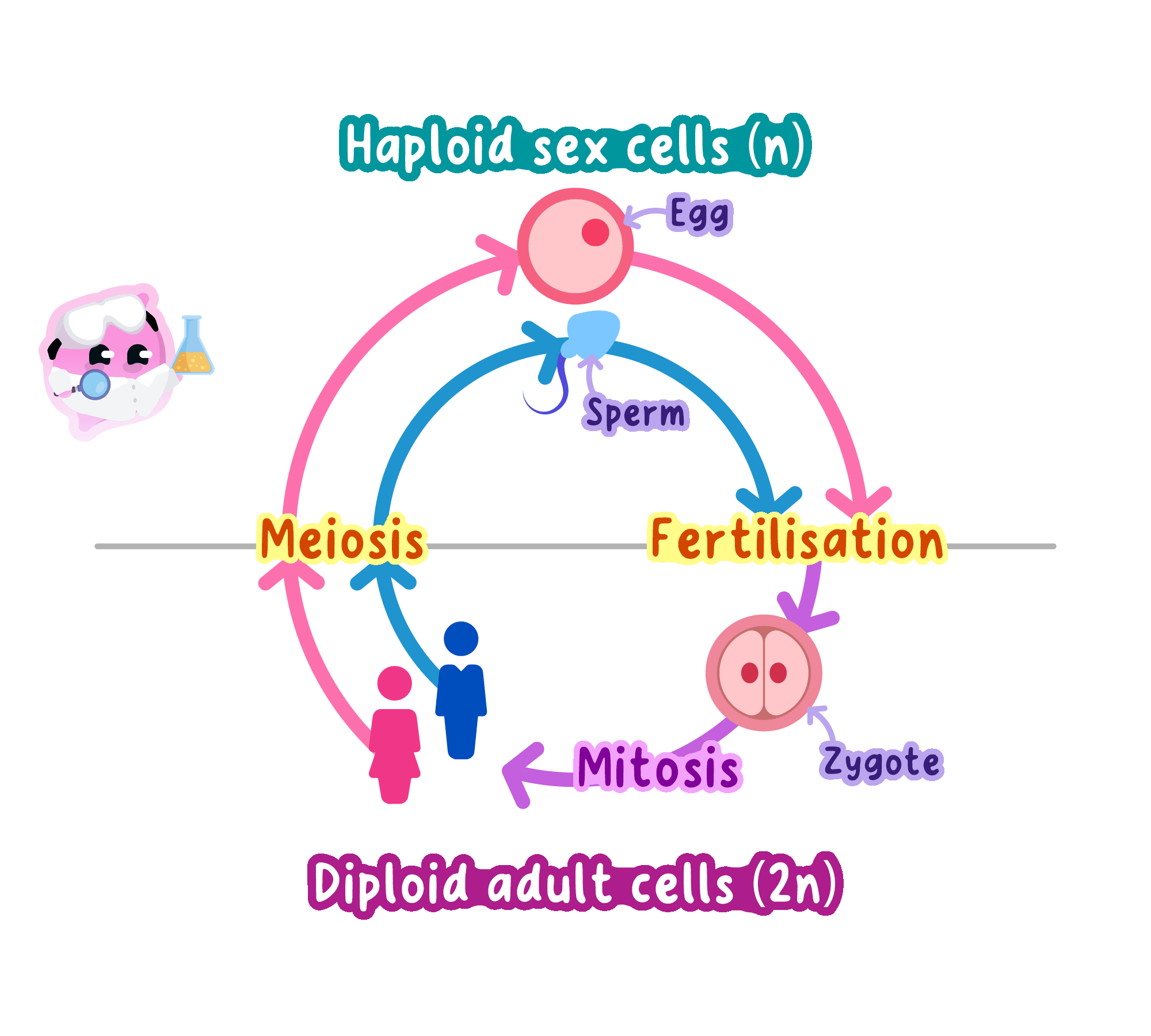
- Gametes are made by a type of cell division called meiosis, which halves the chromosome number.
- The cells meiosis makes are all genetically different from each other, whereas mitosis turns out cells that are exact genetic copies.
- At fertilisation two haploid gametes fuse, which restores the full diploid number.
- This keeps the chromosome number the same from one generation to the next, while combining genetic information from both parents.
- In humans, each body cell has 464646 chromosomes and each gamete has 232323, so fertilisation restores the full 464646 in the zygote.
Self review
- State two differences between sexual and asexual reproduction.
- Name the male and female gametes in animals and in flowering plants.
- Which type of cell division produces gametes, and what does it do to the chromosome number?
- Why are the offspring of asexual reproduction genetically identical?
- What is a clone?
