Selective breeding
Choosing organisms with a desired characteristic and breeding them together over many generations so the characteristic becomes stronger in the offspring. Also called artificial selection.
- In selective breeding, also called artificial selection, people decide which organisms are allowed to breed so that a feature they want is handed on.
- You start by picking out the members of a mixed population that show the wanted feature most strongly.
- Only those chosen individuals are mated with each other.
- Their young are checked, the best examples are picked out again, and those are bred on in turn.
- Repeating this for generation after generation slowly builds a population in which nearly every individual shows the feature.
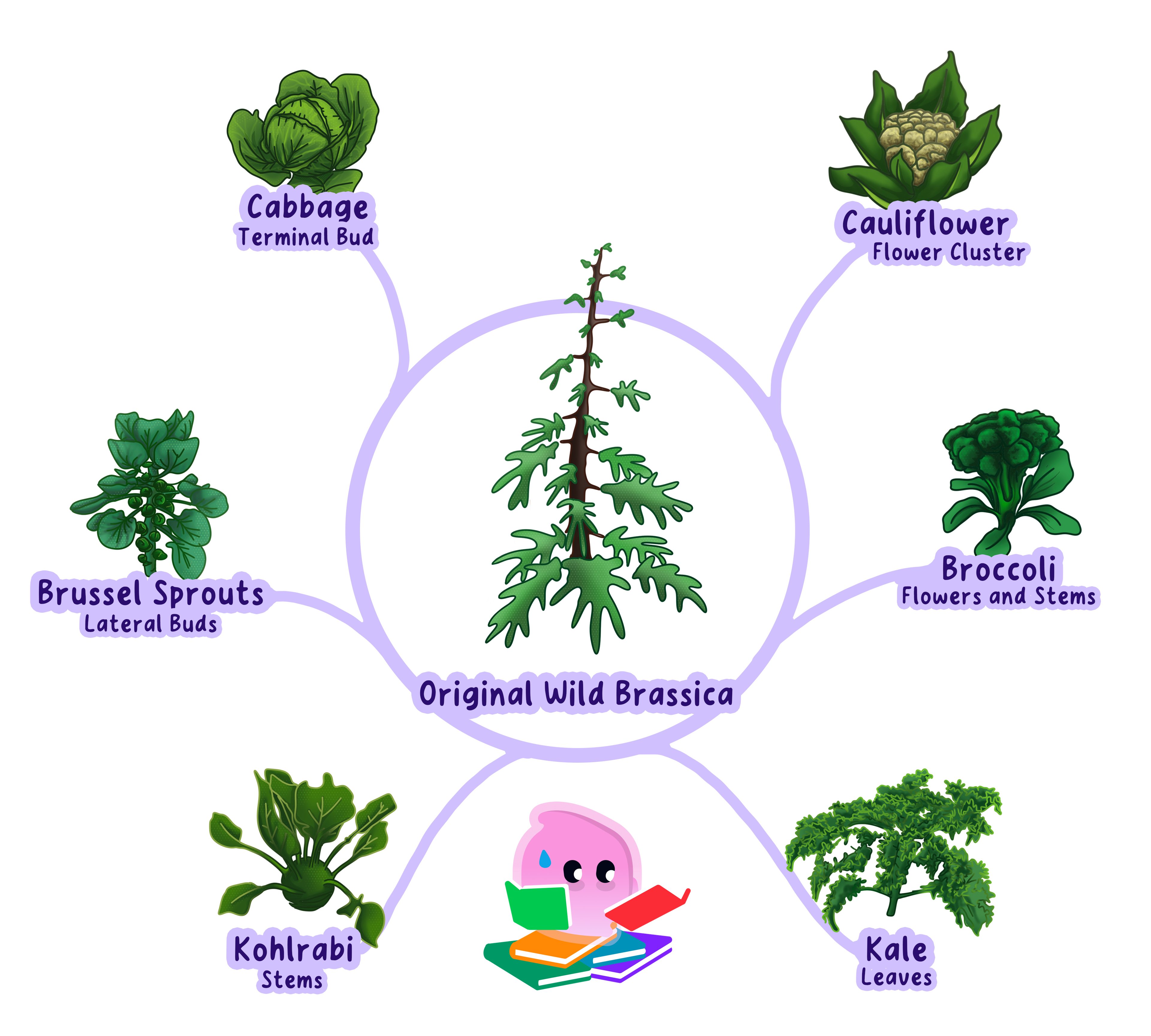
The feature has to be present in the population to begin with; breeding can strengthen an existing variation but cannot invent a brand-new one.
What breeders select for
- Crops that can resist disease so that more of the harvest survives.
- Farm animals that give more meat or more milk.
- Pet dogs bred to be calm and gentle around people.
- Garden plants with unusually large or striking flowers.
Dairy cattle have been bred over many generations by mating the highest-milk cows with bulls whose mothers gave high milk yields.
The risk of inbreeding
Inbreeding
Breeding between closely related organisms, which reduces genetic variation and can lead to inherited defects.
- Breeding close relatives together again and again shrinks the range of alleles left in the population.
- This narrowing of the gene pool is called inbreeding.
- Harmful recessive alleles are then more likely to meet up, so more offspring are born with inherited defects.
- The group also copes badly with a new disease, since the animals or plants are so alike that what harms one tends to harm them all.
Some pedigree dog breeds suffer inherited health problems, such as hip trouble, because breeding for looks narrowed their gene pool.
Do not confuse selective breeding with genetic engineering; selective breeding chooses natural matings and does not move genes directly.
- What is selective breeding also called?
- Describe the repeating steps of selective breeding.
- Give two characteristics that organisms are selectively bred for.
- Why does selective breeding reduce genetic variation?
- Give one problem caused by inbreeding.
