Natural selection
Natural selection
The process by which organisms with alleles best suited to their environment are more likely to survive and reproduce, so those alleles become more common in the population over generations.
- Individuals in a population show variation, and some of it is genetic, caused by different alleles.
- Organisms produce more offspring than the environment can support, so they compete for resources such as food, space and mates.
- Individuals with alleles that make them better adapted to the environment are more likely to survive this competition.
- The survivors are more likely to reproduce and pass on the advantageous alleles to their offspring.
- Over many generations these advantageous alleles become more common, so the population gradually becomes better adapted.
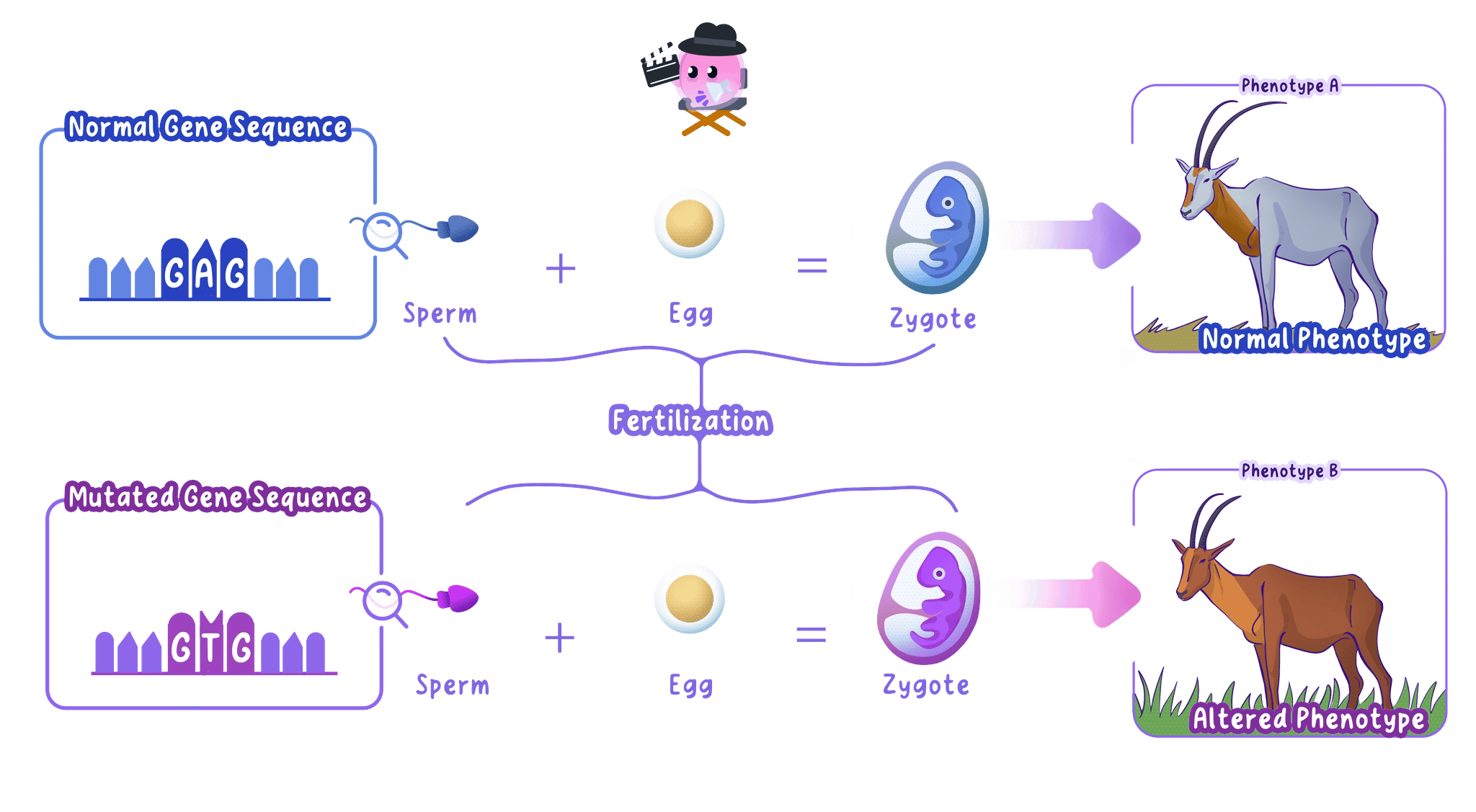
When soot darkened tree bark, dark peppered moths were better camouflaged, survived predation and became more common, while pale moths declined.
Do not say organisms change on purpose to suit their environment; the useful alleles are already present by chance, and selection simply favours them.
Evolution
Evolution
The gradual change in the inherited characteristics of a population over many generations, brought about by natural selection acting on variation.
- Evolution is the way a whole population's inherited features gradually shift over many generations as natural selection keeps favouring the best-suited alleles.
- It is seen at the level of the population, as a change in how common each allele is, not in a single individual.
- An individual cannot change its own alleles to suit the environment; it either has the advantageous alleles or it does not.
- Small changes build up generation after generation, so over long periods a population can become very different from its ancestors.
Evolution has no goal or end point; it simply tracks whatever suits the environment at the time.
Forming a new species
Species
A group of similar organisms that can breed together to produce fertile offspring.
- Sometimes two populations of one species become separated and adapt to different conditions.
- Over many generations their phenotypes change so much that they become very different.
- Once the two groups have drifted so far apart that mating them could no longer produce fertile offspring, they count as two separate species.
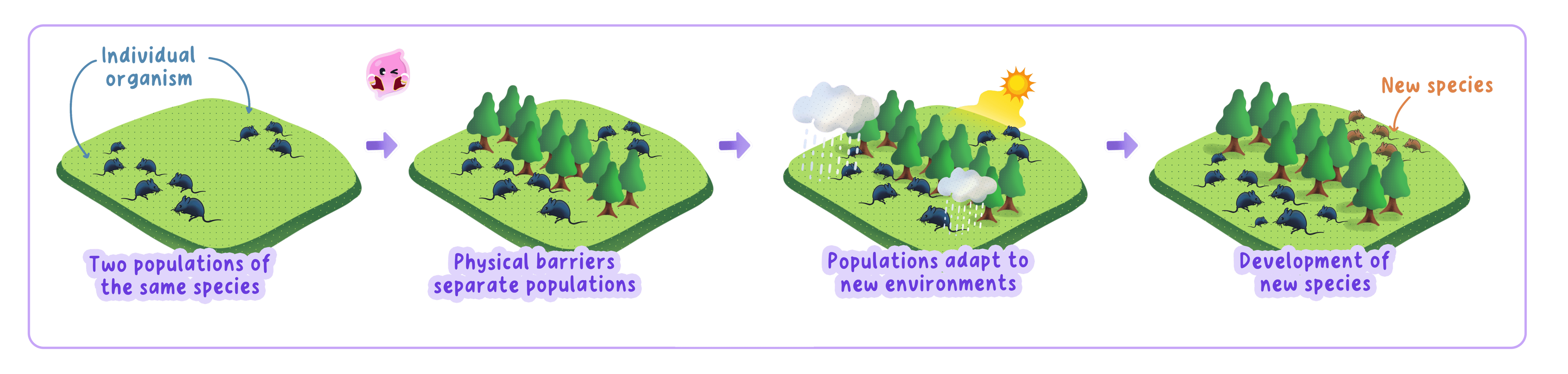
Natural selection changes a population over generations, and enough change can split one species into two.
- List the steps of natural selection in order.
- Why do organisms compete?
- Define evolution.
- Why is it wrong to say an animal changes its body to suit its environment?
- When are two populations considered to be two different species?
