Skip to content

Course home

7.4.1 Trophic levels

7.4.1 Trophic levels

Definition

Trophic level

The position of an organism in a food chain, shown by a number starting at 1 for the producers.

  1. Each organism in a food chain belongs to a trophic level, shown by a number that starts at 1.
  2. Level 1 is the producers, which make biomass by photosynthesis.
  3. Level 2 is the primary consumers, the herbivores that eat producers.
  4. Level 3 is the secondary consumers, carnivores that eat the primary consumers.
  5. Level 4 is the tertiary consumers, carnivores that eat the secondary consumers.
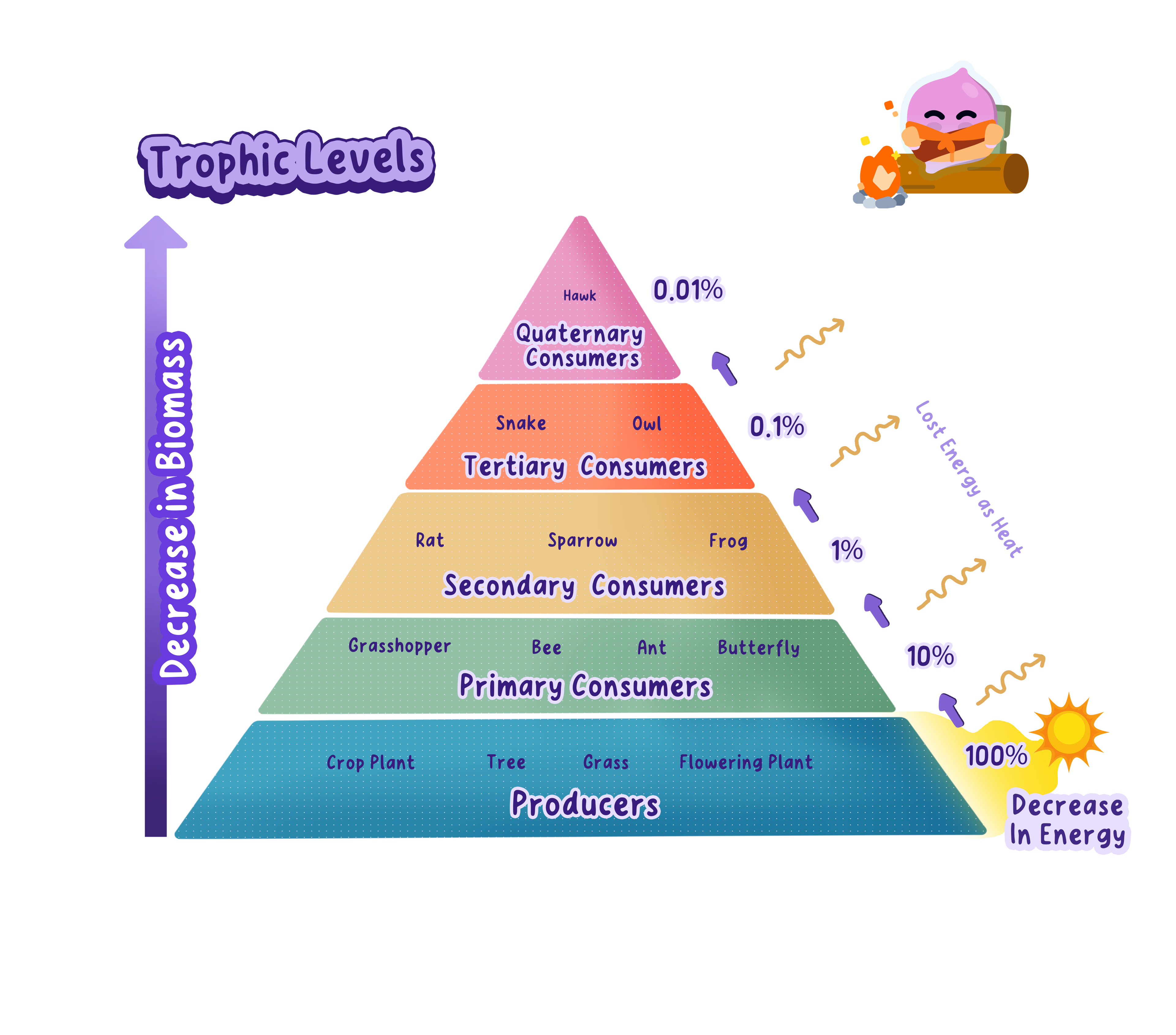
A food chain drawn as trophic levels: a producer at level 1, a herbivore at level 2, and carnivores at levels 3 and 4, each eating the level below.

Key Idea

The numbers rise along the chain: producers are level 1, and each animal that eats the one before is the next level up.

Producers, consumers and apex predators

Definition

Consumer

An organism that gets its energy by eating other organisms rather than by making its own food.

  1. Producers are green plants and algae that make their own food and start every food chain.
  2. Consumers eat other organisms; the primary consumers are usually herbivores and the later ones are carnivores.
  3. Apex predators are carnivores at the top of a food chain, with no predators of their own.

Decomposers

Definition

Decomposer

A microorganism, such as a bacterium or fungus, that breaks down dead organisms and waste, returning carbon dioxide to the air and mineral ions to the soil.

  1. Decomposers are bacteria and fungi that break down the dead bodies and waste of organisms from every trophic level.
  2. They release enzymes that digest the dead material, then absorb the nutrients.
  3. This returns carbon and mineral ions to the environment for producers to use again.
Self review
  • What is a trophic level?
  • Which trophic level are producers, and how do they make biomass?
  • What is an apex predator?
  • How do decomposers return nutrients to an ecosystem?

PreviousNext

How was this guide?

Teach Genie

Review 7.4.1 Trophic levels by teaching Genie

Teach it back in your own words, spot gaps, and remember it better.

Start teaching
Genie and Baby Genie

Lesson

Recap your knowledge with an interactive lesson

7 minute activity

Start lesson

A trophic level is the position of an organism in a food chain. The numbering starts at 1 for producers and increases by one each time an organism eats the organism below it.

Level 1 contains producers such as green plants and algae. They make biomass by photosynthesis, so they start every food chain.

Level 2 contains primary consumers, usually herbivores. Level 3 contains secondary consumers, which eat primary consumers, and level 4 contains tertiary consumers, which eat secondary consumers. Organisms at every trophic level produce waste and eventually die. This waste and dead material flow from the organisms to decomposers. Decomposers break down the material and return mineral nutrients to the environment, where producers can absorb them.

Flashcards

Remember key concepts with flashcards

20 flashcards

Practice flashcards

Which trophic level contains producers?

7.4.1 Trophic levels Revision Guide

  1. GCSE
  2. /Biology
  3. /7.4.1 Trophic levels

Revision notes for AQA GCSE Biology 7.4.1 Trophic levels. Open the guide for explanations and worked examples. Written against the AQA GCSE Biology (8461) specification, so the content matches what's examinable rather than general Biology background.