Question 3
FA student investigated the antibacterial chemicals made by three plants.
The student spread bacteria over the surface of an agar plate. Three paper discs were each soaked in an extract from a different plant. A fourth disc was soaked in distilled water. The four discs were placed on the agar and the plate was left for two days.
The figure shows the agar plate after two days.
Figure: An agar plate spread with bacteria, showing the clear zones around four paper discs after two days
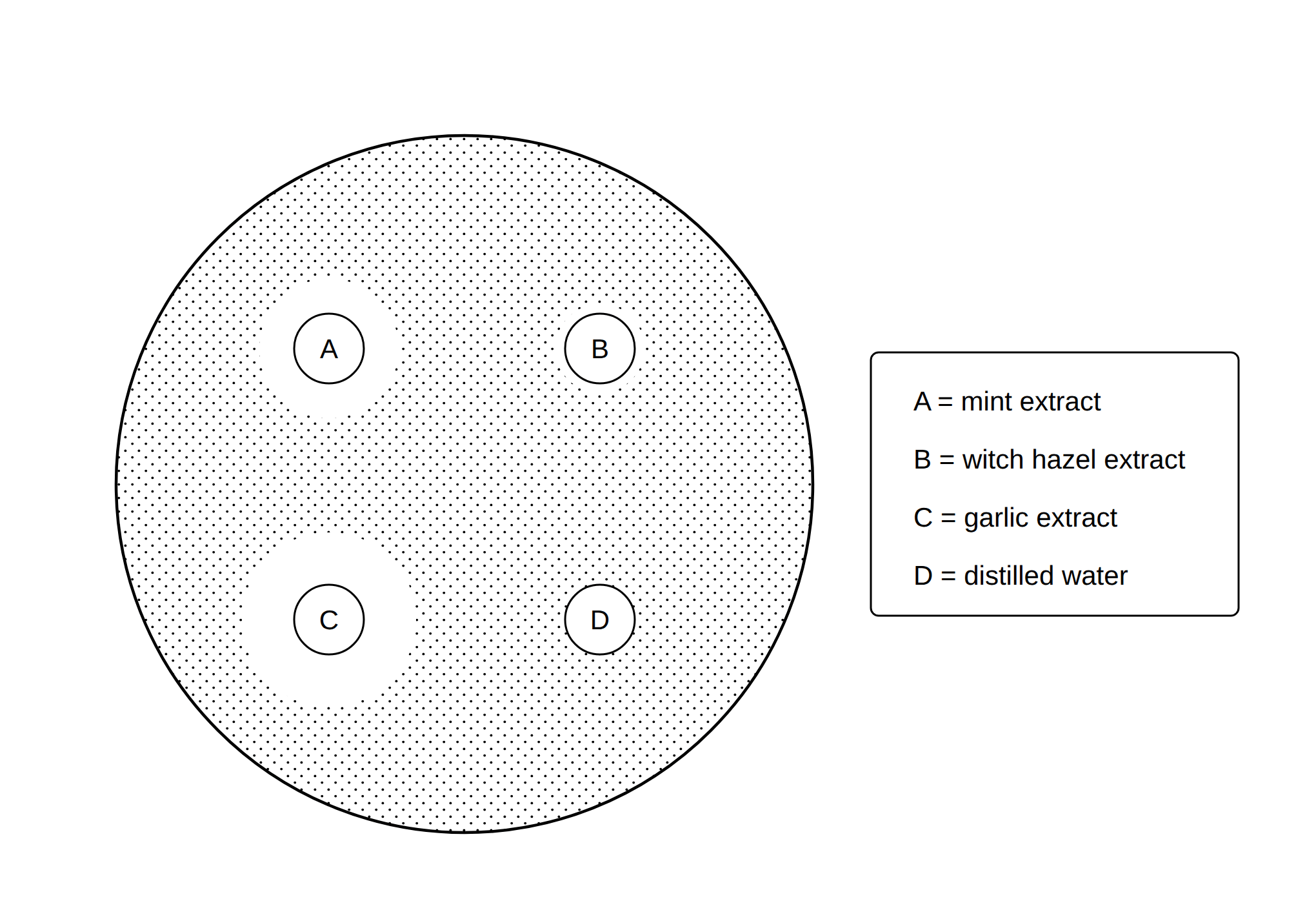
The student measured the diameter of the clear zone around each disc three times. The table shows the results.
Table: The diameter of the clear zone around each of the four discs, measured three times
| Disc | Diameter of the clear zone in mm, measurement 1 | Diameter of the clear zone in mm, measurement 2 | Diameter of the clear zone in mm, measurement 3 |
|---|---|---|---|
| A | 14 | 15 | 13 |
| B | 9 | 21 | 10 |
| C | 18 | 19 | 17 |
| D | 0 | 0 | 0 |
a.[1]
Give the purpose of disc D.
b.[2]
One measurement for disc B is anomalous. Identify the anomalous measurement and give what the student should do with it.
c.[2]
Calculate the mean diameter of the clear zone for disc B. Do not include the anomalous measurement.
d.[3]
The clear zones show where the bacteria have not grown.
Explain what these results show about the chemicals made by the three plants.
e.[1]
Suggest one way in which making antibacterial chemicals is an advantage to these plants.
3.3 Plant disease Questions
57 exam-style questions on AQA GCSE Biology 3.3 Plant disease, covering 3.3.1 Detection and identification of plant diseases and 3.3.2 Plant defence responses. Each one has a worked solution and a mark scheme showing where the marks go.