3.3.1a Detection and identification of plant diseases
Plants Are Attacked by Pathogens and Pests
Pathogen
A microorganism that causes disease. Plant pathogens include viruses, bacteria and fungi.
- Like animals, plants can be infected by pathogens: viruses, bacteria and fungi.
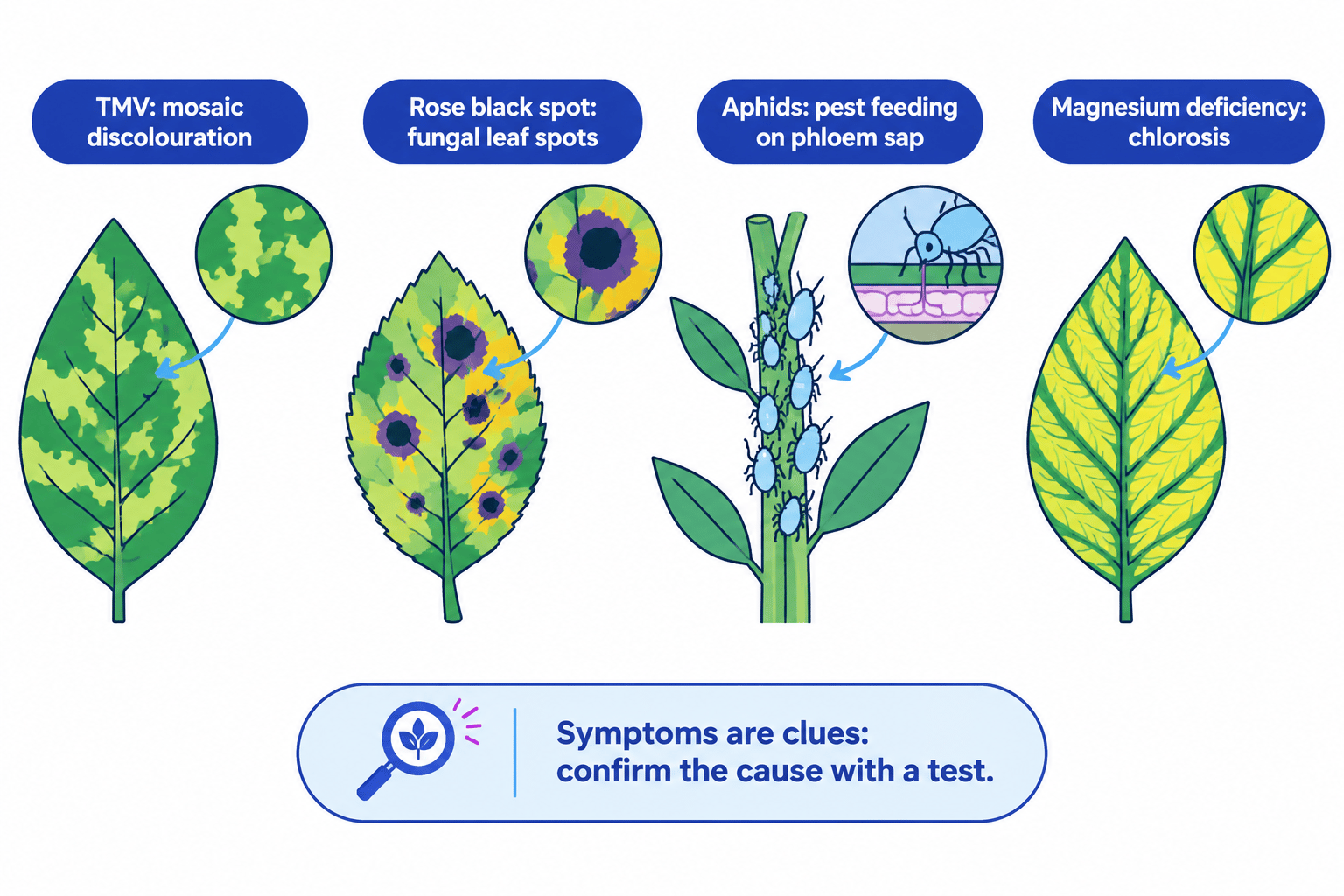
- For AQA you need three examples: tobacco mosaic virus (viral), rose black spot (fungal) and aphids (an insect pest).
- Tobacco mosaic virus (TMV) gives leaves a mosaic pattern of pale, discoloured patches, so the plant photosynthesises less and grows poorly.
- Rose black spot is a fungus that makes purple or black spots on leaves, which then turn yellow and drop, reducing photosynthesis.
Anything that stops a plant photosynthesising well, whether a virus, a fungus or a pest, reduces its growth and its crop.
Aphids Are a Major Insect Pest
Aphid
A small insect pest that pierces the phloem and feeds on sugary sap, weakening the plant and acting as a vector that spreads pathogens between plants.
- Aphids are small insects that pierce the phloem with sharp mouthparts and feed on the sugary phloem sap.
- They attack in huge numbers, taking the sugars the plant made in photosynthesis, so the plant is weakened.
- Aphids also act as vectors, carrying viruses, bacteria and fungi from diseased plants to healthy ones on their mouthparts.
- Other pests, such as nematode worms and insect larvae in the soil, damage roots so the plant cannot take up water and mineral ions well.
Aphids can be controlled with pesticides, or in a greenhouse by biological control, such as releasing ladybirds that eat them.
Mineral Deficiencies Cause Non-Communicable Diseases
Mineral deficiency
A non-communicable plant disorder caused by a shortage of a mineral ion in the soil, such as too little nitrate or magnesium.
- Not every plant disease is caused by a pathogen; some are caused by a lack of mineral ions in the soil.
- These are non-communicable: they are not passed from one plant to another.
- Plants need nitrate ions to make proteins for growth, in protein synthesis.
- A nitrate deficiency limits protein production, so the plant shows stunted growth.
For AQA, link each ion to its exact job: nitrate ions for protein synthesis and growth, magnesium ions for making chlorophyll.
Magnesium Deficiency Causes Chlorosis
Chlorosis
The yellowing of a plant's leaves caused by too little chlorophyll, a sign of magnesium deficiency.
- Plants need magnesium ions to make chlorophyll, the green pigment used in photosynthesis.
- Without enough magnesium, the plant cannot make enough chlorophyll.
- The leaves turn yellow, a condition called chlorosis, and growth slows because photosynthesis falls.
- If the missing ions are added back, for example with a fertiliser, the plant can recover; if not, it may die.
A houseplant with leaves yellowing between green veins is often short of magnesium, and a dose of fertiliser greens it up again.
Comparing the Two Types of Plant Disease
- Communicable diseases are caused by pathogens such as TMV and black spot, or by pests such as aphids, and can spread between plants.
- Non-communicable diseases are caused by mineral deficiencies and do not spread.
- Nitrate deficiency stunts growth, while magnesium deficiency causes chlorosis.
- Name the AQA examples of a viral, a fungal and an insect plant disease.
- How do aphids damage a plant?
- Why does a nitrate deficiency stunt growth?
- What is chlorosis, and which ion deficiency causes it?
- Give one difference between a communicable and a non-communicable plant disease.
3.3.1b Detection and identification of plant diseases (Higher tier)
Spotting the Signs of a Diseased Plant
Pathogen
A microorganism that causes disease. Plant pathogens include viruses, bacteria and fungi.
- The sooner a disease is spotted, the sooner the plant can be treated or removed to stop it spreading.
- Seven signs that a plant may be diseased.
- Stunted growth, for example from a nitrate deficiency.
- Spots on the leaves, for example rose black spot.
- Areas of decay or rot on stems, leaves or fruit.
- Growths, such as galls caused by some infections.
- Malformed stems or leaves, for example from aphid or nematode attack.
- Discolouration, such as chlorosis or the mosaic pattern of tobacco mosaic virus.
- The presence of pests, such as visible aphids or caterpillars.
Many diseases cause similar signs, so the symptoms are only the first clue and do not on their own tell you the exact cause.
Identifying the Cause of the Disease
Monoclonal antibody
An antibody produced from identical cells that binds to one specific target, used in testing kits to detect a particular plant pathogen.
- Once the signs are seen, the exact cause is identified in three main ways.
- Comparing the symptoms with a gardening manual or website.
- Taking the infected plant to a laboratory, where scientists identify the pathogen, for example using DNA analysis.
- Using a testing kit that contains monoclonal antibodies, which bind to one specific pathogen and show whether it is present.
Monoclonal antibody kits give a fast, specific result and can be used out in the field, not just in a laboratory.
Why Fast Detection Matters
- Fast detection means treatment can start early, when it is most likely to work.
- It also lets diseased plants be removed quickly to stop the pathogen spreading.
- Signs such as spots, decay, growths, discolouration and visible pests point to a problem.
- The exact pathogen is then identified using a manual, a laboratory, or a monoclonal antibody testing kit.
- Give four signs that a plant may be diseased.
- Why is it important to detect a plant disease early?
- Name three ways to identify the cause of a plant disease.
- What do monoclonal antibody testing kits detect?