Differentiation Turns Unspecialised Cells into Specialised Ones
Definition
Differentiation
The process by which an unspecialised cell gains the sub-cellular structures it needs to become a specialised cell.
- As an organism develops, its cells differentiate to form the different types of cell it needs.
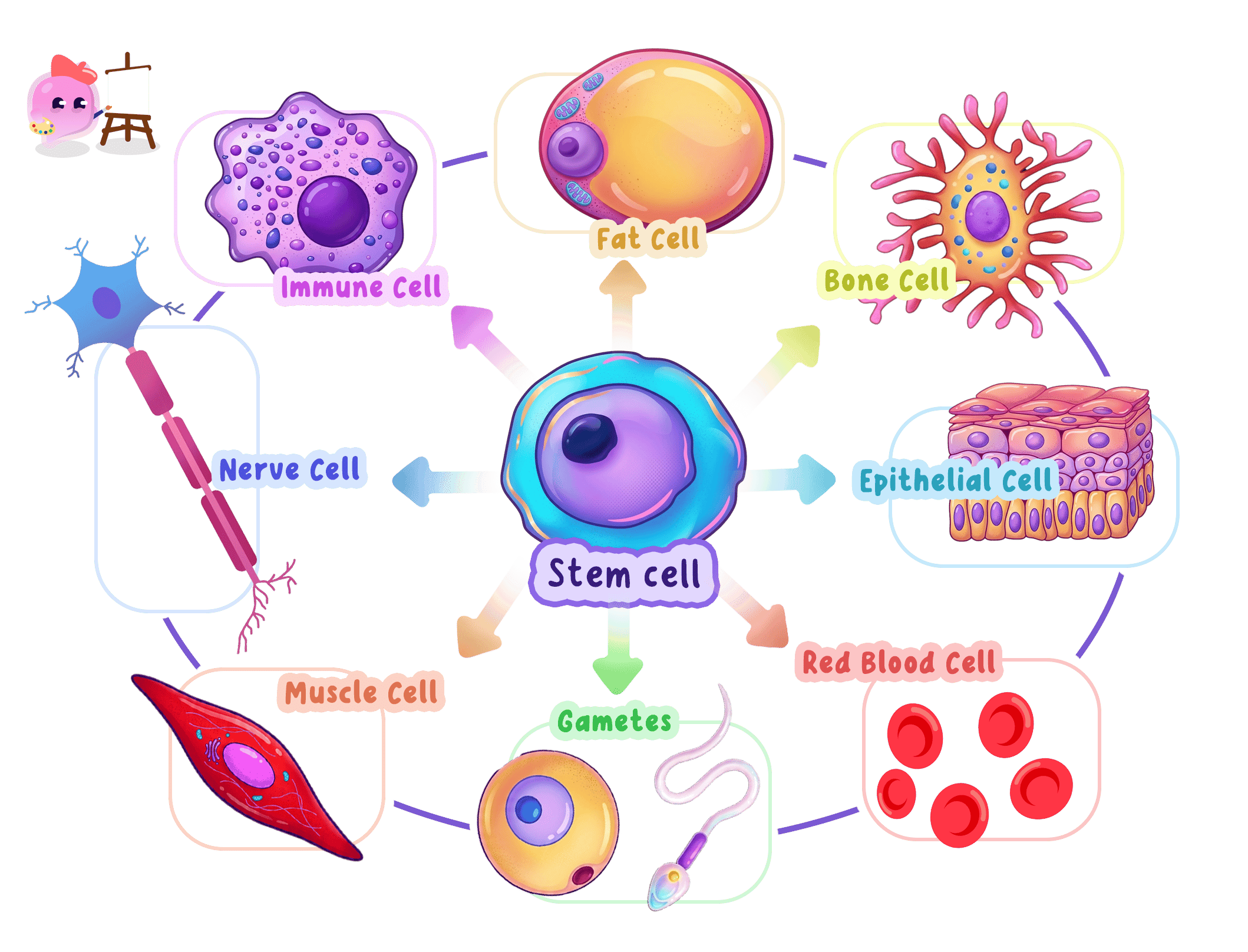
- Differentiation is the process by which an unspecialised cell gains the sub-cellular structures it needs for a particular job.
- As it differentiates, a cell may change shape and gain more of certain organelles, becoming a specialised cell.
- Differentiation matters because it lets one fertilised egg build all the specialised cells of a whole organism.
- Unspecialised cells that can still divide and differentiate into other cell types are called stem cells.
Example
- To become a nerve cell, an unspecialised cell grows long extensions of cytoplasm to carry impulses.
- To become a muscle cell, it gains extra mitochondria and protein fibres so it can contract.
Animals and Plants Differentiate at Different Times
Definition
Specialised cell
A cell whose structure is adapted to carry out a particular function, such as a sperm, nerve or root hair cell.
- In animals, most cells differentiate at an early stage while the organism is developing.
- Once an animal cell has specialised, it usually loses the ability to differentiate into other types of cell.
- In mature animals, cell division is mainly restricted to the repair and replacement of cells.
- Many plant cells keep the ability to differentiate throughout the plant's life.
- Mature animal cells still divide for growth, repair and replacement, but mostly cannot change into a different type of cell.
Self review
- What is cell differentiation?
- What does a cell gain as it differentiates?
- At what stage do most animal cells differentiate?
- What is cell division mainly used for in mature animals?
- How does differentiation in plants differ from differentiation in animals?
