Respiration Transfers Energy in Every Living Cell
- Respiration is the process that transfers energy from glucose in every living cell.
- It happens continuously, in animals, plants and microorganisms.
- It is an exothermic reaction, so it transfers energy to the surroundings.
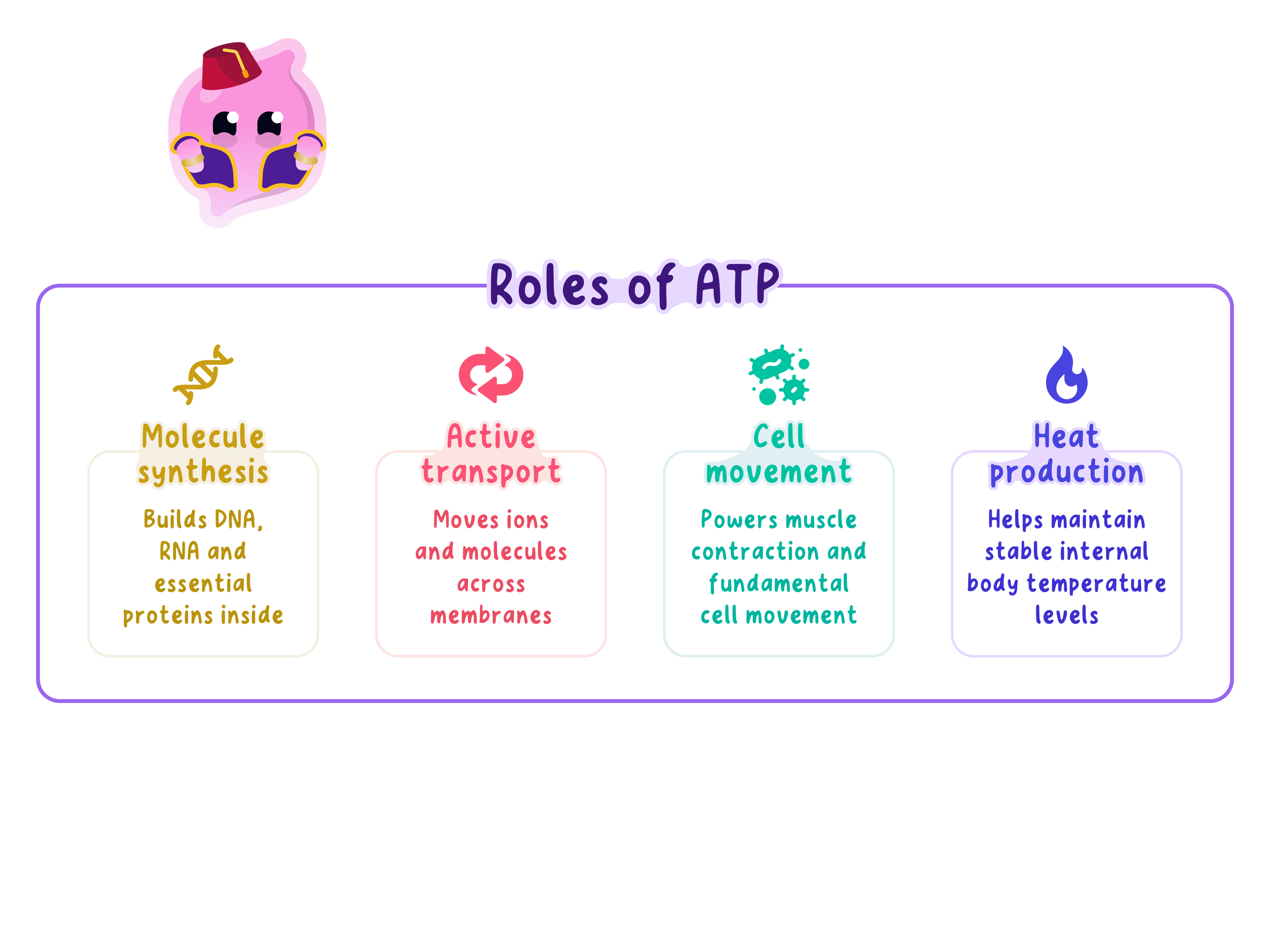
- Organisms need this energy to build larger molecules, to move, and, in mammals and birds, to keep warm.
- Respiration can be aerobic, using oxygen, or anaerobic, without oxygen.
Respiration is not the same as breathing: it is the chemical reaction inside cells that transfers energy from glucose.
Aerobic Respiration Uses Oxygen
Aerobic respiration
Respiration that uses oxygen to break glucose down completely, transferring a large amount of energy and releasing carbon dioxide and water.
- Aerobic respiration uses oxygen to break glucose down completely.
- It transfers a large amount of energy and takes place mainly in the mitochondria.
- It produces carbon dioxide and water as waste products.
- glucose+oxygen→carbon dioxide+water\text{glucose} + \text{oxygen} \rightarrow \text{carbon dioxide} + \text{water}glucose+oxygen→carbon dioxide+water
- C6H12O6+6O2→6CO2+6H2O\text{C}_6\text{H}_{12}\text{O}_6 + 6\text{O}_2 \rightarrow 6\text{CO}_2 + 6\text{H}_2\text{O}C6H12O6+6O2→6CO2+6H2O
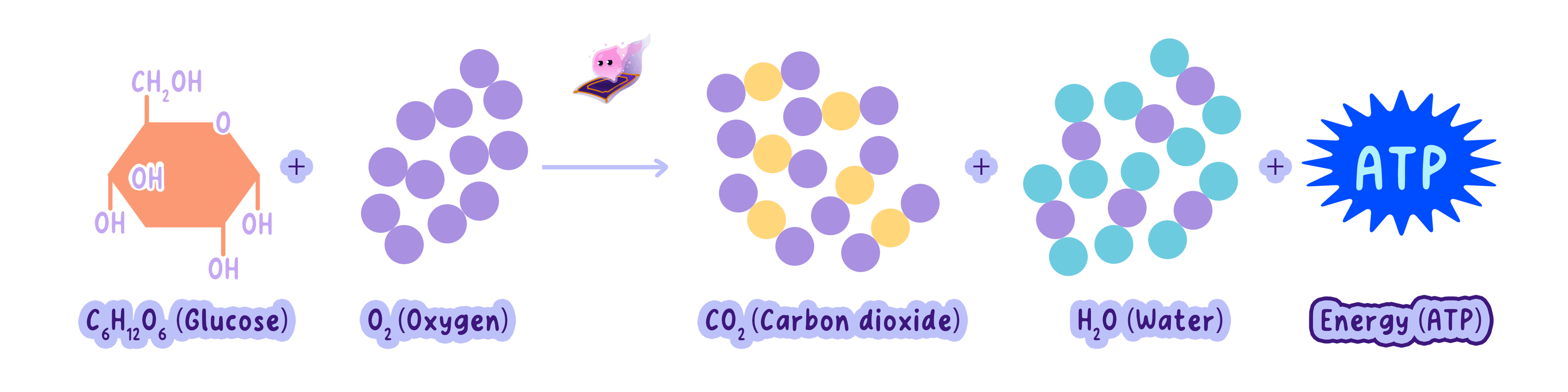
You should recognise the symbols: glucose is C6H12O6\text{C}_6\text{H}_{12}\text{O}_6C6H12O6, oxygen is O2\text{O}_2O2, carbon dioxide is CO2\text{CO}_2CO2 and water is H2O\text{H}_2\text{O}H2O.
Anaerobic Respiration in Muscles
Anaerobic respiration
Respiration without oxygen that breaks glucose down incompletely, transferring much less energy than aerobic respiration.
- When muscles cannot get enough oxygen, they respire anaerobically, without oxygen.
- The glucose is broken down incompletely, so much less energy is transferred than in aerobic respiration.
- The only product is lactic acid.
- glucose→lactic acid\text{glucose} \rightarrow \text{lactic acid}glucose→lactic acid
Anaerobic respiration transfers much less energy than aerobic respiration because the glucose is only partly broken down.
Anaerobic Respiration in Plants and Yeast
Fermentation
Anaerobic respiration in yeast, which produces ethanol and carbon dioxide and is used to make bread and alcoholic drinks.
- Plant cells and yeast can also respire without oxygen.
- In plants and yeast, anaerobic respiration produces ethanol and carbon dioxide.
- glucose→ethanol+carbon dioxide\text{glucose} \rightarrow \text{ethanol} + \text{carbon dioxide}glucose→ethanol+carbon dioxide
- Anaerobic respiration in yeast is called fermentation.
- Fermentation is economically important, because it is used to make bread and alcoholic drinks.
In bread-making, the carbon dioxide from yeast fermentation makes the dough rise.
Comparing Aerobic and Anaerobic Respiration
- Oxygen:
- Aerobic respiration needs oxygen, while anaerobic respiration does not.
- Breakdown of glucose:
- Aerobic respiration breaks glucose down completely, while anaerobic respiration breaks it down only partly.
- Energy transferred:
- Aerobic respiration transfers much more energy than anaerobic respiration.
- Products:
- Aerobic respiration makes carbon dioxide and water, while anaerobic respiration makes lactic acid in animals, or ethanol and carbon dioxide in plants and yeast.
- Give the word equation and the symbol equation for aerobic respiration.
- What is the product of anaerobic respiration in muscles?
- Write the word equation for anaerobic respiration in yeast.
- Why does anaerobic respiration transfer less energy than aerobic respiration?
- Give three things organisms need the energy from respiration for.