What you'll learn
- How sociologists define gender roles, domestic labour and power relationships in families.
- The main debates about whether families are becoming more equal or remain shaped by patriarchy.
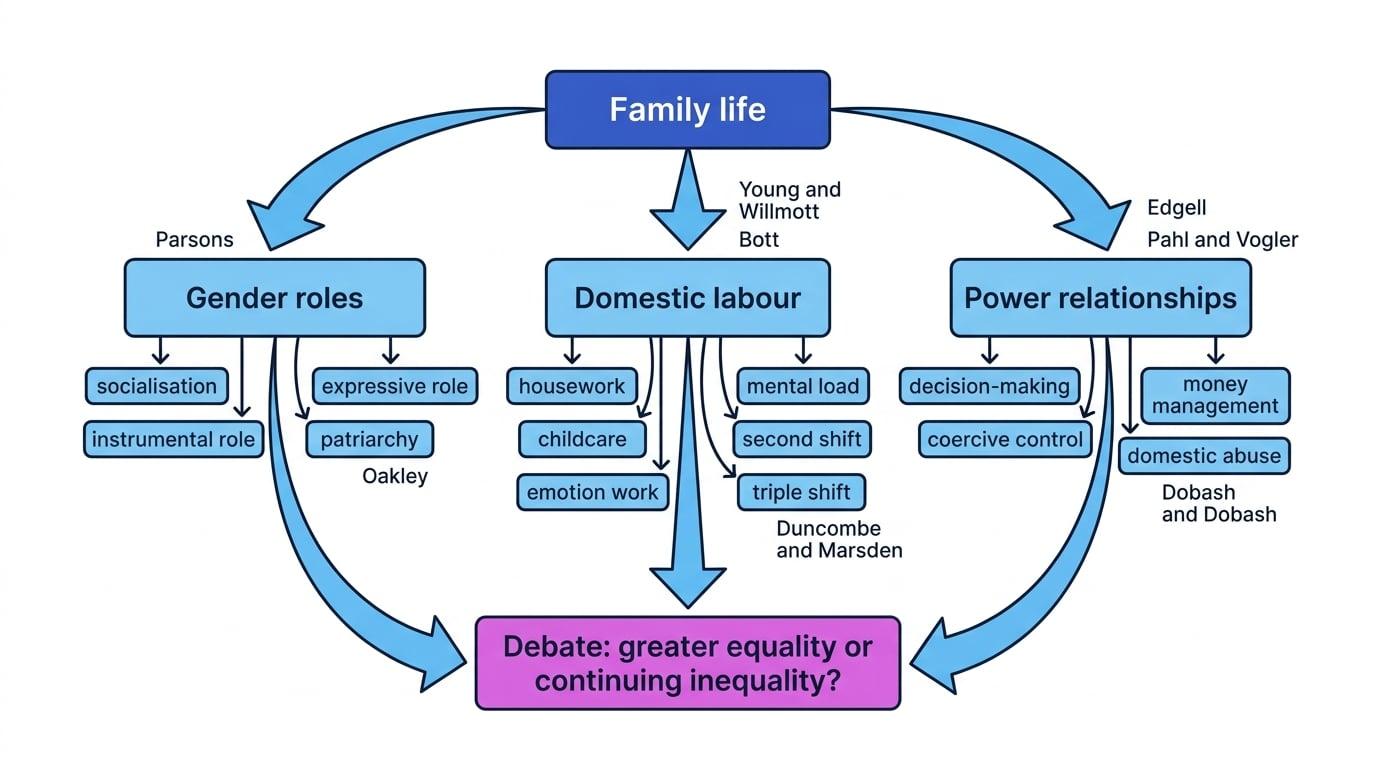
- Key studies including Parsons, Young and Willmott, Oakley, Duncombe and Marsden, Edgell, Pahl and Vogler, and Dobash and Dobash.
- How to evaluate evidence using AO1, AO2 and AO3 in essay-style answers.
The big picture
This topic is about everyday family life: who cooks, cleans, earns, cares, decides, manages money, comforts others and holds power. It links strongly to the core themes of socialisation, culture and identity because people learn ideas about “masculine” and “feminine” behaviour. It also links to social differentiation, power and stratification because gender inequalities often overlap with class, ethnicity, sexuality, age and disability.
Core terms
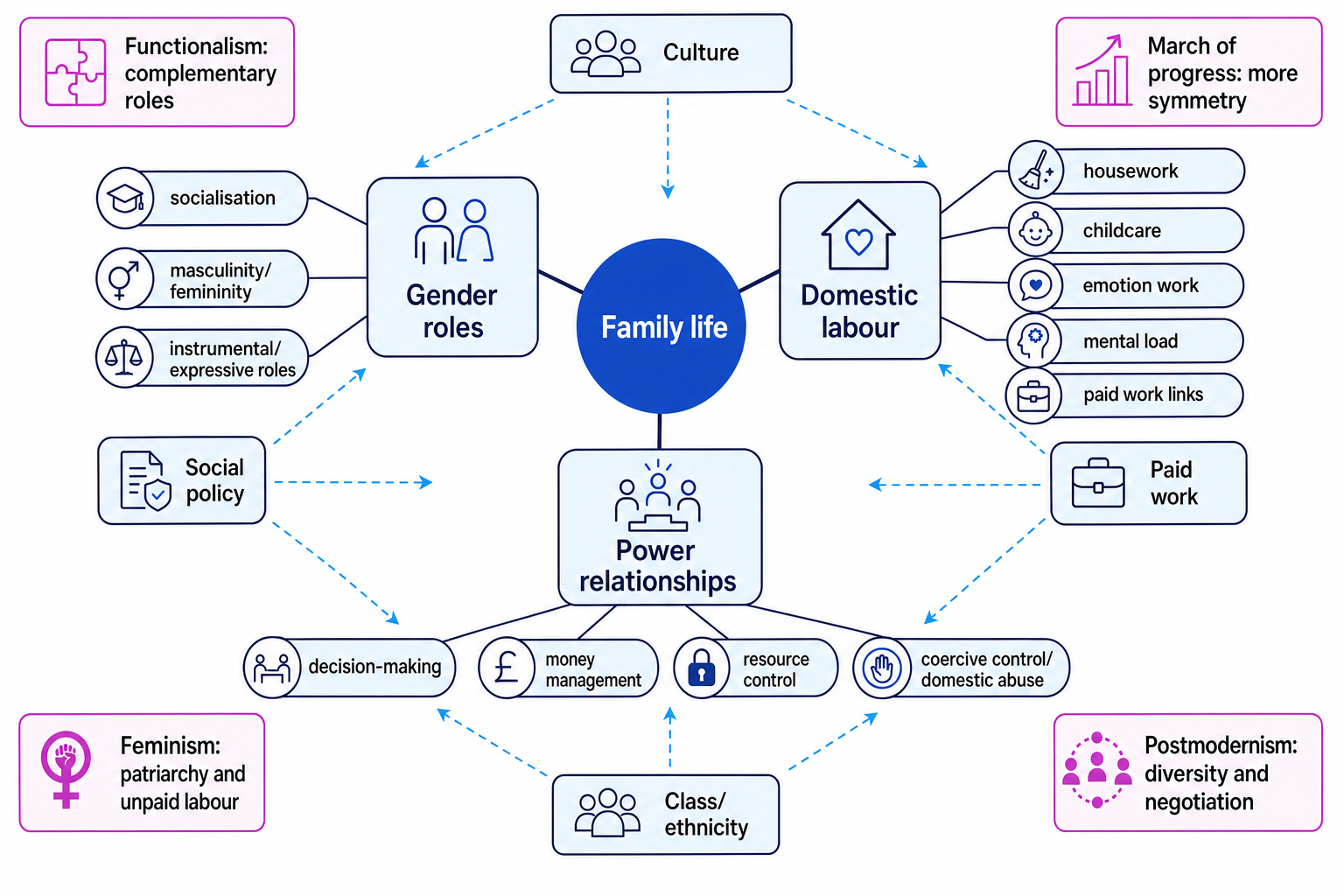
- Gender roles are the socially expected behaviours associated with being male or female, such as expectations that women should be caring or men should be breadwinners.
- Domestic labour means unpaid work done in the home, including housework, childcare, caring for relatives, shopping, cooking and organising family life.
- Power relationships are patterns of control and influence within families, including decision-making, control over money, emotional control and, in extreme cases, coercive control or domestic abuse.
- Patriarchy means a system of male dominance in society and social institutions, including the family.
Gender roles: learned, not natural
A starting point is that sociologists usually treat gender roles as socially constructed. This means they are created and maintained through social life, not simply biologically fixed. Children learn gender expectations through primary socialisation in the family and secondary socialisation in schools, peer groups, media and religion.
For example, children may see mothers taking more responsibility for meals and fathers doing DIY or earning more. Even if parents do not intend to teach inequality, repeated patterns can shape a child’s sense of what is “normal”.
Functionalism: complementary roles
Parsons argued that the nuclear family works best when adults perform different but complementary roles. He described the male instrumental role as earning money and connecting the family to the outside world. He described the female expressive role as caring, nurturing and stabilising family members emotionally.
This is a consensus view because it sees role division as beneficial for family stability. However, feminists criticise Parsons for presenting gender inequality as natural and functional, rather than asking who benefits from women’s unpaid labour.
Treating Parsons as evidence of equality
Parsons is not saying men and women have equal power. He is arguing that different roles are functionally useful. In evaluation, you can challenge this by asking whether “different” roles are actually unequal roles.
Feminism: gender roles reproduce inequality
Oakley criticised the idea that women’s domestic role is natural. She argued that the “housewife role” is socially created and reinforced through gender socialisation, advertising, education and family expectations. For Oakley, the family can reproduce patriarchy by making women responsible for unpaid care and housework.
This matters today because even where women are in paid work, they may still be expected to organise birthdays, school forms, dentist appointments, meals and emotional support. This is often called the mental load.
Gender roles are about culture and power
Gender roles are not just private preferences. They are cultural expectations that can shape identity, opportunities and unequal power inside the family.
Conjugal roles: who does what in couples?
Conjugal roles are the roles performed by partners in a marriage or cohabiting relationship.
Bott distinguished between:
- Segregated conjugal roles, where partners have clearly separate tasks and leisure activities.
- Joint conjugal roles, where partners share tasks, decisions and leisure more equally.
Young and Willmott developed a “march of progress” view. They argued that the family was moving towards the symmetrical family, where partners become more similar in their roles, both contributing to paid work, housework, childcare and leisure.
They linked this to social changes such as women’s increased employment, labour-saving domestic technology, smaller families and more home-centred leisure.
Classifying conjugal roles
A couple both work full-time. One partner cooks, cleans, arranges childcare and remembers family appointments. The other partner does occasional DIY and manages the car.
- Compare the range of tasks each partner performs. The first partner is doing routine, frequent and time-sensitive tasks, while the second is doing occasional tasks.
- Decide whether the roles are genuinely joint. Although both may “help”, the everyday responsibility is not equally shared, so this is closer to segregated than symmetrical.
- Add evaluation. A march of progress sociologist might see improvement if both partners are in paid work, but a feminist would argue that paid work alone does not prove equality if unpaid labour remains unequal.
Domestic labour: housework, childcare and the “second shift”
Domestic labour includes visible tasks like cooking and cleaning, but also less visible tasks like planning meals, remembering appointments and emotionally supporting family members.
Hochschild used the idea of the second shift to describe how women may do paid work and then come home to unpaid domestic work. Duncombe and Marsden developed the idea of the triple shift, where women may do paid work, housework and emotional work.
Emotion work means managing other people’s feelings, such as soothing children, supporting a partner or maintaining family relationships. This connects directly to socialisation and identity: women are often expected to be “naturally” caring, which can make their labour seem invisible.
Evidence of change and continuity
There is evidence of change. Studies such as Gershuny and Sullivan suggest that men’s contribution to housework and childcare has increased over time, especially where women are in paid employment. Contemporary UK examples include more fathers attending school events, taking paternity leave, and being involved in childcare.
However, there is also strong evidence of continuity. ONS time-use data has repeatedly shown that women still tend to do more unpaid work overall. The gap may narrow, but narrowing is not the same as disappearing.
Boulton argued that men may “help” with childcare, but women often retain overall responsibility. This is a crucial distinction: doing a task is not the same as carrying responsibility for ensuring it gets done.
A useful essay distinction
Separate participation from responsibility. A partner may participate in childcare, but the other partner may still be responsible for planning, organising and noticing what needs doing.
Power relationships: decisions, money and control
Power in families is not only about who does chores. It also includes who makes decisions, who controls money, and whose needs take priority.
Decision-making
Edgell found that husbands tended to make major decisions, such as moving house or changing jobs, while wives were more likely to make routine decisions, such as food and home decoration. This suggests that even when women manage daily family life, men may hold more power over high-status decisions.
This is useful AO2 for contemporary society: a couple may appear equal because both discuss daily routines, but inequality may appear in bigger choices such as whose career comes first after having children.
Money management
Pahl and Vogler studied how couples organise money. Some couples use an allowance system, where one partner, often the man, controls income and gives the other money for household spending. Others use pooling, where income is shared in a joint pot.
Pooling may look equal, but sociologists warn that it does not automatically mean equal power. One partner may still control big spending or have more personal spending money.
Domestic abuse and coercive control
Power can also involve violence, intimidation and coercive control. Coercive control means a pattern of behaviour that restricts another person’s freedom, such as monitoring, isolation, threats or controlling money.
Dobash and Dobash argued that domestic violence is linked to patriarchy and men’s control over women. Radical feminists see domestic abuse as an extreme expression of wider gender inequality, not just a private individual problem.
In the UK, the Domestic Abuse Act 2021 is useful AO2 because it recognises domestic abuse as including emotional, economic and controlling behaviour, not only physical violence.
Do not reduce abuse to arguments
Domestic abuse is not simply “conflict in relationships”. Sociologically, it is often analysed as patterned control shaped by gendered power, economic dependence and wider social inequalities.
Comparing the main perspectives
Functionalist view
Functionalists stress role differentiation and family stability. Parsons’ view is useful for explaining why traditional roles may have been seen as socially approved in mid-twentieth-century nuclear families.
AO3 criticism: this view can be outdated and deterministic. It underplays women’s employment, same-sex families, lone-parent families and the unequal power built into “complementary” roles.
March of progress view
Young and Willmott argue that families have become more symmetrical. This is useful because it recognises real social changes: women’s education and employment, changing fatherhood, contraception, divorce reform and more egalitarian attitudes.
AO3 criticism: Oakley argued that Young and Willmott exaggerated equality. If men do more than before but women still do most routine domestic labour, the family is not fully symmetrical.
Feminist views
Feminists focus on patriarchy, unpaid labour and unequal power.
- Liberal feminists emphasise legal and cultural progress, such as the Equality Act 2010, women’s education and changing workplace expectations.
- Marxist feminists argue that women’s unpaid labour benefits capitalism by reproducing the workforce for free.
- Radical feminists focus on male power, domestic abuse and control over women’s bodies and labour.
- Difference and intersectional feminists argue that “women’s experience” is not all the same; class, ethnicity, religion, migration status and sexuality shape family roles.
Postmodern and individualisation views
Postmodern sociologists argue that family life is more diverse and negotiated. Giddens suggested that modern relationships are increasingly based on communication and choice, while Beck and Beck-Gernsheim argued that individuals now construct “normal chaos” in personal life.
AO3 criticism: choice is not equally available to everyone. A well-paid couple may buy childcare or reduce hours; a low-income family may have far fewer choices. This brings social differentiation and stratification back into the analysis.
Evaluating a claim of family equality
A student writes: “Families are now equal because fathers do more childcare than in the past.”
- Identify the strength of the claim. Evidence of increased father involvement supports the march of progress view and suggests gender roles can change.
- Test the claim against domestic labour. If mothers still do more routine care, mental load and emotion work, increased father involvement may show partial change rather than full equality.
- Bring in power. Equality also involves decision-making, money and safety, so evidence about childcare alone cannot prove equality across the whole family.
Methods note: how do sociologists study this?
Sociologists often use time-use diaries, surveys and interviews to study domestic labour.
Time-use diaries can produce more reliable data than vague survey questions because participants record activities across the day. However, they may still miss the mental load, emotion work and responsibility.
Interviews can give more valid insight into how people experience family roles, but they may be affected by social desirability. For example, men may overstate their contribution, or women may understate inequality if they see it as normal.
Researching domestic abuse raises major ethical issues: confidentiality, informed consent, safety and avoiding further harm are essential.
In the exam
- Define the key concept in the question, such as gender roles, domestic labour or power, before bringing in studies.
- Use paired evidence: for example, Young and Willmott for increasing symmetry, then Oakley, Duncombe and Marsden, or Edgell to challenge it.
- Keep AO3 focused on the exact claim. Ask: equality in what area — housework, childcare, emotion work, money, decisions or safety?
Check yourself
- What is the difference between joint conjugal roles and segregated conjugal roles?
- Why might women’s paid employment not automatically create equality at home?
- How can domestic abuse be used as evidence in debates about power relationships within families?