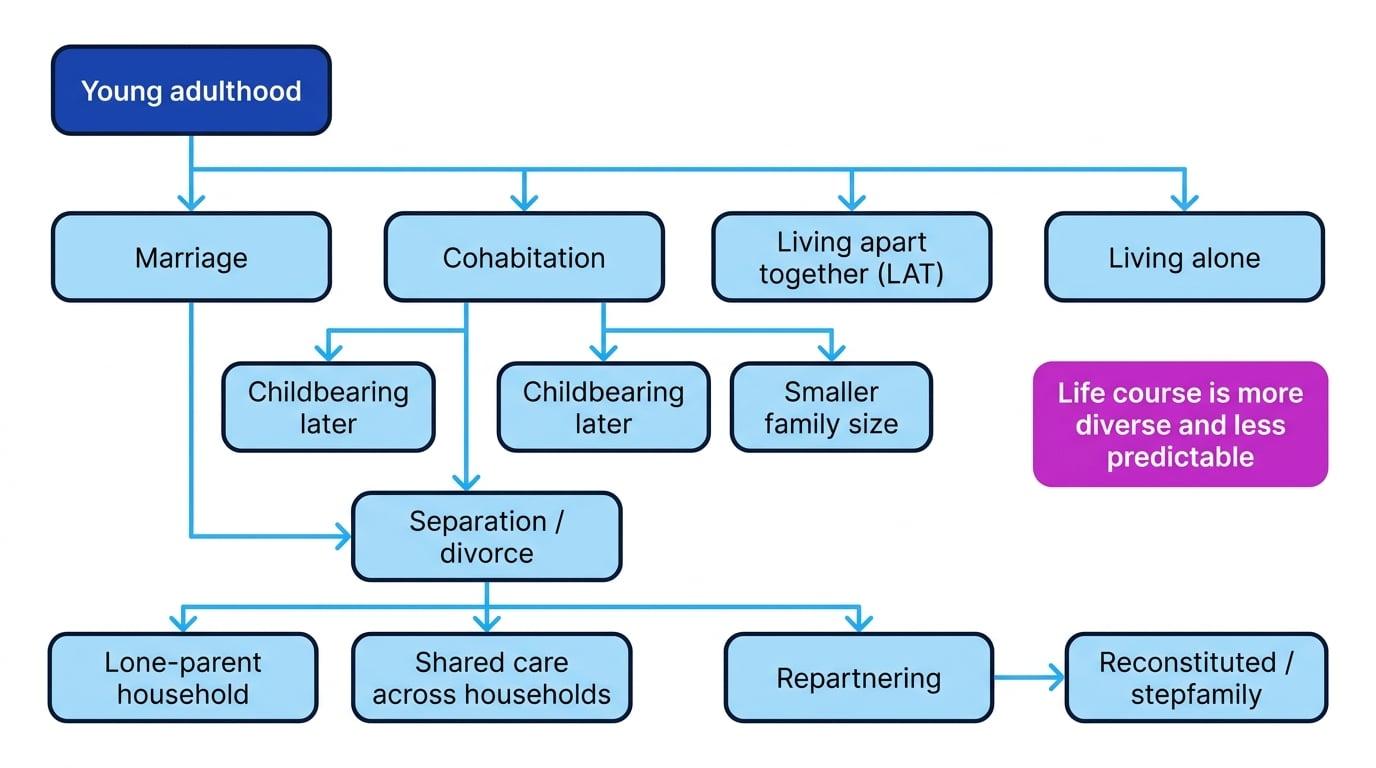
What you'll learn
- How marriage, cohabitation, divorce, separation and childbearing have changed in contemporary UK society.
- How the life course has become less predictable and more diverse.
- How the sociology of personal life challenges older ideas about “the family”.
- How to use AO1, AO2 and AO3 to build strong essay answers on family diversity.
1. The starting point: family life is patterned, but not fixed
A pattern means a regular trend we can observe across society. In this topic, you are looking at how common different family events and structures are: marriage, cohabitation, divorce, having children, living alone, stepfamilies and so on.
Family and household
- A family is a social group connected by kinship, marriage, civil partnership, cohabitation, parenting, adoption or emotional care.
- A household is one person living alone, or people living at the same address who share living arrangements.
- A household is not always a family: students sharing a flat are a household, while a divorced parent living elsewhere may still be part of a child’s family life.
Before you go into theories, keep the main family and household structures clear in your head. These are the “building blocks” you can apply in essays.
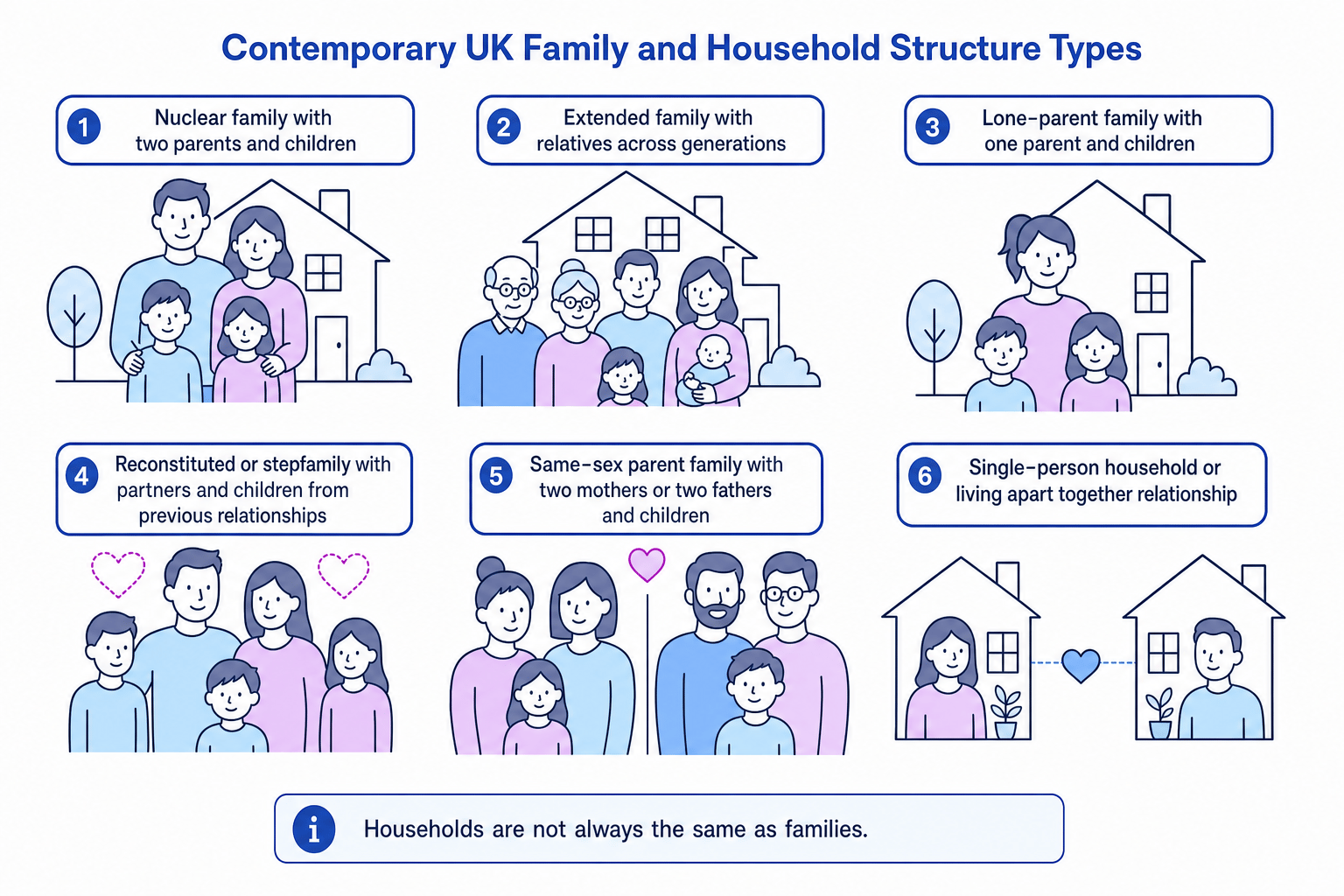
The big trend
The UK has not simply moved from “family” to “no family”. It has moved from one strongly expected family pathway towards greater family diversity: more acceptable ways of forming, ending and reorganising intimate relationships.
2. Marriage: declining, later, but still important
Marriage is a legally recognised relationship between spouses. Historically, marriage was often treated as the expected foundation for adult family life, especially childbearing.
In the UK, marriage rates have generally fallen since the 1970s, and people tend to marry later. There has also been more recognition of different forms of partnership: the Civil Partnership Act 2004 gave same-sex couples legal recognition, and the Marriage (Same Sex Couples) Act 2013 legalised same-sex marriage in England and Wales.
Sociologists explain declining marriage in several ways:
- Secularisation means religion has less influence over people’s lives, so there is less pressure to marry before sex or children.
- Changing gender roles mean women’s paid work and education can reduce economic dependence on husbands.
- Contraception and changing sexual norms separate sex, marriage and childbearing more than in the past.
- Individualisation, associated with Beck and Giddens, means people are more likely to construct their own life choices rather than follow tradition.
- The cost of weddings and housing can delay marriage, especially for younger adults.
Explaining declining marriage
-
Link the trend to a social change: if fewer people see religion as central to everyday life, marriage loses some of its moral force as the “proper” setting for sex and children.
-
Add a power-and-stratification point: women’s access to education, employment and welfare support can reduce the economic pressure to enter or stay in marriage.
-
Analyse the meaning of relationships: Giddens argues that modern relationships are increasingly based on intimacy and satisfaction, so marriage is less automatic and more conditional.
-
Evaluate the claim: marriage has declined, but it has not disappeared. Chester argues many people still live in a neo-conventional family, meaning a dual-earner couple with children, so there is continuity as well as change.
3. Cohabitation: living together without marriage
Cohabitation means an unmarried couple living together in an intimate relationship. It has grown strongly in the UK and is often described as one of the fastest-growing family forms.
For some couples, cohabitation is a “trial marriage”. For others, it is an alternative to marriage. It may also be more practical where people face insecure work, expensive housing or the cost of divorce from a previous relationship.
Living apart together, often shortened to LAT, means a couple are in a committed relationship but live in separate homes. This may happen because of work, children from previous relationships, caring responsibilities, or a desire for independence.
The common-law marriage myth
In England and Wales, long-term cohabiting couples do not automatically have the same legal rights as married couples. Avoid writing as if “common-law marriage” gives full legal protection.
AO3 matters here. New Right thinkers may argue cohabitation is less stable and weakens commitment. However, personal life sociologists argue this judges families by a traditional standard and ignores the meanings couples give to their own relationships.
4. Divorce and separation: relationships ending and families reorganising
Separation means partners stop living as a couple. Divorce is the legal ending of a marriage. Divorce rose significantly in the late twentieth century, partly after the Divorce Reform Act 1969, which made divorce easier by recognising irretrievable breakdown. The Divorce, Dissolution and Separation Act 2020, implemented in 2022, introduced no-fault divorce in England and Wales.
Reasons for increased divorce include:
- legal changes making divorce easier and less blame-based;
- reduced stigma around ending unhappy relationships;
- women’s greater financial independence;
- higher expectations of love, intimacy and equality;
- feminist challenges to patriarchal marriage;
- greater recognition of domestic abuse and coercive control.
Divorce does not mean family life ends. It often produces new family forms, such as lone-parent families, where one parent lives with dependent children, and reconstituted families, also called stepfamilies, where partners bring children from previous relationships.
Linking divorce to family diversity
-
Start with the relationship change: a divorce legally ends one marriage, but the adults and children involved still have family relationships.
-
Trace the structural effect: if children mainly live with one parent after separation, this can increase the number of lone-parent households.
-
Add the next stage: if a parent later forms a new partnership, the household may become a reconstituted family with step-parents or step-siblings.
-
Evaluate with inequality: these pathways are shaped by gender and class. Lone-parent families are often headed by women and may face higher poverty risks due to childcare costs, lower pay and insecure work.
5. Childbearing and the life course
Childbearing means having children. UK patterns have changed: people often have children later, average family size is smaller than in the mid-twentieth century, and many children are born outside marriage, often to cohabiting parents. There is also more visible childlessness, meaning adults not having children, whether by choice, circumstance or infertility.
The life course means the sequence of stages and transitions across a person’s life, such as leaving home, forming partnerships, becoming a parent, separating, repartnering, ageing and becoming a grandparent.
In the past, sociologists often described a more standard sequence: leave home, marry, have children, stay married, retire, then experience widowhood. Today, the life course is more varied and reversible: people may cohabit, live alone, return to the parental home, delay parenthood, divorce, repartner or remain childfree.
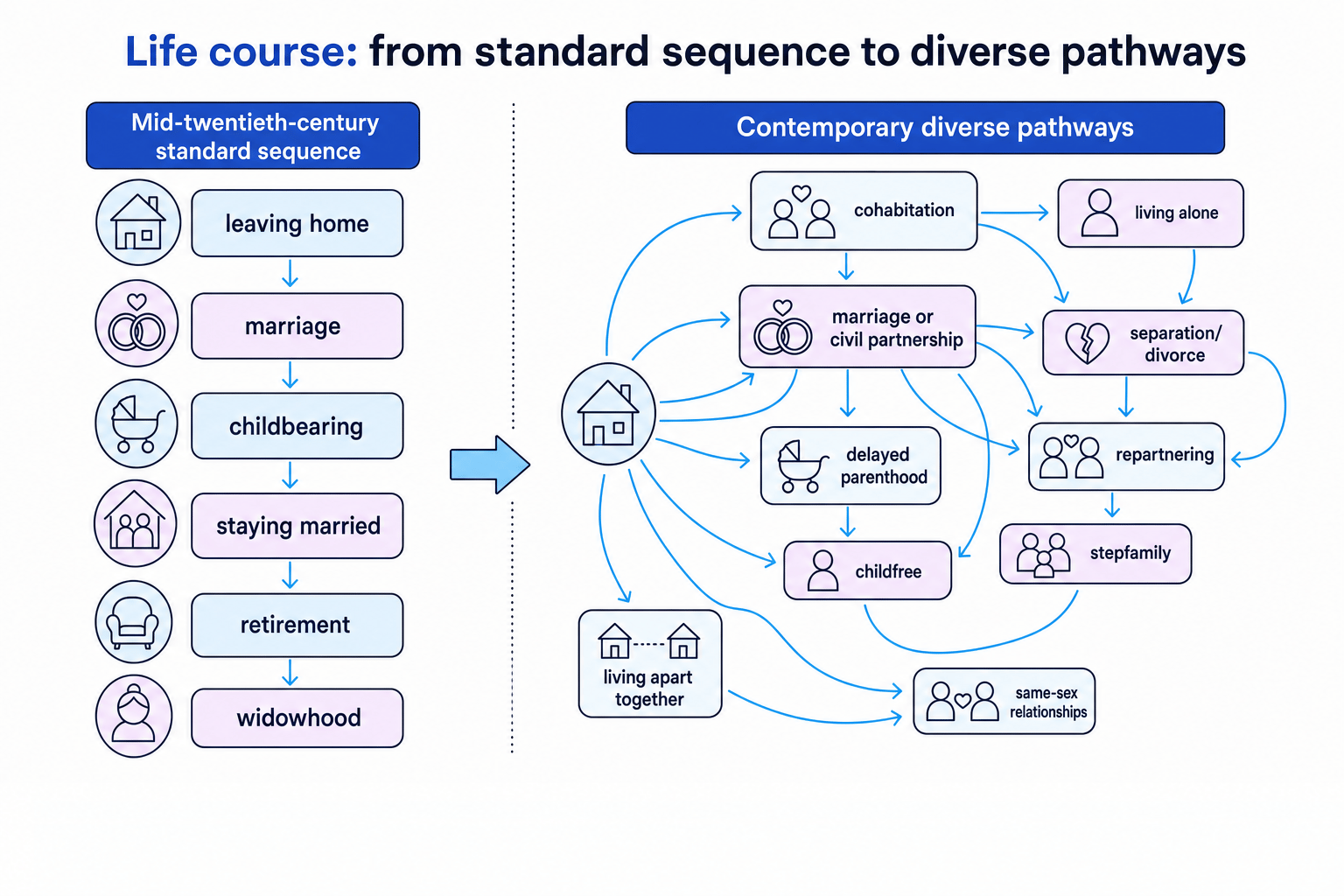
Reasons for changing childbearing include reliable contraception, the Abortion Act 1967, women’s education and careers, expensive childcare, housing costs, and changing identities. Motherhood and fatherhood are still important, but they are less likely to be treated as compulsory parts of adulthood.
Using life-course language
-
Identify the old assumption: a “traditional” model treats marriage and childbearing as early, linked and permanent stages.
-
Compare it with a contemporary pathway: a person might cohabit in their twenties, live alone after separation, repartner in their thirties, and have children later.
-
Analyse what this shows: family life is not just more diverse at one moment in time; it is more diverse across people’s biographies.
-
Evaluate the freedom involved: late modern theorists stress choice, but choices are limited by class, gender, housing, childcare costs and cultural expectations.
6. The sociology of personal life
The sociology of personal life studies the relationships that matter to people, rather than assuming only traditional family structures count. It is associated with writers such as Smart, Mason and May.
This approach asks: who do people actually care for, depend on and see as emotionally significant? That might include friends, ex-partners, grandparents, pets, neighbours, chosen families, online relationships or deceased relatives remembered through family stories.
Morgan’s idea of family practices is useful here. It means family is something people do through everyday actions: cooking, caring, texting, visiting, remembering birthdays, sharing money or giving emotional support. Finch’s idea of displaying family adds that people often have to show others that their relationships “count” as family.
This links strongly to socialisation, culture and identity. Families are not only legal units; they help people learn norms, form identities and experience belonging. It also links to social differentiation, power and stratification, because gender, class, ethnicity, sexuality, disability and age affect whose relationships are recognised and supported.
AO3 evaluation: the sociology of personal life is strong because it captures real emotional complexity, especially LGBTQ+ chosen families and post-divorce relationships. However, critics argue it can underplay structural inequalities such as poverty, patriarchy and housing policy.
7. Explaining family diversity: key perspectives
Family diversity means the range of family and household forms in society. The Rapoports identified several types, including:
- organisational diversity: different divisions of paid work and domestic labour;
- cultural diversity: differences linked to religion, ethnicity and values;
- social class diversity: how income and occupation affect family life;
- life-stage diversity: families differ depending on age and stage;
- cohort diversity: people born in different periods experience different norms.
Different perspectives explain these changes differently.
Functionalists such as Parsons saw the nuclear family as fitting industrial society because it was geographically mobile and specialised in socialisation and emotional support. New Right thinkers, such as Murray, worry that lone-parent families and welfare dependency weaken socialisation and responsibility.
Feminists challenge this by arguing that the “traditional family” often involved women’s unpaid domestic labour and male power. From this view, divorce and cohabitation may represent greater freedom, although women may still carry the burden of childcare and poverty.
Late modern theorists such as Giddens and Beck emphasise choice, negotiation and the pure relationship, where relationships last only as long as they meet partners’ emotional needs. Postmodernists such as Stacey argue there is no single dominant family type anymore.
AO3 balance is important: diversity has increased, but the nuclear family has not vanished. Many people still aspire to couple relationships, children and stable homes, even if they reach them through different routes.
8. Using evidence carefully
Official statistics from the ONS and the Census are useful because they show large-scale trends in marriage, divorce, household size, lone-parent families and births. This supports reliability, meaning repeated measurement is likely to produce consistent results.
However, statistics may miss meanings. A household category cannot show whether a relationship is supportive, abusive, distant or loving. Interpretivist methods, such as interviews, can produce higher validity, meaning they get closer to people’s lived experiences, but they may be less representative.
A strong essay move
Pair a trend with an explanation and then evaluate it. For example: “Cohabitation has increased; this may reflect secularisation and individualisation; however, economic insecurity also shapes whether people can marry or live independently.”
In the exam
-
Use trend language carefully: write “increased”, “declined”, “delayed”, “diversified” or “reorganised” rather than claiming all families have changed in the same way.
-
Build AO3 into each paragraph: compare perspectives, question whether change means freedom for everyone, and consider class, gender, ethnicity and sexuality.
-
Use evidence as application: refer to UK examples such as no-fault divorce, same-sex marriage, rising cohabitation, delayed parenthood and ONS/Census household categories.
Check yourself
- How are marriage, cohabitation and divorce linked to wider changes in gender roles and secularisation?
- What does the life course approach add that a simple list of family types does not?
- Why might the sociology of personal life criticise New Right views of family diversity?