Childhood is a phase of life we all experience, yet sociologists argue that it is not simply a natural, biological stage. Instead, the way we define, experience, and treat childhood is shaped by our social, cultural, and historical contexts.
What you'll learn
- How childhood is a social construction that varies across time, space, and cultures.
- The historical evolution of childhood, from "mini-adults" to the modern, "child-centred" family.
- The core debate between March of Progress theorists and Conflict theorists regarding the status of children.
- Modern anxieties surrounding childhood, including its potential "disappearance" or "toxic" nature.
1. Childhood as a Social Construction
To understand the nature of childhood, we must first look at how society constructs it.
Social Construction
A social construction is an idea, concept, or status that is created and defined by society rather than being an objective, biological reality.
While biology dictates that infants are physically immature and dependent on adults, Stephen Wagg (1992) argues that childhood is a distinct social status. There is no single, universal definition of what a child is or how they should behave.
Cross-Cultural Evidence
To prove that childhood is socially constructed, sociologists compare contemporary Western views with other cultures. Anthropologist Ruth Benedict (1934) argued that children in non-industrial societies are often treated very differently from their Western counterparts in three key ways:
- Taking responsibility at an early age: In many traditional societies, work is seen as a normal part of growing up. For example, Samantha Punch (2001) found that in rural Bolivia, children as young as five are expected to take on work responsibilities in the home and community.
- Less obedience to adult authority: In some cultures, adult-child hierarchies are far weaker. Raymond Firth (1970) found that among the Tikopia of the Western Pacific, doing as you are told by an adult is a concession made by the child, not an automatic right expected by the adult.
- Different attitudes toward sexual behaviour: Bronislaw Malinowski (1957) noted that among the Trobriand Islanders, adults took an attitude of "amused interest" toward children's sexual explorations and activities.
The Western Norm of Childhood
In modern Western society, we view childhood as a distinct, separate life stage characterized by innocence, vulnerability, play, and segregation from the adult world of work. Sociologists call this the "separateness" of childhood.
2. The Historical Construction of Childhood
The way we view children has changed dramatically over time. The most influential historical account comes from French historian Philippe Ariès (1960).
The Middle Ages: "Mini-Adults"
Ariès argues that in the Middle Ages (from the 10th to the 13th century), the idea of childhood did not exist.
[Infant Dependency] ---> [Work & Adult World]
 (High mortality)       (Aged 7+: Mixed with adults)
Once children passed the stage of physical dependency (around age seven), they entered wider society on the same terms as adults:
- They dressed in the same clothes.
- They worked the same jobs.
- They suffered the same punishments for crimes.
Ariès used historical artwork as evidence: paintings from this era depict children simply as scale-model "mini-adults" without any distinct child-like facial features or dress.
The Rise of the Modern Cult of Childhood
According to Ariès, from the 15th century onward, the modern "cult of childhood" began to emerge:
- Schools began to specialise in the education of the young, separating them from the adult workplace.
- The Church increasingly viewed children as "fragile creatures of God" who needed protection from worldliness and corruption.
- Distinction in dress emerged, marking children out visually from adults.
By the 20th century, Western society had become entirely child-centred.
Evaluating Ariès
While Ariès' work is a brilliant demonstration of how childhood changes over time, critics argue he went too far. Linda Pollock (1983) argues it is more accurate to say that in the Middle Ages, society had a different notion of childhood, rather than no notion of childhood at all.
Why Did the Status of Children Change?
The transition from "mini-adult" to the protected modern child was driven by several structural shifts during the 19th and 20th centuries:
- Industrialisation: The economy shifted from agricultural domestic labour to factory-based work, which eventually required a more educated, literate workforce.
- Laws excluding children from work: The Factory Acts of the 19th century banned children from mines and factories, transforming them from economic assets (wage-earners) into economic liabilities (dependents).
- Compulsory education: The 1880 Education Act made school attendance compulsory up to age 10, extending the period of dependency.
- Child protection legislation: Laws such as the 1889 Prevention of Cruelty to Children Act made the state responsible for policing parental treatment of children.
- The growth of child rights: The UN Convention on the Rights of the Child (1989) established basic rights to protection, education, and healthcare.
- Declining family size: Smaller families meant parents could invest more emotional and financial resources into each individual child.
3. Has Childhood Improved? The Great Debate
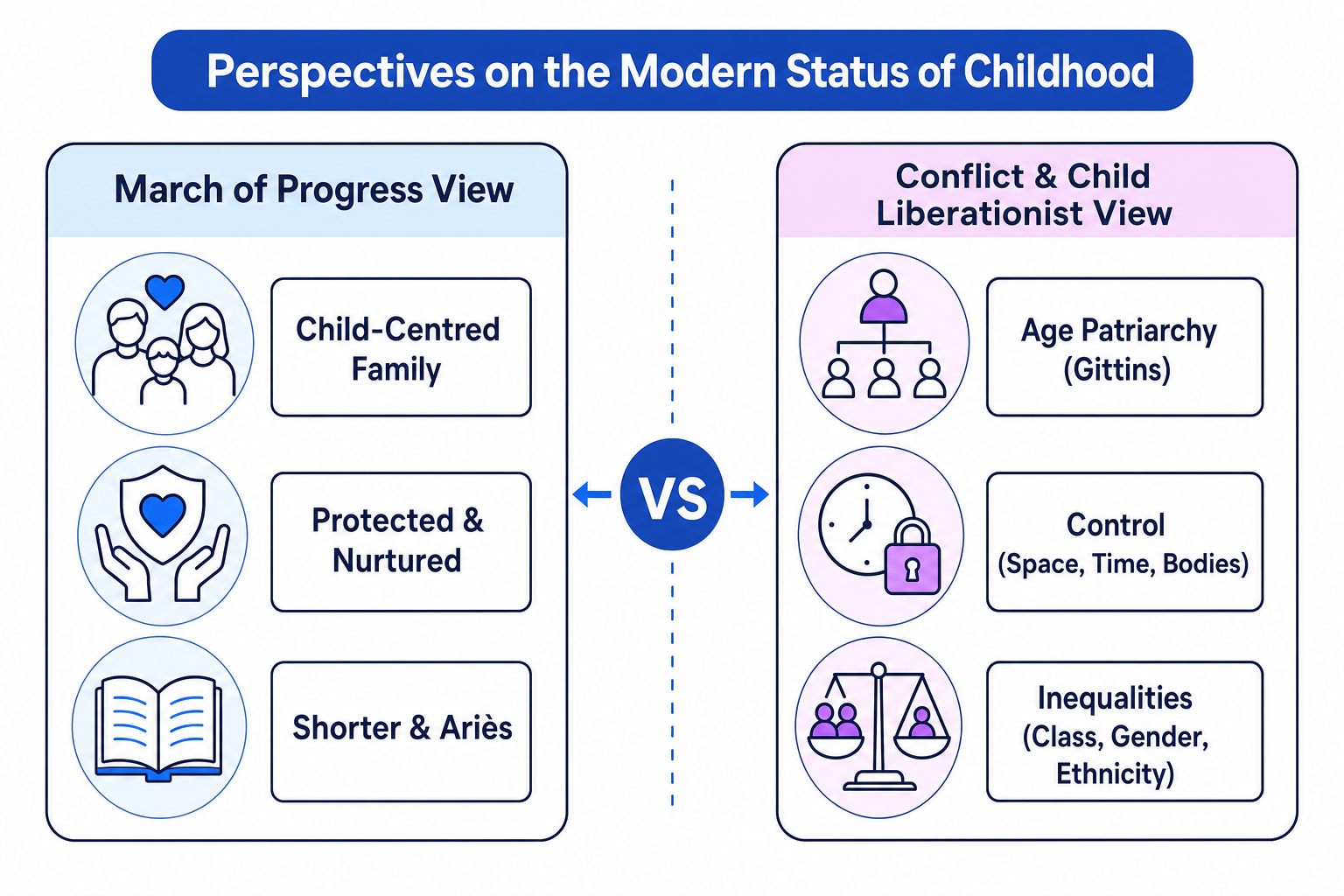
Sociologists are deeply divided over whether these historical changes represent progress. We can divide this debate into two primary camps: the March of Progress view and the Conflict view.
The March of Progress Perspective
March of progress theorists (such as Ariès and Edward Shorter) argue that children’s lives have steadily improved.
- Child-Centred Families: The family is now built around the needs of the child. Parents invest heavily in their children's future, health, and happiness.
- Protection and Welfare: Children are protected from harm by strict laws, social services, and pediatric medicine. Infant mortality rates have plummeted from over 150 per 1,000 births in 1900 to under 4 per 1,000 today.
The Conflict Perspective
Conflict sociologists (including Marxists and Feminists) argue that the March of Progress view paints an idealized, false picture. They highlight two major problems:
A. Inequalities Among Children
Not all children share the same happy, protected childhood.
- Class: Children from poor families are more likely to suffer from hyperactivity, conduct disorders, and lower educational achievement. They are also more likely to experience poverty-related illnesses.
- Gender: Mayer Hillman (1993) found that boys are given more freedom than girls to cross roads, go out after dark, and use public transport. Julia Brannen (1994) found that Asian parents were often much stricter with their teenage daughters than their sons.
- Ethnicity: Cultural expectations differ; for example, some ethnic minority families place a much stronger emphasis on filial piety (respect and obligation to parents) and domestic contributions.
B. Inequalities Between Children and Adults
Child liberationists such as Shulamith Firestone (1979) and John Holt (1974) argue that modern "protection" is actually a form of oppression and control. Adults use protection as an excuse to exert power over children.
Sociologist Diana Gittins (1985) uses the term "age patriarchy" to describe this adult domination.
Age Patriarchy
Age patriarchy refers to the system of adult domination and control over children, which keeps children subordinate, dependent, and powerless relative to adults.
Adults control children through several mechanisms:
- Control over space: Children's movements are highly restricted (e.g., "no schoolchild" signs in shops, CCTV, parental supervision).
- Control over time: Adults dictate when children wake up, eat, play, study, and sleep.
- Control over bodies: Adults control how children sit, dress, and touch their own bodies, as well as subjecting them to physical corrections (slapping/holding hands).
- Control over access to resources: Unlike in feudal times, children cannot work and earn their own money. They remain economically dependent on adults.
Applying 'Age Patriarchy' to Analyze Modern Childhood
Here is how you can build a high-level analytical paragraph evaluating whether modern childhood has improved, by applying Gittins' concept of age patriarchy.
- State the core point of evaluation: Critics of the March of Progress view argue that the modern status of children is not characterized by progress, but rather by heightened adult control and dependency.
- Introduce and define the key concept: Gittins conceptualizes this adult domination as "age patriarchy," arguing that the traditional male-dominated family structure extends to power over children, keeping them economically and socially subordinate.
- Provide empirical or concrete evidence: This is evident in modern UK society through tight spatial surveillance, where children are rarely allowed to walk to school unaccompanied, and economic restrictions that prevent under-16s from working full-time, making them completely dependent on parental pocket money.
- Evaluate/Analyze the significance: While child liberationists like Firestone view this as oppressive, defenders of the system argue these controls are vital safety measures in an increasingly complex, urbanized society, meaning the "oppression" is actually highly functional protection.
Confusing 'Patriarchy' with 'Age Patriarchy'
Be careful: standard patriarchy refers to men dominating women. Age patriarchy refers to adults (both mothers and fathers) dominating children. Make sure to use the prefix "age" to show the examiner you are discussing generational power dynamics, not just gender dynamics.
4. The Future of Childhood
Is childhood staying the same, or is it undergoing another radical shift?
The Disappearance of Childhood: Neil Postman (1994)
Postman argues that childhood is disappearing at a rapid rate. He points to:
- The trend toward giving children the same rights as adults.
- The disappearance of traditional children's games.
- The growing similarity between adult and children's clothing.
[The Information Hierarchy]
   Adults (Literate / Secret Knowledge)
     === (Barrier broken by TV/Internet) ===
   Children (Visual Culture / Exposed to everything)
According to Postman, childhood emerged because of the "information hierarchy" created by the printing press. Reading required training, which created a barrier. Adults could keep "adult secrets" (sex, violence, death) hidden from illiterate children.
However, television and the internet require no special training to access. The boundaries between the adult world and the child world have collapsed.
Criticising Postman
Iona Opie (1993) argues that childhood is not disappearing. Her lifetime of research into children’s street games, rhymes, and songs shows that children still maintain a rich, independent, and distinct secret culture of their own, completely separate from adults.
Toxic Childhood: Sue Palmer (2006)
Rather than childhood disappearing, writer Sue Palmer argues that children in modern societies are experiencing a "toxic childhood".
She argues that rapid technological and cultural changes over the last 25 years have damaged children’s physical, emotional, and intellectual development. This toxicity is driven by:
- The rise of junk food and screen saturation.
- The decline of outdoor play.
- Excessive testing in schools.
- The growth of marketing targeted directly at children.
As a result, the UK has seen skyrocketing rates of childhood obesity, self-harm, ADHD, and clinical depression.
5. The "New Sociology of Childhood"
Traditional sociological perspectives (Functionalism, Marxism, Feminism) often treat children as passive objects to be socialized, shaped, and controlled by external structures like the family and school.
However, the New Sociology of Childhood (championed by theorists like Berry Mayall and Carol Smart) takes a different path.
- Active Agents: It views children not as "adults-in-the-making" (or passive "empty vessels"), but as active human beings who play a major role in creating their own childhood experiences.
- The Child's Perspective: Instead of researching on children from an adult's viewpoint, researchers should study childhood by interviewing and observing children themselves. For example, Smart (2001) found that in divorced families, children were not passive victims; they actively tried to mediate relationships and make things better for their parents.
In the exam
If you face an essay question on the nature of childhood and changes in the status of children, use these strategic tips to maximize your marks:
- Clarify the debate immediately: Start your essay by stating that childhood is not a fixed biological phase, but a socially constructed concept that varies by time, place, and social class.
- Structure around key clashes: Use the March of Progress vs. Conflict debate as your central backbone. Contrast Ariès and Shorter's optimism directly against Gittins' concept of age patriarchy and Firestone's child liberationism.
- Integrate social divisions (AO2/AO3): Do not talk about "children" as a single, homogenous group. Intersect your argument with class, gender, and ethnic inequalities to show high-level critical thinking.
- Bring in the "New Sociology of Childhood" as a cutting-edge conclusion: Use Smart and Mayall to evaluate traditional structural theories, arguing that children must be viewed as active participants in family life rather than passive victims of historical change.
Check yourself
- Why does Ruth Benedict argue that childhood is a social construction?
- What did Philippe Ariès mean when he argued that the "idea of childhood did not exist" in the Middle Ages?
- What is "age patriarchy," and which perspective uses this term?
- According to Neil Postman, how did the "information hierarchy" create the modern concept of childhood, and why is it now collapsing?
