Revision notes for Edexcel AS Level Religious Studies Why did Jesus have to die?. Open the guide for explanations and worked examples. Written against the Edexcel AS Level Religious Studies specification, so the content matches what's examinable rather than general Religious Studies background.
Why did Jesus have to die?
What you'll learn
- How the Fourth Gospel presents conflict between Jesus and religious/political authorities.
- Why disputes about Sabbath, Temple and identity become charges against Jesus.
- How E. Rivkin and R. A. Culpepper explain the causes of Jesus’ death.
- How to evaluate responsibility for Jesus’ death carefully and fairly.
Starting point: John’s Gospel is not just “history told plainly”
The topic asks why Jesus “had to” die, but there are several levels to that question. In the Fourth Gospel, Jesus’ death is caused by human conflict, political calculation and religious accusation — but it is also presented as part of Jesus’ divinely directed “hour”.
Definition
Fourth Gospel
The Fourth Gospel means the Gospel attributed to John. It is distinctive because it presents Jesus with especially explicit divine claims, long theological speeches, strong symbolism and frequent irony.
John does not present Jesus as a passive victim. Jesus says, “No one takes [my life] from me, but I lay it down of my own accord” (John 10:18). So, in John, the death of Jesus is both the result of opposition and the moment when Jesus’ identity is revealed.
Key Idea
Two levels of explanation
In John, Jesus dies because religious and political authorities see him as dangerous; but the Gospel also presents his death as the fulfilment of his mission.
This map shows the main causes working together rather than separately:
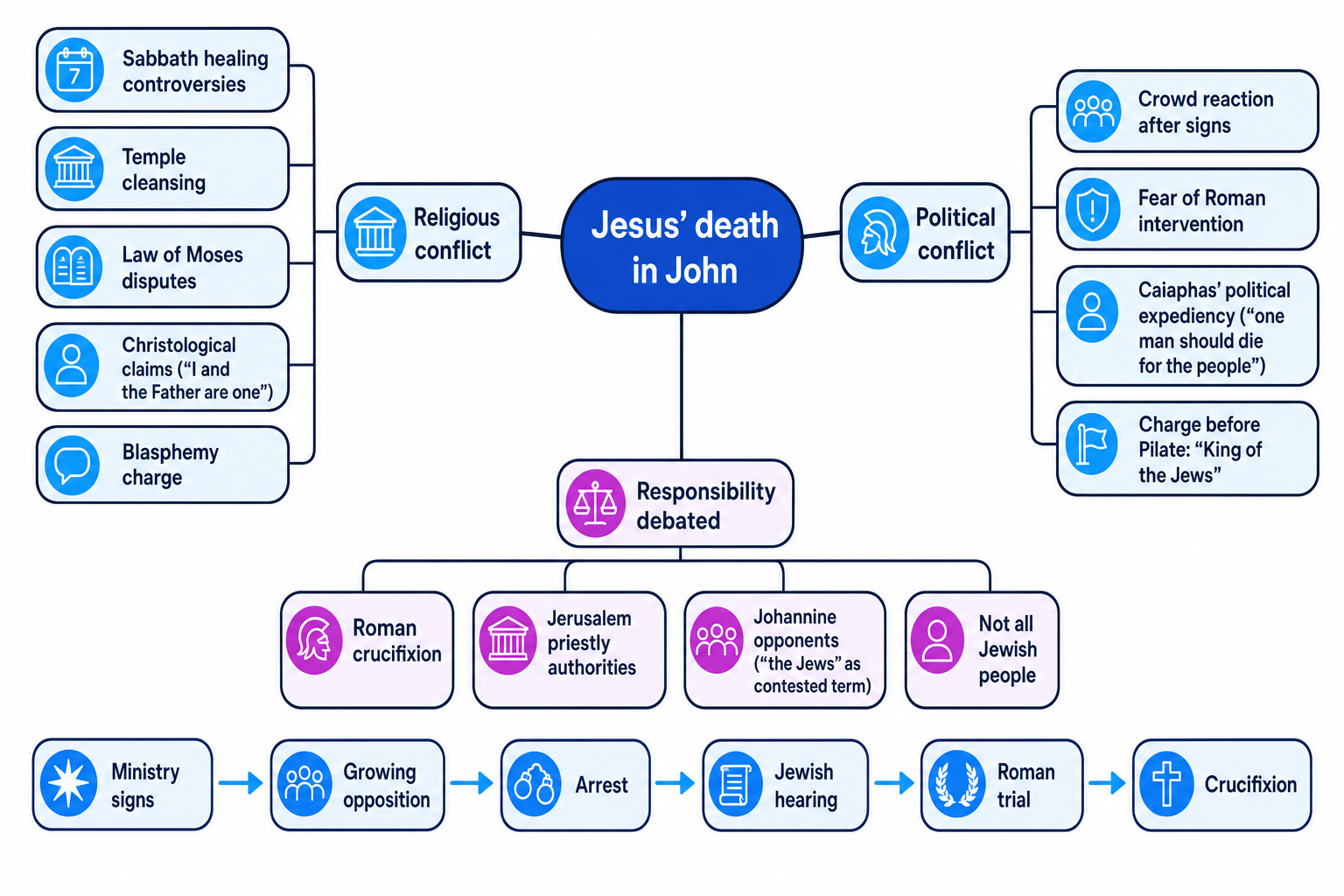
Religious conflict: Jesus challenges authority from within Judaism
Jesus, his disciples and his earliest followers were Jewish. So it is better to say that John presents Jesus as challenging particular religious authorities and interpretations within Judaism, not “Judaism” as a whole.
Definition
Law of Moses
The Law of Moses means the Torah: the commandments and teaching associated with Moses, including rules about worship, purity, circumcision and the Sabbath.
The Sabbath was the Jewish day of rest, rooted in the creation story and the Ten Commandments. In John, Sabbath controversies become major conflict points because Jesus does not merely heal; he explains his actions through his unique relationship with God.
Sabbath controversies
In John 5, Jesus heals a man at the pool of Bethesda on the Sabbath and tells him to carry his mat. The authorities object because this looks like Sabbath-breaking. Jesus replies: “My Father is still working, and I also am working” (John 5:17).
That reply escalates the conflict. John says the authorities seek to kill Jesus not only because he was “breaking the Sabbath” but because he was “calling God his own Father, thereby making himself equal to God” (John 5:18).
Definition
Christology
Christology means beliefs about the identity, nature and role of Jesus as the Christ, or Messiah. John has a “high Christology” because Jesus is presented as pre-existent, sent by the Father and closely united with God.
So the Sabbath issue is not just about whether healing counts as work. It becomes a question of who Jesus thinks he is.
Temple cleansing
In John 2, Jesus drives traders and money-changers out of the Temple. The Temple was the centre of Jewish worship, sacrifice and national identity. By disrupting its activity, Jesus symbolically challenges the authority of the Temple establishment.
John also gives the Temple cleansing a Christological meaning. Jesus says, “Destroy this temple, and in three days I will raise it up” (John 2:19). John explains that Jesus was speaking about “the temple of his body”. This suggests that Jesus himself replaces or fulfils the Temple as the meeting point between God and humanity.
Blasphemy and divine identity
Definition
Blasphemy
Blasphemy means speech or action that dishonours God. In this context, Jesus’ opponents see his claims about divine sonship and unity with the Father as an unacceptable claim to divine status.
In John 8, Jesus says, “Before Abraham was, I am” (John 8:58), echoing divine language from the Hebrew Scriptures. His opponents pick up stones. In John 10, Jesus says, “I and the Father are one” (John 10:30). Again, his opponents try to stone him, saying: “you, though only a human being, are making yourself God” (John 10:33).
This is why Christology is central. Jesus’ death is not presented as caused by a minor legal disagreement. It is caused by a deep dispute over whether Jesus truly reveals God or dangerously dishonours God.
Common Mistake
Blaming John’s opponents too broadly
Do not write that “the Jews killed Jesus.” John’s language about “the Jews” is complex and often refers to specific Judean authorities or opponents of Jesus. Jesus himself is Jewish, and Roman power carries out the crucifixion.
Political conflict: Jesus becomes a threat to order
John also presents Jesus’ death as political. Judea was under Roman rule. The authorities were worried that popular messianic enthusiasm could provoke Roman intervention.
Definition
Political expediency
Political expediency means doing what seems useful for maintaining power or avoiding danger, even if it may be morally questionable.
The key passage is John 11. After Jesus raises Lazarus, many believe in him. The chief priests and Pharisees worry: “If we let him go on like this, everyone will believe in him, and the Romans will come and destroy both our holy place and our nation” (John 11:48).
Caiaphas, the high priest, gives the politically expedient solution: “it is better for you to have one man die for the people than to have the whole nation destroyed” (John 11:50).
Example
Reading Caiaphas’ decision
-
First, identify the immediate trigger: the raising of Lazarus causes public belief in Jesus, so the authorities fear a growing movement.
-
Next, connect the fear to Roman occupation: if Jesus attracts messianic excitement, Rome may see this as rebellion and respond violently.
-
Then, interpret Caiaphas’ logic: he treats Jesus’ death as a sacrifice for political stability — one man dies so the nation avoids Roman punishment.
-
Finally, notice John’s irony: Caiaphas means political survival, but John says he unknowingly prophesies Jesus’ saving death for others.
The arrest, hearings and charges in John
John’s passion narrative moves from religious concern to Roman execution.
The arrest
In John 18, Judas brings soldiers and Temple police to arrest Jesus. Jesus steps forward and identifies himself. This fits John’s wider portrait: Jesus is not overwhelmed; he remains in control.
Jewish hearing
Jesus is taken first to Annas, the former high priest and father-in-law of Caiaphas. Annas questions him about his disciples and teaching. John does not give the same detailed Sanhedrin trial found in the Synoptic Gospels, so be careful not to import details uncritically.
The religious issue is clear across the Gospel: Jesus is dangerous because of what he claims about God, the Temple, the Law and himself.
Roman trial before Pilate
Pilate’s concern is political: “Are you the King of the Jews?” (John 18:33). A kingly claim could be treated as rebellion against Caesar.
Jesus replies, “My kingdom is not from this world” (John 18:36). This does not mean his kingdom is unreal; it means it does not operate by ordinary violence and political power. Yet the charge remains dangerous in Roman terms.
The pressure on Pilate peaks when the authorities say: “If you release this man, you are no friend of Caesar” (John 19:12). The final cry, “We have no king but Caesar” (John 19:15), is deeply ironic: religious leaders appear to choose Caesar over God’s true king.
Rivkin: focus on historical power and political threat
E. Rivkin argues that Jesus’ death should be understood through the structures of power in first-century Judea. He is especially useful for avoiding the simplistic idea that “the Jews” as a whole were responsible.
Rivkin emphasises the role of the ruling priestly establishment and Roman authority. Jesus challenged the Temple system and created a public movement. That made him threatening to those who depended on political stability and cooperation with Rome.
For Rivkin, the key issue is not that Judaism itself could not tolerate Jesus. Rather, particular authorities had a motive to remove him because he threatened their power, status and the fragile relationship with Rome.
Culpepper: focus on John’s narrative and Christology
R. A. Culpepper reads John as a carefully shaped theological narrative. For Culpepper, the conflict is fundamentally about Jesus’ identity. Characters in John are judged by whether they recognise or reject Jesus as the one sent by the Father.
This explains why John’s passion narrative is full of irony. Pilate asks “What is truth?” while Jesus, the truth, stands before him. The soldiers mock Jesus as king, but John’s readers know that Jesus really is king. The inscription “King of the Jews” is meant as Roman mockery, but it also declares the truth.
Culpepper therefore helps you see that John is not simply listing causes. John is interpreting Jesus’ death as the moment when rejection, kingship and glorification meet.
Who was responsible?
Different answers can be defended, as long as they are precise.
| View | Evidence in John | Evaluation |
|---|---|---|
| Specific Jewish religious authorities were responsible | Chief priests and Pharisees plan Jesus’ death in John 11 | Strong within John, but must not become collective blame of all Jews |
| Roman power was responsible | Pilate authorises crucifixion; Roman soldiers execute Jesus | Historically strong because crucifixion was a Roman punishment |
| Caiaphas and the priestly elite acted from expediency | John 11:50 presents Jesus’ death as politically useful | Explains the link between religion, Temple power and Roman occupation |
| Jesus freely accepted death | John 10:18 says Jesus lays down his life | Important theologically, but it does not remove human responsibility |
A balanced judgement is that John presents Jesus’ death as caused by the collision of religious conflict and political fear. Jesus’ divine claims provoke religious opposition; his popularity creates political danger; Roman authority turns accusation into crucifixion.
Tip
Strong essay judgement
A strong answer does not choose “religious” or “political” as if they are separate. In John, Jesus’ religious claims become politically dangerous because they attract followers under Roman occupation.
Bringing Rivkin and Culpepper together
Rivkin and Culpepper are not simply opposites. They answer different kinds of question.
Rivkin is strongest on historical responsibility: who had power, motive and opportunity? His answer highlights Roman rule and the Jerusalem priestly authorities.
Culpepper is strongest on Johannine meaning: how does the Gospel itself explain the death? His answer highlights Christology, irony and the rejection of Jesus as God’s revealer.
Together, they give a fuller answer. Historically, Jesus dies because he threatens the political-religious order. Theologically, John presents his death as the revelation of his identity and mission.
Exam technique
In the exam
-
Start with John’s presentation: Sabbath, Temple, Christological claims, Caiaphas, Pilate and kingship.
-
Use Rivkin for historical-political analysis and Culpepper for narrative-theological analysis.
-
Evaluate responsibility carefully: name specific groups and Roman power, and avoid blaming Judaism or Jewish people collectively.
Self review
Check yourself
- How do Sabbath controversies in John become arguments about Jesus’ identity?
- Why is Caiaphas’ statement in John 11 both politically expedient and ironic?
- How would you compare Rivkin and Culpepper in one clear evaluative paragraph?