Revision notes for Edexcel AS Level Religious Studies Texts and interpretations – The Kingdom of God in Luke: parables of the kingdom and eschatology. Open the guide for explanations and worked examples. Written against the Edexcel AS Level Religious Studies specification, so the content matches what's examinable rather than general Religious Studies background.
Texts and interpretations – The Kingdom of God in Luke: parables of the kingdom and eschatology
Welcome to your study notes on Section 3.5.1 of the Edexcel A-Level Religious Studies specification. The concept of the "Kingdom of God" is the central axis of Jesus' teachings in the Synoptic Gospels, but its timing, nature, and meaning have sparked intense theological debate.
In these notes, we will break down the complex theories surrounding the arrival of the Kingdom, analyze how Luke's parables convey these ideas, and evaluate the contrasting perspectives of two key scholars: Albert Schweitzer and I. Howard Marshall.
What you'll learn:
- The definition and multi-faceted nature of the "Kingdom of God" in Luke's Gospel.
- The distinction between present, future, and inaugurated eschatology.
- How to compare and evaluate the theories of Albert Schweitzer and I. Howard Marshall.
- How to apply these scholarly frameworks to Luke's parables and key texts.
1. What is the Kingdom of God?
Before diving into scholarly debates, we must understand what Jesus meant by the "Kingdom of God."
Definition
The Kingdom of God (Basileia)
In the original Greek of the New Testament, the word used for Kingdom is Basileia. Rather than referring to a physical, geographic territory (a "realm"), it denotes the reign, rule, or sovereign authority of God. To say the Kingdom of God has arrived means that God’s sovereign power is actively breaking into human history to defeat evil and restore creation.
In Luke’s Gospel, the Kingdom is not just a political concept, nor is it merely a state of mind. It is a dynamic event. The central question for scholars is when this event occurs. Is it a past promise, a present reality, or a future hope?
2. Understanding Eschatology: The Timing of the Kingdom
To talk about the arrival of the Kingdom, we must use the term eschatology.
Definition
Eschatology
From the Greek eschaton (meaning "last" or "end"), eschatology is the study of the "last things." In Christian theology, it refers to beliefs about the end of the current world order, the final judgment, the resurrection of the dead, and the ultimate fulfillment of God's plan for humanity.
The New Testament presents a tension regarding the timing of this eschaton:
- Past: The Kingdom was promised in the Old Testament scriptures and predicted by the prophets.
- Present: Jesus performs miracles, casts out demons, and declares that the Kingdom is "in your midst" (Luke 17:21).
- Future: Jesus speaks of cosmic signs, his return (the Parousia), and a final judgment when the Kingdom will be fully established (Luke 21).
3. Two Competing Interpretations: Schweitzer vs. Marshall
To access the top marks in your AO2 (evaluation) exam questions, you must contrast the scholarly interpretations of the Kingdom's arrival. Edexcel expects you to focus on Albert Schweitzer and I. Howard Marshall.
Albert Schweitzer: Consistent (Thoroughgoing) Eschatology
In his landmark 1906 book The Quest of the Historical Jesus, the German theologian and Nobel laureate Albert Schweitzer put forward a radical view known as Consistent Eschatology (sometimes called Thoroughgoing Eschatology).
Key Idea
Consistent Eschatology (Schweitzer)
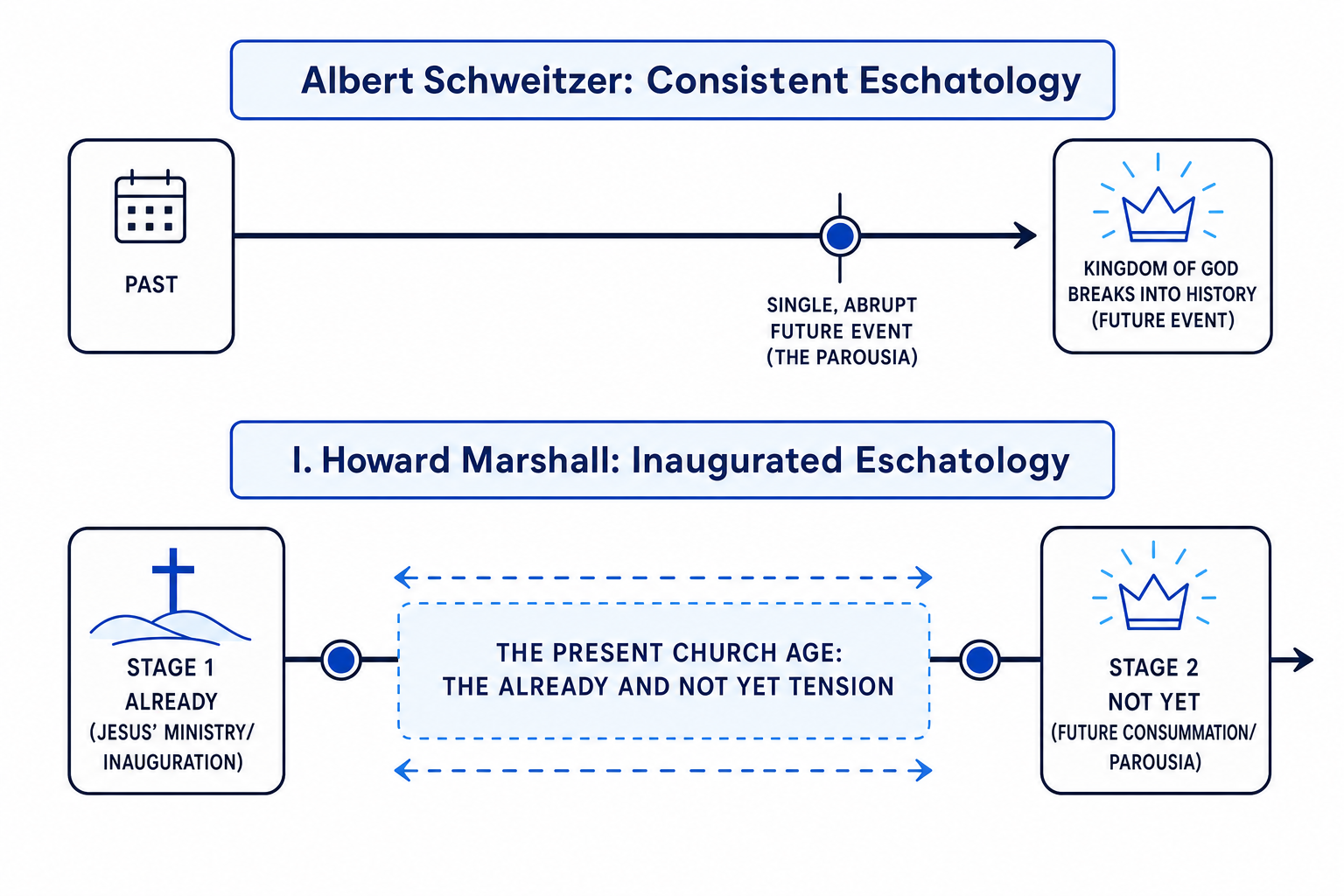
Schweitzer argued that Jesus was a thoroughly apocalyptic prophet who believed that the physical end of the world and the supernatural establishment of the Kingdom of God were entirely future and imminent (about to happen in his own lifetime).
According to Schweitzer:
- The Delayed Parousia: Jesus expected God to intervene dramatically while his disciples were out preaching (see Matthew 10:23). When this did not happen, Jesus believed he had to suffer and die to force God’s hand and bring about the end of the world.
- The Tragedy of Jesus: On the cross, Jesus realized the cosmic transformation was not happening. He died disappointed, crushed by the "wheel of history" he tried to turn.
- Ethics as "Interim Ethics": Jesus' moral teachings (like the Sermon on the Plain in Luke 6) were not meant as a permanent blueprint for human society. Instead, they were "interim ethics"—an extreme, emergency code of conduct for the short period before the world ended.
I. Howard Marshall: Inaugurated Eschatology
Writing in the late 20th century, the British evangelical scholar I. Howard Marshall offered a powerful critique of Schweitzer. In works like Luke: Historian and Theological, Marshall presented Luke's view of history as highly structured and purposeful, rather than an apocalyptic panic.
Key Idea
Inaugurated Eschatology (Marshall)
Marshall argued that Luke presents an Inaugurated Eschatology (often summarized as "already but not yet"). The Kingdom of God has already broken into history through the life, ministry, death, and resurrection of Jesus, but its final, ultimate consummation remains in the future.
According to Marshall:
- Salvation History (Heilsgeschichte): Luke divides history into three distinct, purposeful epochs:
- The Age of Israel (the law and the prophets up to John the Baptist).
- The Center of Time (the ministry of Jesus, where the Kingdom is inaugurated).
- The Age of the Church (the era of the Holy Spirit, stretching from Pentecost to the future return of Christ).
- The "Already": The Kingdom is a present reality. When Jesus heals the sick and preaches to the poor, the power of God's reign is visibly at work.
- The "Not Yet": Luke does not abandon the future hope. He maintains that there will be a future, literal consummation of the Kingdom, but the delay is not a "mistake" (as Schweitzer argued). Instead, the delay is a purposeful period of grace to allow the Gospel to spread to the ends of the earth.
4. Key Parables and Passages in Luke
To support your essays, you must ground these scholarly theories in the text of Luke's Gospel. Let's look at how Schweitzer and Marshall would interpret key passages.
A. The Kingdom "In Your Midst" (Luke 17:20–21)
“Once, on being asked by the Pharisees when the kingdom of God would come, Jesus replied, ‘The coming of the kingdom of God is not something that can be observed... because the kingdom of God is in your midst [or within you].’”
- Schweitzer's View: Schweitzer argued that the Greek phrase entos hymon ("in your midst" or "within you") cannot mean a present spiritual reality inside the Pharisees (who opposed Jesus). Instead, he suggested Jesus was speaking of the future Kingdom which would appear so suddenly and universally that it would instantly be "in their midst" without warning signs.
- Marshall's View: Marshall interprets this as prime evidence of present, inaugurated eschatology. Jesus is saying, "Stop looking for future astrological signs; the King is standing right here in front of you, and therefore the power of the Kingdom is already active among you."
B. Parables of Growth: The Mustard Seed and the Leaven (Luke 13:18–21)
“What is the kingdom of God like?... It is like a mustard seed, which a man took and planted in his garden. It grew and became a tree, and the birds perched in its branches.”
- Schweitzer's View: Schweitzer downplayed the idea of "organic growth." He argued that these parables do not teach a slow, evolutionary development of the Kingdom through human effort. Rather, they highlight the contrast between the tiny, insignificant present start and the sudden, massive supernatural intervention of God at the end.
- Marshall's View: Marshall argues these parables show the continuity between the present and the future. The Kingdom begins small in Jesus' ministry (the seed), but it is designed to grow historically through the missionary work of the Church (the tree) before reaching its final cosmic scope.
C. The Great Banquet (Luke 14:15–24)
“A certain man was preparing a great banquet and invited many guests...”
- Theological Significance: The banquet is a traditional Jewish symbol for the Messianic feast at the end of time.
- When the original wealthy guests make excuses, the host commands his servants to bring in "the poor, the crippled, the blind and the lame."
- Analysis: This parables highlights Luke's unique theme of radical social inclusivity. The outcasts are experiencing the joy of the Kingdom now through Jesus' table fellowship, prefiguring the ultimate, future heavenly feast.
Common Mistake
Confusing Dodd with Marshall
Students often write about C.H. Dodd's "Realised Eschatology" as if it is identical to I. Howard Marshall's view. Be careful! Dodd argued the Kingdom was entirely present in Jesus, leaving almost no room for a future end. Marshall, however, maintains a balance: the Kingdom is both present and future ("already but not yet"). Always use Marshall as your primary counter-weight to Schweitzer to match the spec's focus.
5. Worked Example: Evaluating Luke 17:21
Example
Evaluating the timing of the Kingdom in Luke 17:20-21
Evaluate the claim that Luke 17:20-21 proves Jesus understood the Kingdom of God as an exclusively present, spiritual reality.
-
Deconstruct the verse's key linguistic tension: Identify that the Pharisaic question ("when will it come?") assumes a future, visible chronological event. Jesus’ response that the Kingdom is entos hymon ("within you" or "in your midst") directly challenges this, shifting the focus to the immediate present.
-
Apply Albert Schweitzer's Consistent Eschatology critique: Argue that Jesus could not have meant the Kingdom was a present, internal spiritual state "within" the hearts of his bitter opponents, the Pharisees. Instead, use Schweitzer's framework to show that the saying refers to the absolute certainty of the future Kingdom's sudden, inescapable onset, which will catch them entirely by surprise.
-
Apply I. Howard Marshall's Inaugurated Eschatology counter-argument: Counter Schweitzer by arguing that entos hymon is best translated as "in your midst." Marshall’s model of Salvation History (Heilsgeschichte) explains that the Kingdom is objectively present in the person and miracles of Jesus. It is "in their midst" because the King is physically present among them, acting as the bridge to the future consummation.
-
Reach a justified, balanced conclusion: Conclude that the verse does not prove the Kingdom is exclusively present or spiritual. Instead, it proves the complex "already but not yet" tension. The best interpretation is Marshall's: the Kingdom is genuinely present in Jesus’ ministry (inauguration), but its presence points forward to a future, visible fulfillment (consummation).
6. Significance for Early Believers
Why does this debate matter so much for the early Church?
When Jesus died and decades passed without the world ending, early Christians faced an existential crisis known as the Delay of the Parousia.
- If Schweitzer was right, the early Church was built on a massive mistake. They had to frantically reinterpret Jesus' failed apocalyptic predictions to keep the movement alive.
- If Marshall is right, Luke wrote his Gospel and the Book of Acts precisely to reassure these early believers. By framing history as Heilsgeschichte, Luke showed them that the delay of the end was not a failure of prophecy, but a gift. It was the "Age of the Church"—a planned era where believers, empowered by the Holy Spirit, were called to live out the values of the Kingdom in the present world while waiting patiently for Christ's return.
Tip
Luke and Acts go together!
Remember that Luke and Acts are two volumes of the same work by the same author. To support Marshall’s view of "Salvation History," point out how the end of Luke’s Gospel flows seamlessly into the start of Acts, where Jesus tells the disciples to wait for the Holy Spirit rather than worrying about the exact date of the end (Acts 1:7-8).
Exam technique
In the exam
When writing an extended essay on Luke's eschatology:
- Clarify terminology immediately: In your introduction, define Basileia and Eschatology. Explain that the debate is not about geography, but about timing and sovereign rule.
- Anchor your essay in the two named scholars: Structure your paragraphs to pit Schweitzer’s "Consistent Eschatology" against Marshall’s "Inaugurated Eschatology." Use terms like Heilsgeschichte and interim ethics to demonstrate high-level academic knowledge.
- Use specific textual evidence: Do not just talk about theories in the abstract. Quote or closely paraphrase key texts (like Luke 17:20-21, Luke 13:18-21, or Luke 21) and show how both Schweitzer and Marshall would interpret them differently.
- Evaluate, don't just list: To get high AO2 marks, make a clear judgment. Which scholar provides a more coherent reading of Luke's entire narrative? (Most scholars today lean toward Marshall, as Schweitzer’s view struggles to explain why Luke would write a history of the early Church in Acts if he believed the world was ending immediately).
Self review
Check yourself
- Why did Albert Schweitzer believe that Jesus' ethical teachings were only "interim ethics"?
- What are the three stages of Heilsgeschichte (Salvation History) proposed by I. Howard Marshall?
- How does the translation of the Greek phrase entos hymon in Luke 17:21 affect whether we view the Kingdom as present or future?