Revision notes for Edexcel AS Level Religious Studies The crucifixion and resurrection narratives in Luke's Gospel. Open the guide for explanations and worked examples. Written against the Edexcel AS Level Religious Studies specification, so the content matches what's examinable rather than general Religious Studies background.
The crucifixion and resurrection narratives in Luke's Gospel
What you'll learn
- How Luke presents Jesus’ death and resurrection as part of God’s saving plan.
- The main Old Testament references, symbols, and fulfilment themes in Luke 22–24.
- Why the resurrection mattered so much for early believers and the future Church.
- How to use I. H. Marshall and F. Matera in evaluation, not just as name-drops.
1. The starting point: Luke is writing theology through narrative
Luke’s Gospel is not just “what happened next”. It is a carefully shaped narrative that presents Jesus as the innocent, suffering Messiah whose death and resurrection fulfil scripture and open salvation to the world.
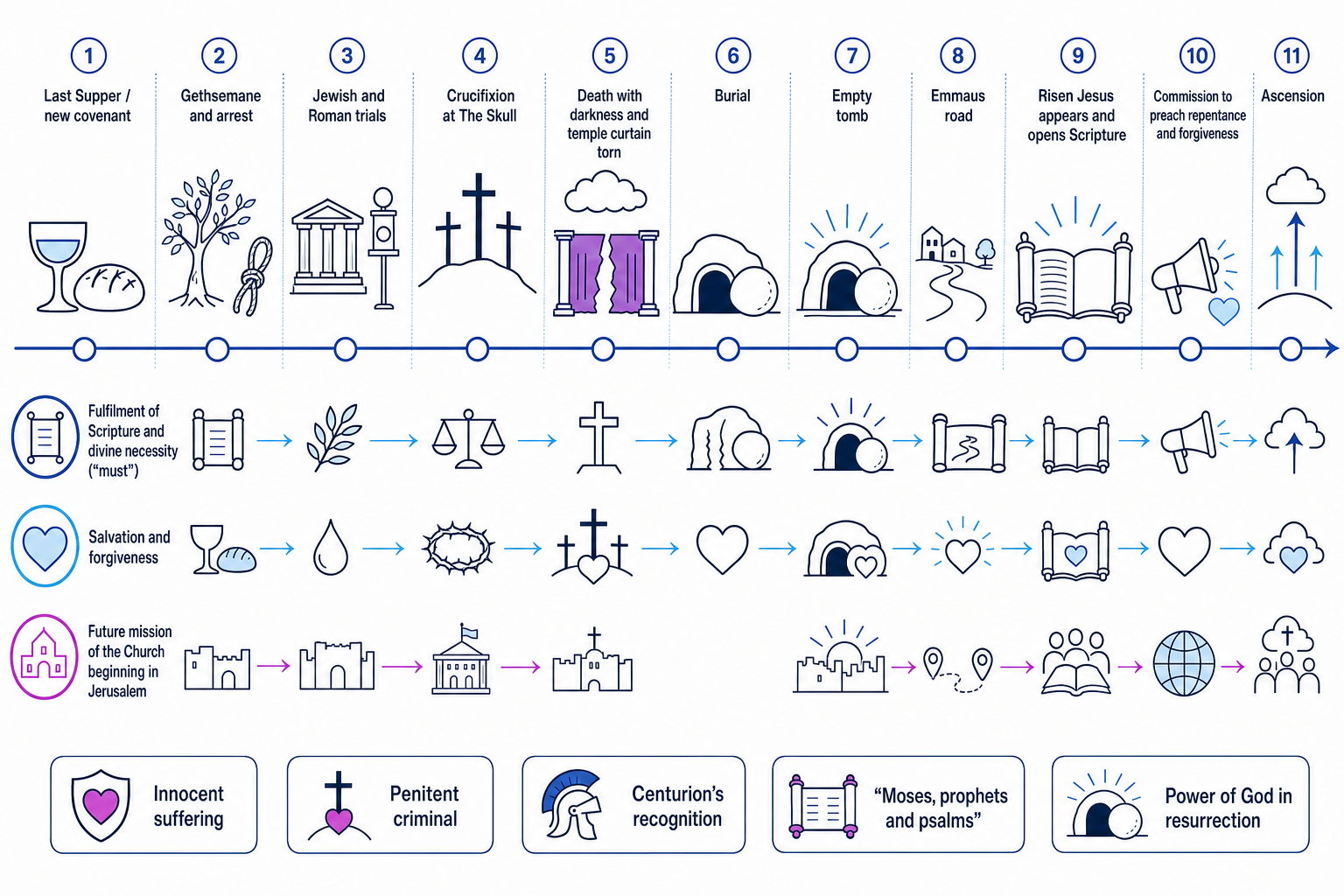
Luke’s crucifixion and resurrection material is mainly in Luke 22–24. It moves from the Last Supper, through Jesus’ arrest, trials, crucifixion and burial, to the empty tomb, Emmaus road, appearances, commission and ascension.
Definition
Fulfilment of scripture
Fulfilment of scripture means that Luke presents Jesus’ suffering, death and resurrection as the completion of God’s purposes already witnessed in Israel’s scriptures. It is not just “prediction comes true”; it is Luke saying that Jesus reveals the deeper meaning of the Law, Prophets and Psalms.
Key Idea
Luke’s big theological claim
For Luke, the cross is not a tragic accident. It is the place where human injustice, Jesus’ innocence, divine mercy and God’s saving plan meet.
2. God’s saving plan and the language of “must”
A key Lukan word is the idea that events must happen. This expresses divine necessity: Jesus’ suffering is necessary because it belongs to God’s plan, not because God is powerless or cruel.
In Luke 24:26, the risen Jesus asks: “Was it not necessary that the Messiah should suffer these things and then enter into his glory?” In Luke 24:44, he says everything written about him in “the law of Moses, the prophets, and the psalms” must be fulfilled.
This matters because Luke wants the reader to see continuity between Israel, Jesus, and the Church. Christianity is not presented as a random break from Judaism, but as the fulfilment of God’s promises.
Example
Tracing fulfilment in Luke 24
- Start with the resurrection scene: the disciples are confused because they expected the Messiah to be victorious, not crucified.
- Jesus reinterprets the scriptures for them, especially the pattern of suffering followed by glory. This reframes the crucifixion as part of divine purpose rather than failure.
- The result is mission: because the scriptures are fulfilled, “repentance and forgiveness of sins” must now be preached to all nations, beginning from Jerusalem.
3. Old Testament references and symbolism in the crucifixion
Luke uses explicit references and symbolic details to show that Jesus’ death has religious significance.
Isaiah 53 and the suffering servant
At the Last Supper, Jesus says: “This cup that is poured out for you is the new covenant in my blood” (Luke 22:20). This language suggests sacrifice and covenant. Luke 22:37 also quotes Isaiah 53:12: “He was counted among the lawless.”
Isaiah 53 describes a suffering figure who bears the sins of others. Luke does not develop this as fully as Paul might, but the connection gives Jesus’ death a saving meaning.
Psalm 31 and trusting the Father
Jesus’ final words in Luke are: “Father, into your hands I commend my spirit” (Luke 23:46), echoing Psalm 31:5. Unlike Mark’s “My God, my God, why have you forsaken me?”, Luke stresses trust, obedience and intimacy with God.
Darkness and the torn temple curtain
Luke 23 describes darkness over the land and the temple curtain being torn. These are symbols, not just background details.
The darkness suggests cosmic seriousness: creation itself responds to Jesus’ death. The torn curtain may suggest judgement on the temple system, new access to God, or the transition from temple-centred worship to salvation through Jesus.
Common Mistake
Making Luke sound anti-Jewish
Do not write as if Luke simply rejects Judaism. Luke’s Gospel ends with the disciples in the temple blessing God. A better argument is that Luke presents Jesus as fulfilling Israel’s hopes and redirecting worship around himself.
4. The religious significance of the crucifixion
Luke’s crucifixion narrative has several distinctive emphases.
Jesus is innocent
Pilate repeatedly finds no guilt in Jesus. Herod does not condemn him. The centurion declares, “Certainly this man was innocent” or “righteous” (Luke 23:47, depending on translation). This supports Luke’s presentation of Jesus as the righteous sufferer.
Jesus forgives
Luke includes the prayer: “Father, forgive them; for they do not know what they are doing” (Luke 23:34). This fits Luke’s wider emphasis on mercy, forgiveness and salvation for sinners.
The penitent criminal is saved
One criminal recognises Jesus and asks to be remembered. Jesus replies: “Today you will be with me in Paradise” (Luke 23:43). This is hugely significant: salvation is offered at the cross, even to someone with no time to perform good works.
Definition
Salvation
Salvation means rescue and restoration by God. In Luke, this includes forgiveness of sins, restored relationship with God, inclusion in God’s kingdom and hope beyond death.
Tip
A useful Lukan pattern
Luke often links innocence, forgiveness, and mission. Jesus is innocent, forgives sinners, and then sends witnesses to proclaim that forgiveness to the world.
5. Sacrifice, atonement and forgiveness
Definition
Atonement
Atonement means the restoration of the relationship between God and humanity. It is often explained through ideas such as sacrifice, forgiveness, reconciliation, covenant and the removal of sin.
Luke’s Gospel does not present atonement in exactly the same way as Paul’s letters. However, it would be too simple to say Luke has no atonement theology.
At the Last Supper, Jesus’ body is “given for you” and his blood is “poured out for you”. This sounds sacrificial and covenantal. The phrase “new covenant” recalls Jeremiah 31, where God promises forgiveness and renewed relationship with his people.
The crucifixion also immediately produces signs of forgiveness and response: the criminal is promised Paradise, the centurion praises God, and the crowds return beating their breasts, suggesting repentance.
Example
Evaluating atonement in Luke
- Identify evidence for atonement: the Last Supper uses “given for you”, “poured out for you” and “new covenant”, which suggests sacrificial saving significance.
- Identify evidence for a different emphasis: Luke gives more attention to Jesus’ innocence, forgiveness and trust in the Father than to a detailed theory of substitution.
- Reach a balanced judgement: Luke does teach that Jesus’ death saves, but he expresses this through narrative themes of covenant, mercy, repentance and fulfilment rather than through systematic doctrine.
6. The resurrection narratives and early believers
Luke’s resurrection narrative includes the empty tomb, the women witnesses, the Emmaus road, Jesus’ appearance to the disciples, the opening of scripture, the commission and the ascension.
The empty tomb
Women discover the tomb empty and are told that Jesus has risen. Their testimony is initially dismissed as “an idle tale” (Luke 24:11). This detail can be read as historically awkward, because women were not always treated as strong legal witnesses in the ancient world, but Luke gives them a central role.
Emmaus and the breaking of bread
On the road to Emmaus, the disciples fail to recognise Jesus until the breaking of bread. This links resurrection faith with scripture, fellowship and worship. Their hearts “burn” as Jesus opens the scriptures to them.
Jesus’ physical resurrection
Luke stresses that the risen Jesus is not a ghost. He says he has “flesh and bones” and eats fish. This matters because resurrection is not merely a private spiritual feeling; it is God’s powerful act in history.
Definition
Power of God
The power of God refers to God’s active ability to overcome sin, death and human rejection. In Luke 24, the resurrection shows that God vindicates Jesus and begins the next stage of salvation history.
7. Forgiveness, relationship with God and the future Church
The risen Jesus gives the disciples their mission: “repentance and forgiveness of sins is to be proclaimed in his name to all nations, beginning from Jerusalem” (Luke 24:47). This is one of the most important verses for this topic.
The resurrection means early believers can claim:
- Jesus is vindicated by God.
- Sins can be forgiven in Jesus’ name.
- Relationship with God is restored through repentance and faith.
- The Church has a worldwide mission.
- The disciples are “witnesses” who must continue Jesus’ work.
- The coming “power from on high” points forward to the Holy Spirit in Acts.
The ascension also matters. Jesus’ departure is not absence or defeat; it prepares for the Spirit-led mission of the Church.
8. I. H. Marshall and F. Matera
I. H. Marshall
I. H. Marshall sees Luke as both historian and theologian. He strongly emphasises salvation history: God’s plan moves through Israel, Jesus and the Church. For Marshall, Jesus’ death and resurrection are necessary parts of this plan.
Marshall is useful against the view that Luke has no theology of atonement. He points to the Last Supper and the mission of forgiveness as evidence that Jesus’ death has saving significance. The resurrection then confirms Jesus’ identity and launches the Church’s proclamation.
F. Matera
F. Matera emphasises the distinctive shape of Luke’s passion narrative. Luke presents Jesus especially as the innocent, righteous sufferer and forgiving martyr. Compared with some other New Testament writings, Luke is less focused on explaining the mechanics of atonement and more focused on Jesus’ innocence, mercy and obedience.
Matera helps you notice Luke’s narrative details: Jesus heals, forgives, comforts, trusts the Father and brings repentance even as he dies.
Comparing them
Marshall and Matera are not total opposites. Both take Luke’s theology seriously. The difference is emphasis:
- Marshall highlights saving purpose, covenant, fulfilment and forgiveness.
- Matera highlights innocence, martyrdom, mercy and the distinctive Lukan portrayal of Jesus.
A strong essay can argue that Luke combines both: Jesus dies as the innocent righteous one, and precisely through that death God’s saving plan is fulfilled.
Exam technique
In the exam
- Anchor your answer in Luke 22–24, especially the Last Supper, the cross, Emmaus and Luke 24:46–49.
- Use Marshall and Matera to create evaluation: Marshall supports a stronger saving/atoning reading, while Matera highlights Luke’s innocent martyr and forgiveness themes.
- Avoid generic resurrection claims. Always connect resurrection to Luke’s specific themes: fulfilment, forgiveness, witness, Jerusalem, the Spirit and the future Church.
Self review
Check yourself
- How does Luke use scripture to show that Jesus’ suffering was part of God’s plan?
- Why is the penitent criminal important for Luke’s understanding of salvation?
- How would you compare Marshall and Matera on the meaning of Jesus’ death?