Revision notes for Edexcel AS Level Religious Studies Ways of interpreting Scripture. Open the guide for explanations and worked examples. Written against the Edexcel AS Level Religious Studies specification, so the content matches what's examinable rather than general Religious Studies background.
Ways of interpreting Scripture
What you'll learn
- What Christians may mean when they call the Bible inspired or the Word of God.
- How the literal, allegorical and moral senses of Scripture work.
- How Karl Barth and Rudolf Bultmann defended the value of Scripture in the modern world.
- How four post-Enlightenment approaches — rational, historical, sociological and literary — interpret biblical texts today.
The basic problem: how should Scripture be read?
Christians do not only ask, “What does the Bible say?” They also ask, “How should it be understood?” That question matters because the Bible contains law, poetry, prophecy, parables, letters, genealogy, apocalyptic imagery and narrative. Different genres need different reading strategies.
Definition
Hermeneutics
Hermeneutics means the theory and method of interpretation. In Religious Studies, it asks how sacred texts should be understood, applied and evaluated.
A related term is exegesis, which means drawing meaning out of a text by careful reading. Its opposite is eisegesis, which means reading your own assumptions into the text.
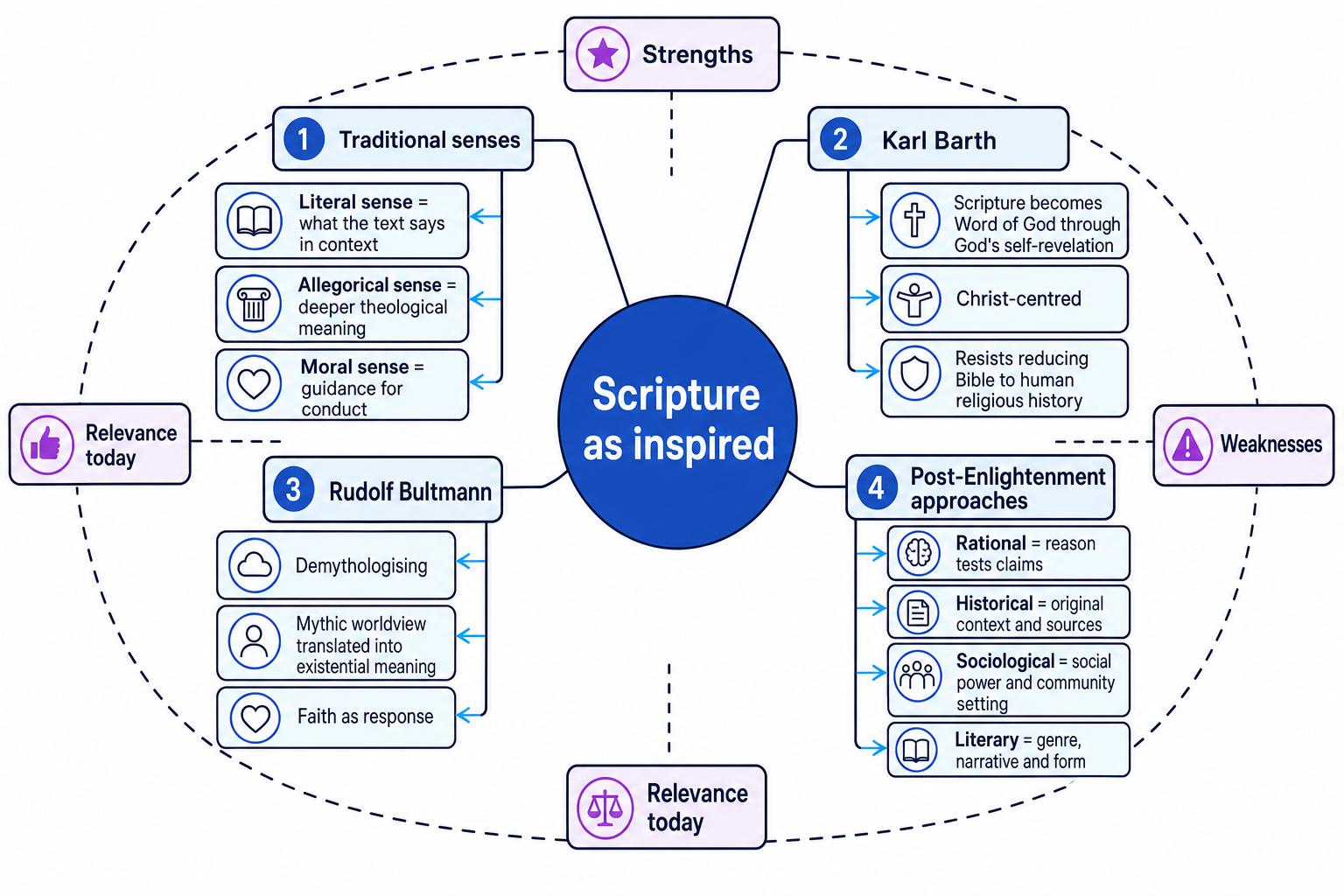
The map below gives you the whole topic at a glance: traditional senses, Barth, Bultmann and the four modern approaches.
The Bible as inspired
To call the Bible inspired is to say that God is involved in it in a special way, so that it has authority for faith, worship and life. A classic biblical basis is 2 Timothy 3:16, where Scripture is described as “God-breathed”.
Definition
Inspiration
Inspiration is the belief that Scripture is, in some sense, given or guided by God, rather than being merely a human religious document.
Christians disagree about what inspiration implies. Some link it with inerrancy, the view that Scripture is without error. Others prefer infallibility, the view that Scripture is trustworthy in what God intends it to teach, especially about salvation, while still being written through human authors in historical cultures.
Key Idea
Inspired does not mean one single method
Belief in biblical inspiration does not automatically settle how every passage should be read. A Christian might believe Scripture is inspired and still read poetry as poetry, parable as parable, and apocalyptic imagery as symbolic.
The literal, allegorical and moral senses
Traditional Christian interpretation often used more than one “sense” of Scripture. A sense means a level or kind of meaning within a text.
The literal sense
The literal sense is what the text means according to its words, genre and context. It is not always the same as a flat “literalist” reading.
For example, if a psalm says “the trees clap their hands”, the literal sense is not that trees have palms and fingers. The literal sense is the poetic meaning: creation is pictured as praising God.
Common Mistake
Literal is not always literalist
Do not write as if the literal sense means “take every sentence as scientific or historical reportage”. The literal sense means the meaning intended by the words in their literary and historical context.
The allegorical sense
The allegorical sense reads persons, events or objects as pointing beyond themselves to deeper theological meanings. For example, some Christian interpreters read the Exodus from Egypt as symbolising salvation from sin.
The moral sense
The moral sense asks what the passage teaches about how believers should live. It focuses on ethical transformation: what kind of person, community or behaviour the text encourages.
Example
Using the three senses on the Good Samaritan
-
Start with the literal sense: in Luke 10, Jesus tells a story in response to the question “Who is my neighbour?” A Samaritan, despite being an outsider to many Jewish hearers, shows practical mercy to a wounded man.
-
Consider the allegorical sense: a traditional Christian reading might see the wounded man as fallen humanity and the Samaritan as Christ, who rescues and heals. This is not the plain narrative meaning, but a theological interpretation built on it.
-
Apply the moral sense: the passage challenges the reader to show costly compassion, especially across social or religious boundaries. The “neighbour” is not just someone like you, but anyone to whom you can show mercy.
Karl Barth: Scripture as the Word of God
Karl Barth was a twentieth-century Protestant theologian associated with neo-orthodoxy, a movement that reacted against liberal theology’s tendency to reduce Christianity to human religious feeling, ethics or culture.
For Barth, revelation means God’s self-disclosure; humans do not climb up to God by reason alone. God makes himself known, supremely in Jesus Christ.
Barth described the Word of God in three connected forms:
- Jesus Christ as the revealed Word of God.
- Scripture as the written witness to the Word of God.
- Preaching as the proclaimed Word of God.
This is important: Barth did not simply say the Bible is a divine textbook dropped from heaven. Scripture is written by human authors, but God uses it to encounter people. In that event, Scripture becomes the Word of God for the reader or hearer.
Strengths of Barth’s approach
Barth protects the authority and distinctiveness of Scripture. The Bible is not reduced to archaeology, sociology or moral advice. His approach is also Christ-centred: the purpose of Scripture is to witness to God’s revelation in Christ.
Weaknesses of Barth’s approach
Critics argue that Barth can seem circular: Scripture is authoritative because God speaks through it, but that claim may be hard to test from outside faith. It may also be difficult to settle disagreements, because different readers may claim that God addresses them differently through the same text.
Example
Applying Barth to a Gospel miracle
-
Focus on witness to Christ: if reading Jesus calming the storm, Barth would not begin by treating the passage mainly as evidence to be tested like a laboratory report. He would ask how the text witnesses to Christ’s identity and authority.
-
Ask how God addresses the reader: the passage may become the Word of God by confronting the reader with trust, fear and the lordship of Christ over chaos.
-
Evaluate the result: this keeps the text theologically alive, but it does not by itself answer every historical question about what happened on the lake.
Rudolf Bultmann: demythologising Scripture
Rudolf Bultmann was a twentieth-century New Testament scholar influenced by existentialist philosophy, especially the concern with authentic human existence. He argued that modern people cannot simply inhabit the ancient biblical worldview.
Definition
Demythologising
Demythologising means interpreting biblical mythological language so that its existential meaning can be understood today. It does not simply mean deleting myths or calling them worthless.
For Bultmann, myth does not just mean “false story”. It means a way of speaking about God, the world and human life using cosmic imagery: heaven above, earth in the middle, underworld below, angels, demons and supernatural interventions.
Bultmann famously argued that it is difficult to use “electric light and the wireless” while also accepting the New Testament’s ancient supernatural worldview in a straightforward way. His aim was not to destroy Christian faith, but to recover the kerygma, meaning the core proclamation of Christ that calls people to faith.
Strengths of Bultmann’s approach
Bultmann makes Scripture intellectually accessible in a modern context shaped by science, historical criticism and scepticism. He helps readers ask, “What demand does this text make on my existence now?”
Weaknesses of Bultmann’s approach
Critics argue that Bultmann risks reducing Christianity to inner existential decision and losing the importance of God’s action in history. If resurrection, miracle and incarnation become mainly symbolic, some Christians think the heart of the faith has been weakened.
Common Mistake
Demythologising is not just disbelief
Do not say Bultmann “removed miracles because he did not believe the Bible”. His project was interpretive: he wanted to translate mythological language into existential meaning for modern readers.
Four post-Enlightenment approaches
The Enlightenment was an intellectual movement in the seventeenth and eighteenth centuries that emphasised reason, evidence, criticism and human autonomy. After the Enlightenment, biblical interpretation increasingly asked whether Scripture could be studied using the same critical tools as other ancient texts.
| Approach | Main question | Strength | Weakness |
|---|---|---|---|
| Rational | Is this claim coherent and credible to reason? | Challenges superstition and encourages intellectual honesty. | Can reduce Scripture to what modern reason already accepts. |
| Historical | What did the text mean in its original context? | Takes authorship, sources, audience and culture seriously. | May make Scripture feel trapped in the past. |
| Sociological | How does the text reflect social groups, power and community life? | Highlights class, gender, empire, exclusion and liberation. | Can reduce theology to social forces. |
| Literary | How does the final text work as literature? | Respects genre, narrative, symbolism and structure. | May avoid questions of truth, history or authority. |
Rational interpretation
A rational approach tests biblical claims by reason. It may ask whether miracles are possible, whether doctrines are logically coherent, or whether moral commands can be defended.
This can be useful, but it may become reductionist if it assumes in advance that anything supernatural must be impossible.
Historical interpretation
A historical approach studies the original context: authorship, audience, sources, language, culture and setting. It asks what the text likely meant when first written or received.
This is essential for avoiding anachronism, which means imposing later ideas onto an earlier text.
Sociological interpretation
A sociological approach examines how texts relate to social structures: poverty, gender, purity, empire, authority, conflict and community identity.
This helps modern readers see the Bible’s relevance to justice and power. However, it can become too narrow if it treats religion only as a product of society.
Literary interpretation
A literary approach focuses on the text as a crafted work. It asks about genre, plot, character, imagery, symbolism, repetition and narrative structure.
This is especially helpful because biblical truth is often communicated through story and symbol, not abstract argument.
Example
Choosing approaches for the feeding of the five thousand
-
Use the rational approach: ask whether a miraculous multiplication of food is credible, or whether a naturalistic explanation is more persuasive. This directly tests the plausibility of the event.
-
Use the historical approach: ask what the story meant in its first-century Jewish context, including expectations about wilderness, Moses-like provision and messianic hope.
-
Use the sociological and literary approaches: sociologically, the shared meal raises questions about poverty, inclusion and community. Literarily, details such as bread, wilderness and abundance shape the reader’s understanding of Jesus.
-
Judge which approach fits the task: if the question is about historical reliability, historical and rational methods are central. If it is about modern relevance, sociological and literary readings may be more fruitful.
Tip
Think in lenses
The approaches are not mutually exclusive. A strong essay can say that different methods act like different lenses: each reveals something, but each can also distort if used alone.
Comparing Barth and Bultmann
Barth and Bultmann both respond to the modern world, but in different ways.
Barth’s priority is revelation: Scripture matters because God speaks through it. Bultmann’s priority is interpretation: Scripture matters because its mythological language can be translated into existential challenge.
Barth is stronger if you want to defend the Bible’s theological authority. Bultmann is stronger if you want to explain how ancient texts can still speak meaningfully to people shaped by modern science and scepticism.
However, both have risks. Barth may seem too dependent on faith-claims that outsiders cannot verify. Bultmann may seem too willing to reinterpret doctrines that many Christians regard as historically central.
Key Idea
A balanced judgement
The most convincing approach is often not “one method wins”. Literal context guards against fantasy, allegory and morality keep Scripture spiritually and ethically alive, Barth preserves divine authority, Bultmann addresses modern credibility, and critical scholarship helps readers avoid naïve interpretation.
Why this matters today
These models affect how Christians respond to modern issues. For example:
- A literal-contextual reading may ask what a biblical command meant in its ancient setting.
- A moral reading may ask what kind of life the passage forms in believers.
- A sociological reading may ask whether the text challenges or reinforces oppression.
- A Barthian reading may ask how God confronts the Church through Scripture now.
- A Bultmannian reading may ask how the text’s ancient worldview can be translated for modern existence.
The big exam issue is not simply “Which interpretation is correct?” It is whether a model preserves the value of Scripture while also being intellectually responsible in the modern world.
Exam technique
In the exam
-
Define your key terms early: inspiration, literal sense, allegorical sense, moral sense, demythologising and post-Enlightenment criticism.
-
Use Barth and Bultmann accurately: Barth sees Scripture as a witness that becomes the Word of God through divine revelation; Bultmann seeks to interpret mythological language existentially.
-
Evaluate throughout, not just at the end: for each approach, explain its context, one strength, one weakness and its significance for understanding Scripture today.
Self review
Check yourself
- Why is the literal sense not the same as literalism?
- How do Barth and Bultmann differ in their understanding of Scripture’s value?
- Which post-Enlightenment approach do you think is strongest for modern relevance, and why?