Revision notes for Edexcel AS Level Religious Studies The purpose and authorship of the Fourth Gospel. Open the guide for explanations and worked examples. Written against the Edexcel AS Level Religious Studies specification, so the content matches what's examinable rather than general Religious Studies background.
The purpose and authorship of the Fourth Gospel
What you'll learn
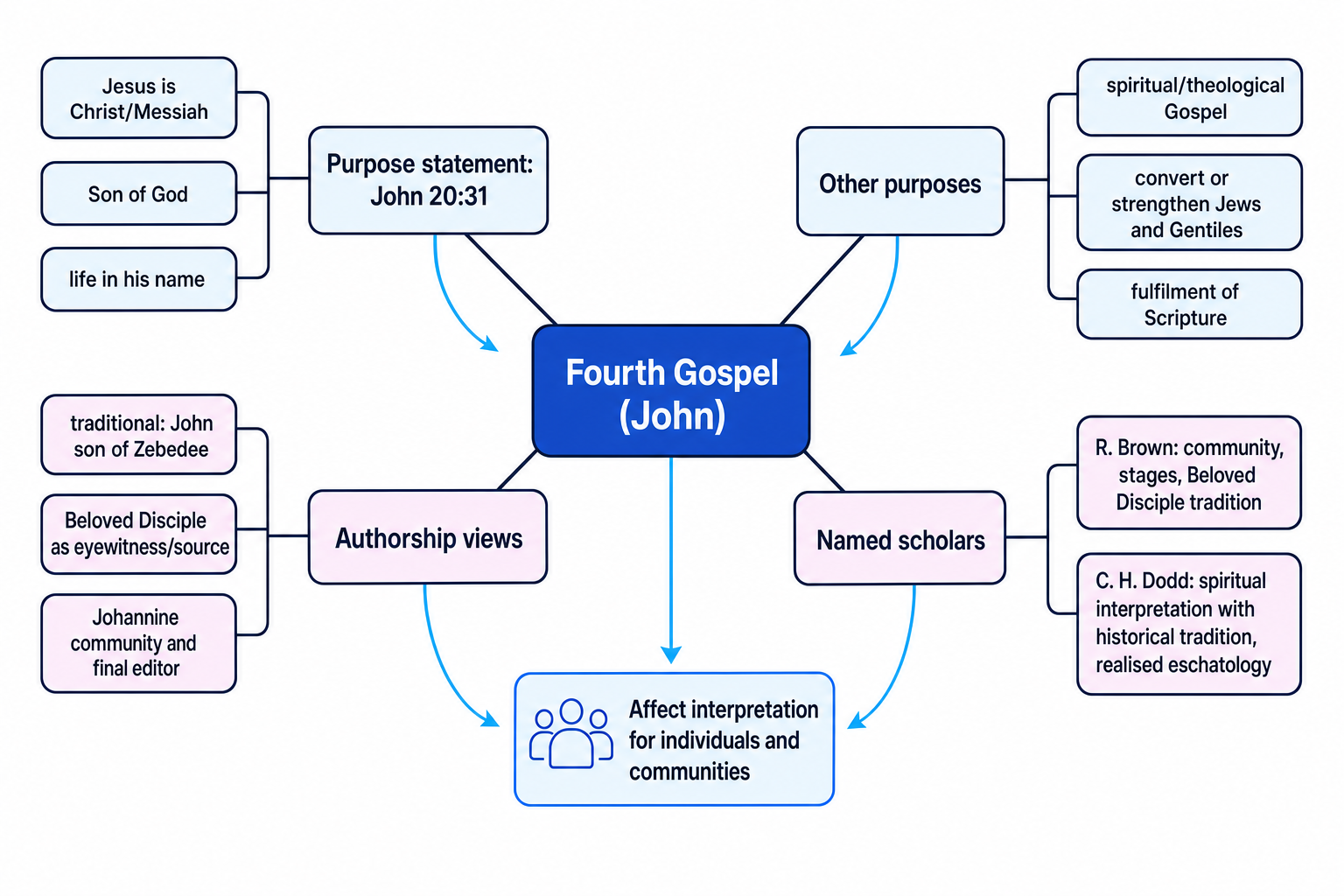
- How John 20:31 gives the clearest statement of the Gospel’s purpose.
- Why scholars call John the “Spiritual Gospel” and what that does — and does not — mean.
- The main authorship views: John son of Zebedee, the Beloved Disciple, and the Johannine community.
- How R. Brown and C. H. Dodd help you evaluate the text for essay answers.
Getting oriented: what is the Fourth Gospel?
The Fourth Gospel is the Gospel according to John. It is called “fourth” because it appears after the three Synoptic Gospels — Matthew, Mark and Luke — which are called “synoptic” because they share a similar outline and much common material.
John is very distinctive. It has long theological speeches, “I am” sayings, a strong focus on Jesus’ divine identity, and a different style from the Synoptics. This makes questions of purpose and authorship especially important: what was John trying to do, and whose testimony stands behind it?
Definition
Purpose and authorship
- Purpose means the reason a text was written: for example, to persuade, teach, strengthen faith, explain identity, or shape a community.
- Authorship means who wrote, edited, or supplied the testimony behind a text. For John, this may include an eyewitness source, an evangelist, and a later editor.
John 20:31: the clearest purpose statement
The key verse is John 20:31:
“These are written so that you may believe that Jesus is the Messiah, the Son of God, and that through believing you may have life in his name.”
This verse gives three central purposes:
- to present Jesus as Christ/Messiah;
- to present Jesus as Son of God;
- to bring readers to life in his name.
Definition
Christ, Son of God, and life
- Christ is the Greek form of Messiah, meaning “anointed one”: the expected agent of God’s salvation.
- Son of God in John means more than a holy person; it points to Jesus’ unique relationship with the Father.
- Eternal life in John is not only future life after death. It begins now through relationship with Jesus.
C. H. Dodd is especially helpful here. He argued that John has a strong sense of realised eschatology: blessings expected at the end of time, such as life and judgement, are already experienced in the present through encounter with Christ.
Definition
Realised eschatology
Realised eschatology is the view that end-time realities are already present. In John, eternal life is not merely a future reward; it is something believers begin to possess now.
Example
Inferring purpose from John 20:31
-
The phrase “these are written” points backwards to the selected signs and speeches in the Gospel, so the verse functions as a purpose statement for the whole text.
-
The titles “Messiah” and “Son of God” show that John is not just recording events; he is interpreting Jesus’ identity for the reader.
-
The phrase “through believing you may have life” shows that the Gospel aims for response. It is written not only to inform readers, but to lead them into faith or strengthen the faith they already have.
Key Idea
John’s central purpose
The Fourth Gospel is written as testimony that invites belief: Jesus is the Christ, the Son of God, and the source of life.
Purpose 1: Jesus as Christ/Messiah
John presents Jesus as the fulfilment of Jewish messianic hope. Early in the Gospel, Andrew says, “We have found the Messiah” (John 1:41). Nathanael calls Jesus “Son of God” and “King of Israel” (John 1:49). Martha later confesses, “You are the Messiah, the Son of God” (John 11:27).
This purpose is strengthened by the signs in John. A sign is a miracle that points beyond itself to Jesus’ identity. For example, the raising of Lazarus in John 11 is not just an impressive miracle; it reveals Jesus as “the resurrection and the life”.
A weakness of seeing messiahship as the only purpose is that John’s Christology goes beyond a simple Jewish royal Messiah. The Prologue presents Jesus as the eternal Logos, or Word, who was “with God” and “was God” (John 1:1). So John’s purpose is messianic, but also deeply theological.
Purpose 2: Jesus as Son of God
John repeatedly presents Jesus as uniquely united with the Father. Jesus says, “I and the Father are one” (John 10:30), and Thomas climaxes the Gospel by confessing Jesus as “My Lord and my God” (John 20:28).
This supports the view that John was written to shape a high understanding of Jesus’ identity. The Gospel does not merely ask, “Was Jesus the Messiah?” It asks, “Who is Jesus in relation to God?”
Dodd’s approach fits well here. He sees John as a theological interpretation of Jesus, using symbols such as light, life, bread, water, and truth. The Gospel is therefore not a bare biography but a meditation on the meaning of Jesus.
Purpose 3: life in his name
John’s purpose is practical as well as doctrinal. “Life in his name” means that faith in Jesus brings relationship with God. In John 5:24, Jesus says that whoever hears his word and believes “has eternal life”. The present tense matters: life begins now.
This has significance for individuals because the Gospel invites personal trust in Jesus. It also matters for communities because it defines Christian identity around belief in Jesus’ revealed identity.
The “Spiritual Gospel”
The early Christian writer Clement of Alexandria, quoted by Eusebius, described John as a Spiritual Gospel. This does not mean “made up” or “unhistorical”. It means John explores the deeper theological meaning of Jesus’ words and actions.
John’s narratives often work on two levels. Jesus speaks about water, bread, birth, blindness, and death, but these become symbols of spiritual realities: new birth, revelation, faith, and eternal life.
Dodd strongly supports this kind of reading. In The Interpretation of the Fourth Gospel, he argues that John should be read through its symbolic world. However, in Historical Tradition in the Fourth Gospel, Dodd also argues that John preserves early and independent historical tradition. For Dodd, John is both theological and historically serious.
Common Mistake
Spiritual does not mean fictional
Do not write as if “Spiritual Gospel” means John is unconcerned with history. A stronger answer says that John interprets history theologically.
A Gospel to convert Jews and Gentiles
John may have been written to persuade both Jews and Gentiles. A Gentile is a non-Jewish person. The Gospel is deeply rooted in Jewish Scripture and festivals, but it also explains Jewish customs for readers who may not know them.
There is strong evidence for a Jewish context. John refers to synagogue expulsion in John 9:22 and 16:2, which suggests conflict between followers of Jesus and some Jewish authorities. Brown uses this to reconstruct a Johannine community: a group of Christians shaped by conflict with the synagogue and by strong belief in Jesus’ divine identity.
There is also evidence for a wider audience. John uses universal language such as “the world”, includes Samaritans in John 4, and mentions Greeks seeking Jesus in John 12:20–21. This suggests a Gospel with a mission beyond one ethnic group.
Definition
Johannine community
The Johannine community is the scholarly name for the Christian group or network behind the Gospel and letters of John. R. Brown argues that its experiences of belief, conflict, exclusion, and identity shaped the Gospel’s final form.
Common Mistake
Misreading ‘the Jews’
John’s phrase “the Jews” should not be treated as a blanket attack on all Jewish people. In context it often refers to particular Jewish authorities or opponents. Responsible interpretation must avoid anti-Jewish generalisation.
Fulfilment of Scripture
John repeatedly presents Jesus as the fulfilment of Scripture. For example:
- John 2:17 echoes Psalm 69: “Zeal for your house will consume me.”
- John 12:38 uses Isaiah to explain unbelief.
- John 19:24 presents the division of Jesus’ garments as fulfilment of Scripture.
- John 19:36–37 links Jesus’ death to the Passover lamb and the pierced one.
This purpose shows continuity between Jesus and Israel’s Scriptures. It would help Jewish readers see Jesus as the fulfilment of God’s plan, while also helping Gentile readers understand Christianity’s Jewish roots.
The weakness is that fulfilment is not the only purpose. John is not simply a proof-texting exercise. Scripture, signs, symbolism, and personal testimony all work together.
Authorship: who stands behind John?
The Gospel itself does not directly say, “I, John son of Zebedee, wrote this.” Instead, it points to the Beloved Disciple, especially in John 21:24:
“This is the disciple who is testifying to these things and has written them, and we know that his testimony is true.”
Definition
Beloved Disciple and redactor
- The Beloved Disciple is the unnamed disciple “whom Jesus loved”, presented as a key witness in the Gospel.
- A redactor is an editor who shapes, arranges, or adds to existing material.
Traditional view: John son of Zebedee
The traditional Christian view is that the author was John, son of Zebedee, one of the Twelve apostles. This is supported by early church tradition, especially Irenaeus, who says John published the Gospel at Ephesus.
Strengths of this view include the Gospel’s claim to eyewitness testimony and its detailed knowledge of places around Jerusalem. Weaknesses include the fact that the author is not named, the Gospel’s style is very different from the Synoptics, and John 21:24 sounds like a community confirming someone else’s testimony: “we know that his testimony is true.”
Brown: Beloved Disciple and community
R. Brown gives a more layered view. He argues that the Beloved Disciple was probably a real witness behind the tradition, but the Gospel as we have it was shaped by an evangelist and later redactor within the Johannine community.
This explains why the Gospel feels both personal and communal. It claims access to testimony, but it also reflects later community concerns such as synagogue conflict, identity, and belief in Jesus’ divine status.
Dodd: spiritual interpretation rooted in tradition
Dodd is less focused on naming the author and more focused on the nature of the tradition. He argues that John contains independent historical material, not merely a late theological invention. For him, the author is a profound interpreter of Jesus whose theology is rooted in genuine tradition.
Example
Testing Brown’s community reading with John 9
-
At the narrative level, John 9 tells the story of a man born blind who comes to recognise Jesus, while opponents reject him and he is cast out.
-
Brown connects this to the Johannine community’s situation: believers in Jesus may have experienced exclusion from the synagogue, so the story strengthens a community under pressure.
-
The evaluation is balanced: Brown explains the conflict language well, but the chapter should not be reduced only to community history. It also functions as a sign revealing Jesus as “the light of the world”.
Why purpose and authorship matter
For individuals, John’s purpose affects how the Gospel is read devotionally and theologically. If John aims to bring “life in his name”, then the reader is not neutral; the text calls for a response.
For communities, John shapes identity. A Christian community may read it as testimony that strengthens faith in Jesus as Son of God. But communities must also interpret it responsibly, especially where conflict language about “the Jews” has been misused historically.
For scholarship, authorship affects authority and interpretation. If John son of Zebedee wrote it directly, the Gospel has strong apostolic eyewitness authority. If Brown is right, the Gospel is still rooted in witness but also shaped by a community’s experience. If Dodd is right, the best interpretation avoids a false choice between history and theology.
Key Idea
Best evaluative judgement
The strongest view is usually not that John has one purpose only. John is evangelistic, pastoral, theological, scriptural, and communal: it invites belief in Jesus while interpreting his meaning for a living community.
Brown and Dodd in comparison
Brown helps you explain the social setting of the Gospel: a community shaped by faith, conflict, exclusion, and testimony. His weakness is that community reconstructions can become speculative if every detail is treated as a direct mirror of late first-century experience.
Dodd helps you explain the theological depth of the Gospel: symbol, realised eschatology, and spiritual interpretation. His strength is that he takes John’s theology seriously without dismissing historical tradition. A possible weakness is that his focus on realised eschatology can underplay the future elements still present in John, such as resurrection “on the last day” in John 6.
Tip
Essay shortcut
Use Brown for authorship and community context; use Dodd for purpose, symbolism, realised eschatology, and the relationship between theology and history.
Exam technique
In the exam
-
Start from John 20:31, then show that the Gospel has several connected purposes rather than one simple aim.
-
Use Brown and Dodd explicitly: Brown for the Beloved Disciple and Johannine community; Dodd for the Spiritual Gospel, symbolism, and realised eschatology.
-
Evaluate throughout: for each view, give textual support, then a limitation, and finish with a justified judgement.
Self review
Check yourself
- How does John 20:31 support both an evangelistic and a pastoral reading of the Gospel’s purpose?
- Why does “Spiritual Gospel” not mean “unhistorical Gospel”?
- How do Brown and Dodd differ in their main contribution to understanding John?