Revision notes for Edexcel AS Level Religious Studies War and peace. Open the guide for explanations and worked examples. Written against the Edexcel AS Level Religious Studies specification, so the content matches what's examinable rather than general Religious Studies background.
War and peace
What you'll learn
- How Christianity has contributed to debates about war, peace and the use of force.
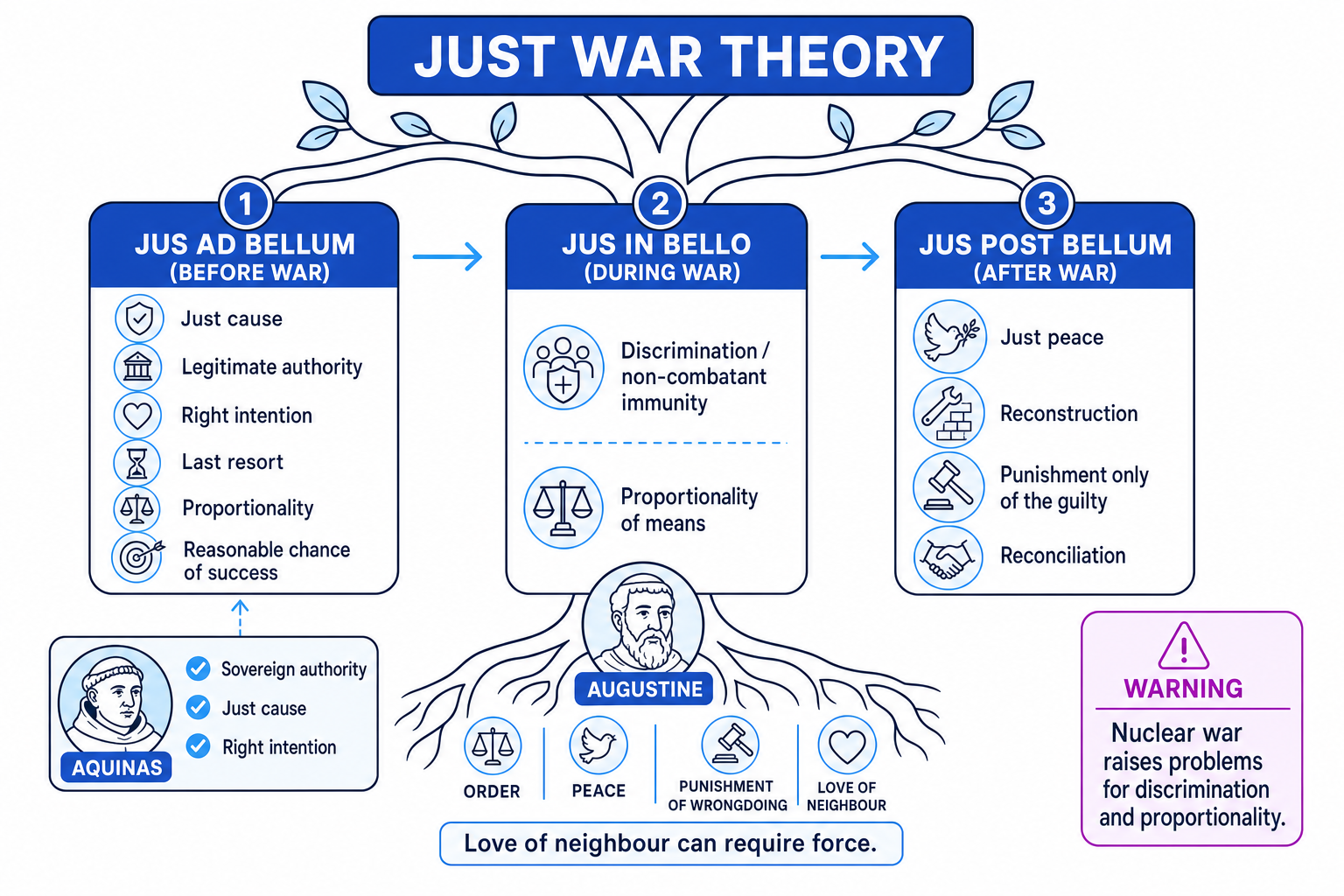
- How Just War Theory works through jus ad bellum, jus in bello and jus post bellum.
- How Augustine and Aquinas shaped Christian thinking about morally justified war.
- How to evaluate pacifism, nuclear war, and real conflicts in an Edexcel essay.
Why war and peace is an ethics issue
War is not just a political event. It raises moral questions about killing, defence, justice, intention, civilians, weapons, punishment and peace after conflict. Religious ethics asks whether war can ever be morally right — and, if so, under what limits.
For Edexcel, you need to know the contribution of at least one religion. The most natural religion here is Christianity, because the set thinkers are Augustine and Aquinas, both major Christian theologians.
Definition
War and peace
War is organised armed conflict between political communities or groups. Peace is not merely the absence of fighting; in Christian ethics it often means right order, justice, reconciliation and human flourishing.
Christianity: a tension in the sacred texts
Christianity contains both pacifist and Just War strands.
Some New Testament teachings seem strongly pacifist. Jesus says, “Blessed are the peacemakers” in Matthew 5:9, “Love your enemies” in Matthew 5:44, and “turn the other cheek” in Matthew 5:39. When Jesus is arrested, he tells Peter to put away his sword, saying that “all who take the sword will perish by the sword” in Matthew 26:52.
However, other texts have been used to support limited force. Romans 13 teaches that governing authorities have a role in restraining wrongdoing. Some Christians argue this means the state may use force to protect the innocent and preserve justice.
Key Idea
The Christian tension
Christian ethics does not give one simple answer on war. It holds together Jesus’ command to love enemies with the duty to protect neighbours from aggression and injustice.
Just War Theory
Definition
Just War Theory
Just War Theory is the view that war is sometimes morally justified, but only if strict conditions are met before, during and after war.
Just War Theory is not a blank cheque for violence. It is meant to limit war by asking whether force is genuinely necessary, proportionate and directed towards peace.
Augustine: war as a tragic duty
Augustine of Hippo was a fourth- and fifth-century Christian theologian. He argued that peace is the proper goal of human society. His famous idea of peace is tranquillitas ordinis, meaning the “tranquillity of order”: peace exists when society is rightly ordered under justice.
Augustine did not think war was good in itself. He saw it as a tragic consequence of sin. However, he believed that rulers might have a duty to use force to punish wrongdoing, restrain evil and protect the innocent.
For Augustine, the inner attitude matters. A Christian should not fight out of cruelty, revenge, greed or hatred. If force is used, it must be motivated by love of neighbour and aimed at restoring peace.
Definition
Right intention
Right intention means acting for a morally good purpose, such as restoring peace or protecting the innocent, rather than for revenge, conquest, hatred or profit.
Aquinas: three classic conditions
Thomas Aquinas, a thirteenth-century theologian, developed Just War thinking in the Summa Theologiae. He asked whether it is always sinful to wage war and gave three key conditions.
- Sovereign authority: war must be declared by the proper public authority, not by private individuals.
- Just cause: those attacked must deserve it because of some serious wrong, such as aggression.
- Right intention: the aim must be the advancement of good or the avoidance of evil.
Aquinas builds on Augustine. Like Augustine, he sees war as justified only if it is ordered towards peace and justice.
Tip
Remember Aquinas
Aquinas’ three classic conditions are: authority, cause, intention. Later Just War Theory adds more detailed criteria such as last resort, proportionality and reasonable chance of success.
The three parts of Just War Theory
Jus ad bellum: justice before war
Definition
Jus ad bellum
Jus ad bellum means “justice towards war”. It asks whether it is morally right to go to war in the first place.
Common criteria include:
- Just cause: for example, self-defence or protecting innocent people.
- Legitimate authority: war must be authorised by a recognised authority.
- Right intention: the aim must be peace and justice, not revenge or gain.
- Last resort: diplomacy, sanctions and negotiation must have been seriously tried.
- Proportionality: the expected good must outweigh the expected harm.
- Reasonable chance of success: it is wrong to cause massive suffering for a hopeless aim.
Jus in bello: justice during war
Definition
Jus in bello
Jus in bello means “justice in war”. It asks whether war is being fought morally once it has begun.
The key principles are:
- Discrimination: soldiers must distinguish between combatants and non-combatants.
- Non-combatant immunity: civilians should not be deliberately targeted.
- Proportionality of means: the force used must not be excessive.
Jus post bellum: justice after war
Definition
Jus post bellum
Jus post bellum means “justice after war”. It asks whether the peace settlement is fair and whether the defeated population is treated justly.
This includes reconstruction, reconciliation, fair trials, avoiding revenge, and building a stable peace.
Example
Applying Just War Theory to Russia’s invasion of Ukraine
-
Assess jus ad bellum: Russia’s invasion in 2022 is difficult to justify because it violated Ukraine’s sovereignty and was not a defensive response to an armed attack. Ukraine’s armed resistance has a much stronger claim to just cause because it is defending its territory and citizens.
-
Assess jus in bello: Even if one side has a just cause, it must still avoid deliberately targeting civilians. Attacks on homes, hospitals or energy infrastructure raise serious discrimination and proportionality concerns.
-
Assess jus post bellum: A just outcome would need more than a ceasefire. It would need security, accountability for war crimes, reconstruction and a settlement that does not reward aggression.
-
Reach a judgement: Just War Theory can clearly condemn aggression and defend self-defence, but it becomes harder to apply where evidence is contested, propaganda is widespread, or the conflict is ongoing.
Why Just War Theory developed
Early Christianity often leaned towards pacifism because Christians followed Jesus’ non-violent example and were a minority within the Roman Empire.
After Christianity became connected with political power, especially after Constantine, Christians had to ask new questions. Could a Christian emperor defend citizens? Could the state punish invaders? Could love of neighbour require protecting victims by force?
Just War Theory developed as a middle position between two extremes:
- Realism: the view that war is mainly about power and survival, not morality.
- Pacifism: the view that war or violence is morally unacceptable, either always or in many cases.
Common Mistake
Treating Just War Theory as pro-war
Just War Theory is not meant to make war easy to justify. Its purpose is to restrict war by setting demanding moral tests.
Examples of wars to evaluate
The Second World War
The Second World War is often used as a strong Just War example. The defeat of Nazi aggression gives a powerful just cause, and the liberation of occupied countries suggests a morally serious aim.
However, the war also raises problems. The bombing of Dresden and the atomic bombings of Hiroshima and Nagasaki raise questions about discrimination and proportionality. Even a war with a just cause can involve unjust methods.
The Iraq War 2003
The Iraq War is often used as a challenge to Just War Theory in practice. Supporters argued that Saddam Hussein was a tyrant and that weapons of mass destruction posed a threat. Critics argue that the evidence was weak, the war lacked clear United Nations authorisation, and the post-war planning was poor.
This makes Iraq useful for evaluating last resort, legitimate authority, reasonable chance of success and jus post bellum.
Nuclear war
Nuclear weapons create special problems for Just War Theory because their effects are massive, long-lasting and hard to control. Blast, fire, radiation and environmental damage make discrimination between combatants and civilians extremely difficult.
A limited nuclear strike might be defended by some as deterrence or self-defence, but full-scale nuclear war appears almost impossible to justify because it would be indiscriminate and disproportionate.
Definition
Nuclear deterrence
Nuclear deterrence is the policy of possessing nuclear weapons in order to discourage enemies from attacking, because they fear devastating retaliation.
Example
Evaluating nuclear deterrence
-
Apply intention: A government may claim its intention is defensive: to prevent war rather than fight one. This gives deterrence a stronger moral case than aggressive nuclear threats.
-
Apply discrimination: The threat still depends on being willing to use weapons that would likely kill large numbers of civilians. This clashes with non-combatant immunity.
-
Apply proportionality: If retaliation would cause mass destruction beyond any military objective, the threat appears disproportionate. This makes nuclear deterrence morally unstable within Just War Theory.
Pacifism
Definition
Pacifism
Pacifism is opposition to war and violence, usually because killing is seen as morally wrong or incompatible with peace, love and human dignity.
Absolute pacifism
Absolute pacifism rejects all war and violence in every circumstance. Many Christian pacifists appeal to Jesus’ teaching to love enemies and refuse retaliation.
Its strength is moral consistency. Its weakness is practicality: critics argue it may fail to protect innocent people from genocide, invasion or oppression.
Relative or selective pacifism
Relative pacifism, also called selective pacifism, rejects particular wars rather than all wars. A selective pacifist might oppose the Iraq War but support defensive resistance against invasion.
Its strength is flexibility. Its weakness is that it may become very close to Just War Theory, so the difference can become blurred.
Nuclear pacifism
Nuclear pacifism specifically rejects nuclear weapons and nuclear war. A nuclear pacifist may not oppose every conventional war, but argues that nuclear weapons are uniquely immoral because they are indiscriminate and disproportionate.
Common Mistake
Calling all pacifists absolute
Not all pacifists reject every possible use of force. Edexcel expects you to distinguish absolute, selective and nuclear pacifism.
Pacifist movements and pressure groups
Pacifist movements try to shape public conscience, law and government policy.
Examples include:
- Quakers, who have a long history of Christian pacifism, conscientious objection and humanitarian work.
- Fellowship of Reconciliation, a faith-based peace movement opposing war and promoting non-violence.
- Pax Christi, a Catholic peace movement focused on reconciliation, disarmament and justice.
- Campaign for Nuclear Disarmament, known as CND, which campaigns against nuclear weapons.
- Stop the War Coalition, which has organised protests against modern conflicts such as Iraq.
Their success is mixed. They may not always stop wars, but they can influence public debate, support conscientious objectors, challenge government narratives and keep moral scrutiny alive.
Is pacifism practical?
Pacifism has a powerful moral appeal because it refuses to mirror the violence it condemns. It also highlights the human cost of war, especially for civilians.
However, critics argue that absolute pacifism can be unrealistic in the face of aggressive evil. Augustine would argue that love of neighbour may require force to protect victims. Aquinas would ask whether legitimate authority, just cause and right intention are present.
Selective and nuclear pacifism are often more practical because they allow careful moral judgement. But they may struggle to explain exactly where the line should be drawn.
Does war ever have advantages?
Some argue that war has produced technological development: radar, computing, medicine, aviation, nuclear energy, GPS and the internet all have links to war or military competition.
But this is not a strong moral justification for war. A benefit that comes from war does not prove war was right. A Just War judgement must still consider intention, proportionality, civilian harm and whether peaceful alternatives were available.
Key Idea
Benefits do not automatically justify war
Even if war produces useful technology, this does not make war morally good. The ethical question is whether the war itself met the demands of justice.
Overall evaluation: Augustine and Aquinas today
Augustine’s strength is realism. He recognises that a fallen world may require force to restrain evil, but he insists that peace must remain the goal. Aquinas gives clearer criteria, especially authority, just cause and right intention.
The weakness is that governments can manipulate Just War language to justify wars they already want to fight. Iraq 2003 is a common example used by critics. Nuclear weapons also expose serious limits in the theory, because discrimination and proportionality are so difficult to maintain.
A balanced judgement might be: Just War Theory is highly successful as a moral framework for criticising war, but less successful at preventing unjust wars in practice. Pacifism gives a powerful witness to peace, but absolute pacifism may be difficult to defend when innocent life is under immediate threat.
Exam technique
In the exam
-
Start with the type of issue: sacred texts, Augustine/Aquinas, Just War criteria, pacifism, nuclear weapons or a named conflict.
-
Use the technical language precisely: jus ad bellum, jus in bello, jus post bellum, discrimination, proportionality, legitimate authority and right intention.
-
Evaluate throughout: do not just describe the theory. Test it against real wars, nuclear weapons, pacifism, and the views of Augustine and Aquinas.
Self review
Check yourself
- Can you explain Aquinas’ three conditions for a just war and link them to Augustine?
- Why do nuclear weapons create problems for discrimination and proportionality?
- Is pacifism more practical in its selective form than in its absolute form?

Keep learning
Make a free account to read the full revision notes and worked examples.