Revision notes for Edexcel AS Level Religious Studies Sexual Ethics. Open the guide for explanations and worked examples. Written against the Edexcel AS Level Religious Studies specification, so the content matches what's examinable rather than general Religious Studies background.
Sexual Ethics
What you'll learn
- How Christianity applies sacred texts to sex, marriage, contraception, childlessness and same-sex relationships.
- Why there is diversity within religion, not just a single “religious view”.
- How Peter Vardy and Jack Dominian shift the debate towards love, commitment and personal relationships.
- How to evaluate religious teaching, secular attitudes and ethical theory in an Edexcel essay.
1. What is sexual ethics?
Definition
Sexual ethics
Sexual ethics is the study of what makes sexual choices, relationships and practices morally right or wrong. It asks questions about consent, love, commitment, marriage, faithfulness, procreation, pleasure, equality and human dignity.
This topic is not just about listing rules. In an A-Level essay, you need to explain why a view is held, how it applies to real issues, and whether it remains convincing today.
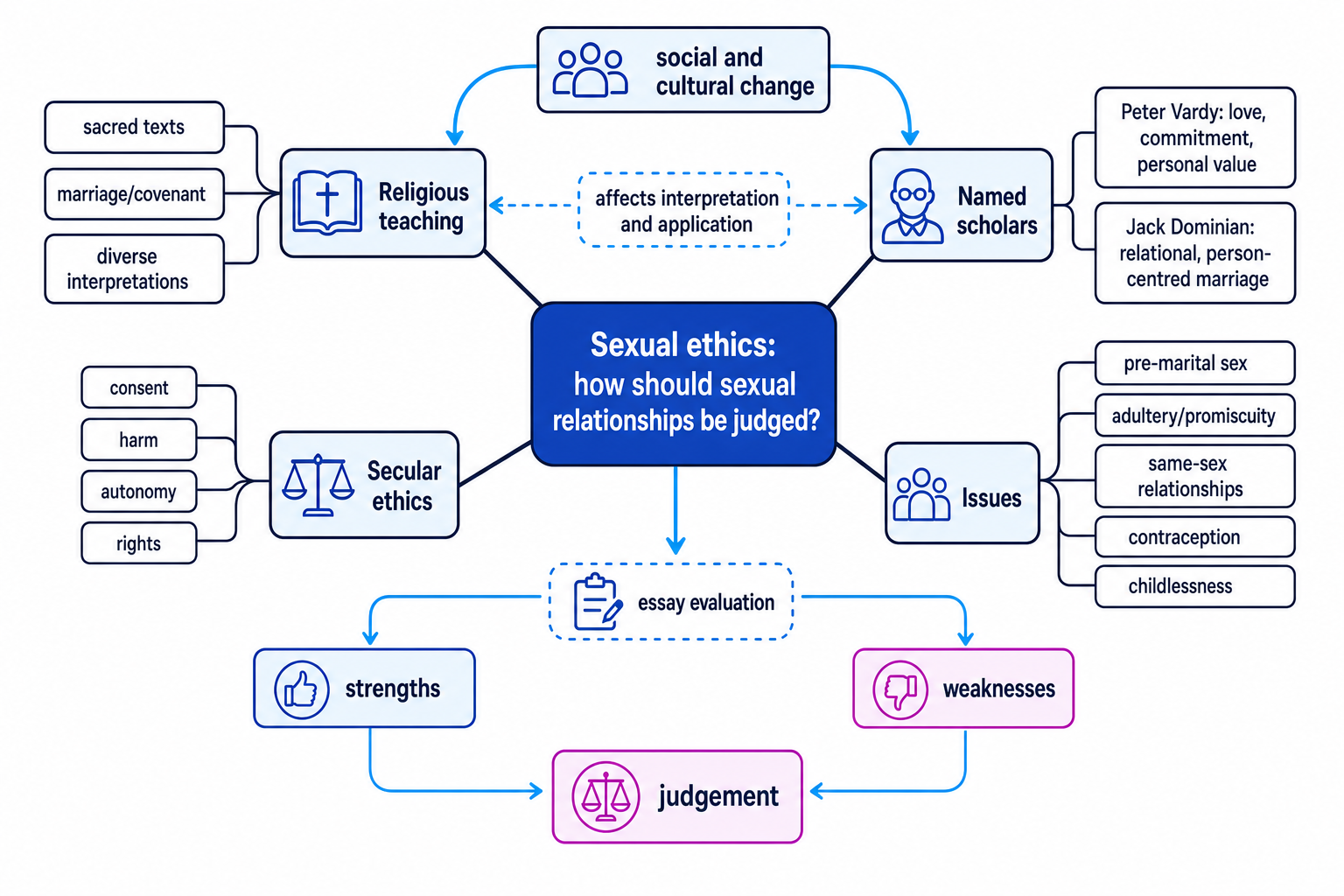
The map below shows the main “moving parts” of the topic: religious teaching, named scholars, secular approaches, specific issues, and evaluation.
2. Christianity as a world religion: key starting points
A sacred text is a writing treated by a religious community as authoritative for belief and practice. For Christianity, the Bible is central, but Christians disagree about how literally, contextually or pastorally it should be applied.
Marriage, covenant and “one flesh”
In Genesis 2:24, a man and woman become “one flesh”. Traditional Christians often interpret this as support for sex within marriage. A covenant is a solemn, binding promise; marriage is therefore not just a private romantic choice but a public commitment before God and the community.
In the Ten Commandments, adultery is prohibited: “You shall not commit adultery” (Exodus 20:14). Jesus also intensifies sexual morality by warning against lustful objectification in Matthew 5:28. Paul writes in 1 Corinthians 6 that the body is a “temple of the Holy Spirit”, so sex is morally serious, not merely physical.
Procreation and union
Definition
Procreative and unitive meanings
The procreative meaning of sex concerns openness to having children. The unitive meaning concerns the bonding, intimacy and mutual self-giving of the couple.
Roman Catholic teaching traditionally holds that sex should keep these two meanings together. This is why Catholic teaching rejects artificial contraception, especially in Humanae Vitae (1968), while allowing natural family planning. Many Protestant and Anglican approaches are more accepting of contraception within marriage as responsible parenthood.
Key Idea
The basic Christian tension
Christian sexual ethics often balances clear rules about marriage, faithfulness and procreation with broader values such as love, commitment, dignity, justice and pastoral care.
3. Diversity within Christian approaches
It is much too simple to write “Christians believe…” and then give one view. There are conservative, Catholic, evangelical, Anglican, liberal and progressive Christian positions.
| Issue | More traditional Christian approach | More liberal or revisionist Christian approach |
|---|---|---|
| Sex within marriage | Sex belongs in lifelong heterosexual marriage. | Marriage is important, but the moral focus may be commitment, love and faithfulness. |
| Pre-marital sex | Usually wrong because it lacks the covenant of marriage. | May be judged by the quality and seriousness of the relationship. |
| Adultery | Wrong because it breaks vows, trust and covenant. | Also wrong, usually because of betrayal and harm. |
| Promiscuity | Wrong because sex is separated from commitment. | Often criticised if it objectifies people or causes harm. |
| Same-sex relationships, marriage and civil partnership | Same-sex sexual acts may be rejected using texts such as Leviticus 18:22 or Romans 1; marriage is seen as male-female. | Texts may be read as culturally specific; committed same-sex marriage or civil partnership may be affirmed as loving and faithful. |
| Contraception | Catholic teaching rejects artificial contraception; some Protestants accept it. | Often accepted as responsible, especially where it protects health, family stability and mutual care. |
| Childlessness | Marriage should be open to children, but infertility is not a moral failure. | Chosen childlessness may be accepted if responsible; celibacy is also honoured in Christianity. |
Common Mistake
Treating religion as one voice
Avoid writing “religion is against sex” or “Christians reject homosexuality”. Better: “Some traditional Christian approaches argue…, whereas liberal Christians argue…”
4. Applying Christian teaching to sexual issues
Pre-marital sex, adultery and promiscuity
Pre-marital sex means sex before marriage. Traditional Christian teaching normally rejects it because sex is seen as belonging to the covenant of marriage. Paul’s advice in 1 Corinthians 7 is often used: if people cannot remain celibate, they should marry.
Adultery means sexual unfaithfulness within marriage. This is strongly condemned across almost all Christian traditions because it breaks vows and damages trust. Promiscuity means repeated sexual relationships without stable commitment; the term can sound judgemental, so in essays define the behaviour rather than using it as an insult.
Example
Applying Christianity to pre-marital sex
- First, identify the traditional rule: if sex belongs within the marriage covenant, then sex before marriage lacks the public promise of lifelong faithfulness.
- Next, consider relational values: if the couple are loving, faithful and responsible, a more liberal Christian may ask whether the relationship already contains the moral goods marriage is meant to protect.
- Then evaluate the disagreement: the traditional view has clarity and protects commitment, but the liberal view may seem more pastoral because it judges the quality of the relationship rather than legal status alone.
Same-sex relationships, marriage and civil partnership
Christian debate over same-sex relationships often turns on biblical interpretation. Conservative Christians argue that scripture presents marriage as male-female and that passages such as Romans 1 reject same-sex sexual acts. Inclusive Christians reply that biblical condemnations may refer to exploitative, idolatrous or culturally specific practices, not modern loving same-sex partnerships.
In the UK, civil partnerships and same-sex marriage have also changed the social context. Some churches distinguish civil rights from religious marriage. Others now bless or affirm same-sex unions because they see covenant love, fidelity and justice as the central Christian values.
Contraception and childlessness
Contraception raises the question: must every sexual act be open to procreation? Traditional Catholic Natural Law says yes, because sex has a God-given purpose. Many other Christians argue that contraception can support responsible parenthood, protect health, and strengthen marriage.
Childlessness can be due to infertility, circumstance, or choice. Christianity values children, but it also honours celibacy: Jesus and Paul were unmarried. So it is inaccurate to say every Christian must have children.
5. Peter Vardy and Jack Dominian
Peter Vardy
Peter Vardy is a Christian philosopher associated with a more personal and relational approach to sexual ethics. He does not reduce sex to biology or reproduction. For Vardy, sexual ethics should ask whether a relationship expresses love, mutual respect, fidelity and commitment.
This means Vardy can be used to challenge both extremes: he would resist a casual “anything goes” attitude, but he also pushes back against rigid rule-following that ignores the actual quality of the relationship.
Jack Dominian
Jack Dominian was a Catholic psychiatrist and writer on marriage. His approach is often described as personalist, meaning it focuses on the development and flourishing of persons. Dominian emphasises marriage as a relationship of emotional intimacy, communication, tenderness and growth.
Dominian is important because he challenges a purely procreative view of sex. He still values stable commitment, but he argues that sex has a deep relational purpose: it helps people give and receive love.
| Scholar | Main emphasis | Strength | Possible weakness |
|---|---|---|---|
| Vardy | Love, commitment, dignity and personal value | Avoids legalism and applies well to modern relationships | May seem too flexible or unclear |
| Dominian | Marriage as personal, emotional and relational growth | Psychologically realistic and pastoral | May conflict with stricter Catholic teaching |
Example
Comparing Vardy and Dominian on contraception
- Start with the issue: contraception separates sex from possible conception, so traditional Catholic Natural Law sees it as morally wrong.
- Apply Dominian: if contraception supports marital love, health and responsible family life, it may strengthen the relationship rather than undermine it.
- Apply Vardy: the key question is whether contraception serves mutual respect and commitment, or whether it enables selfishness or exploitation.
- Evaluate: Vardy and Dominian are pastorally strong, but critics may argue that they give less clear authority than traditional teaching.
6. Secular ethical approaches and social change
Definition
Secular ethical approach
A secular ethical approach makes moral judgements without relying on religious authority. It may appeal to consent, autonomy, harm, equality, rights and wellbeing.
Modern Western sexual ethics is strongly shaped by social and cultural change: reliable contraception, feminism, LGBTQ+ rights, changing divorce laws, cohabitation, online dating, pornography, and declining religious authority.
A consent-based approach argues that sexual activity is morally acceptable if all involved are informed, free and willing. A harm-based approach asks whether anyone is damaged physically, emotionally or socially. A rights-based approach stresses equality and non-discrimination, especially in debates about same-sex marriage and civil partnership.
Ethical theories can help structure this:
- Utilitarianism judges by consequences, so it may support contraception and same-sex marriage if they increase wellbeing and reduce suffering.
- Kantian ethics stresses treating people as ends in themselves, so it strongly condemns coercion, deception and objectification.
- Situation Ethics, associated with Joseph Fletcher, judges by agape love, so it may allow flexibility where rules fail to serve persons.
- Natural Law, associated with Aquinas, gives clear purposes for sex, especially procreation, but may be criticised as too biological.
Example
Assessing adultery using secular theories
- A utilitarian would consider the likely consequences: betrayal, family breakdown, emotional harm and loss of trust usually make adultery wrong.
- A Kantian would focus on duty and honesty: adultery breaks a promise and treats the spouse as a means rather than an end.
- Situation Ethics would ask what love requires, but secret betrayal is rarely the most loving option.
- So adultery can be condemned by secular reasoning as well as religious teaching; it is not only a “religious taboo”.
7. Continuing relevance and evaluation
Religious teachings remain relevant because they offer a serious vision of sex as meaningful, committed and connected to human dignity. They can challenge consumerist attitudes where people are treated as disposable. They also support stable family life and give communities shared moral guidance.
However, weaknesses are important. Some traditional teachings developed in patriarchal cultures where women had less power. Strict approaches can marginalise LGBTQ+ people, unmarried couples, divorced people or those who are childless. If religious ethics seems to ignore love, consent and equality, it may lose credibility.
Changing social attitudes also have strengths and weaknesses. Their strengths include greater attention to consent, women’s equality, LGBTQ+ rights, and compassion for different family forms. Their weaknesses include the risk of individualism, pressure to be sexually active, objectification, and weakened commitment.
A strong final judgement might be: religious sexual ethics is most convincing when interpreted through love, covenant, dignity and justice, as Vardy and Dominian suggest. It is less convincing when it becomes merely rule-based or ignores the lived reality of relationships.
Exam technique
In the exam
- Use specific issues: pre-marital sex, adultery, same-sex marriage or civil partnership, contraception and childlessness.
- Compare Vardy and Dominian directly; do not just name-drop them.
- Balance sacred texts with diversity of interpretation and changing social attitudes.
- Reach a justified judgement about whether religious teaching and ethical theory still help people make sexual decisions.
Self review
Check yourself
- How might Genesis 2:24 and 1 Corinthians 7 be used to support sex within marriage?
- What is the difference between official Catholic teaching on contraception and Dominian’s relational approach?
- Why might a secular consent-based approach still criticise adultery or promiscuity?

Keep learning
Make a free account to read the full revision notes and worked examples.