Revision notes for Edexcel AS Level Religious Studies Natural Moral Law. Open the guide for explanations and worked examples. Written against the Edexcel AS Level Religious Studies specification, so the content matches what's examinable rather than general Religious Studies background.
Natural Moral Law
What you'll learn
- How Natural Moral Law links morality to purpose, reason and God’s created order.
- How Aquinas derives primary and secondary precepts.
- How Bernard Hoose’s proportionalism adapts Natural Law for difficult moral cases.
- How to evaluate the theory against modern law, social attitudes and religious ethics.
1. The basic idea: morality is built into human nature
Natural Moral Law is the view that there is an objective moral order which human beings can discover through reason. “Natural” does not mean “whatever happens in nature”; it means morality is grounded in the purpose and structure of human nature.
For Aquinas, God creates the world with order and purpose. Human beings, because they are rational, can understand enough of this order to know how they ought to live.
Definition
Natural Moral Law
Natural Moral Law is an objective moral theory which says that human reason can discover moral rules by understanding the purposes built into human nature and creation.
Common Mistake
Natural does not mean instinctive
Do not argue that Natural Law says “animals do it, so humans should too”. Aquinas is not copying animal behaviour; he is asking what fulfils rational human nature.
2. Absolutism, legalism and telos
Before Aquinas, you need three key ideas.
Definition
Absolutism and legalism
- Ethical absolutism is the view that some moral rules are objectively true and apply regardless of culture, feelings or consequences.
- Legalism is a strict rule-based approach which can seem to prioritise obedience to law over context, compassion or intention.
Natural Moral Law is often treated as absolutist, because it claims that some acts are wrong because they directly frustrate basic human goods. However, Aquinas should not be reduced to crude legalism. For him, law must be an “ordinance of reason” directed towards the common good.
The other essential word is telos. This means the final purpose or end of something. Aristotle argued that things are understood by their purpose; Aquinas develops this into a Christian moral theory. The telos of human life is not merely survival or pleasure, but true flourishing and ultimately union with God.
3. Classical and biblical foundations
Natural Moral Law did not appear from nowhere. Aquinas draws together several traditions.
Classical foundations
Aristotle’s influence is central. Aristotle believed that everything has a purpose and that human beings flourish by using reason well. Aquinas takes this teleological approach and gives it a Christian framework.
The Stoics also influenced Natural Law. They believed the universe is ordered by reason, sometimes called the logos, and that wise people live according to this rational order. Cicero later argued that true law is right reason in agreement with nature, not merely human convention.
Biblical foundations
Natural Law also fits several biblical ideas. Genesis presents creation as ordered and good, with human beings made in the image of God. Romans 2 suggests that even Gentiles, who do not have the Jewish Law, can have the law “written on their hearts”. This supports Aquinas’ view that moral knowledge is available through reason, not only through scripture.
The Ten Commandments and Jesus’ summary of the law — love God and love neighbour — also connect with Aquinas’ precepts: worship God, preserve life and live in society.
4. Aquinas’ structure of law
Aquinas sets out his theory in the Summa Theologiae. He distinguishes several kinds of law:
- Eternal law: God’s rational ordering of the whole universe.
- Natural law: human participation in eternal law through reason.
- Divine law: law revealed by God, such as scripture.
- Human law: civil law made by societies, which should reflect natural law and serve the common good.
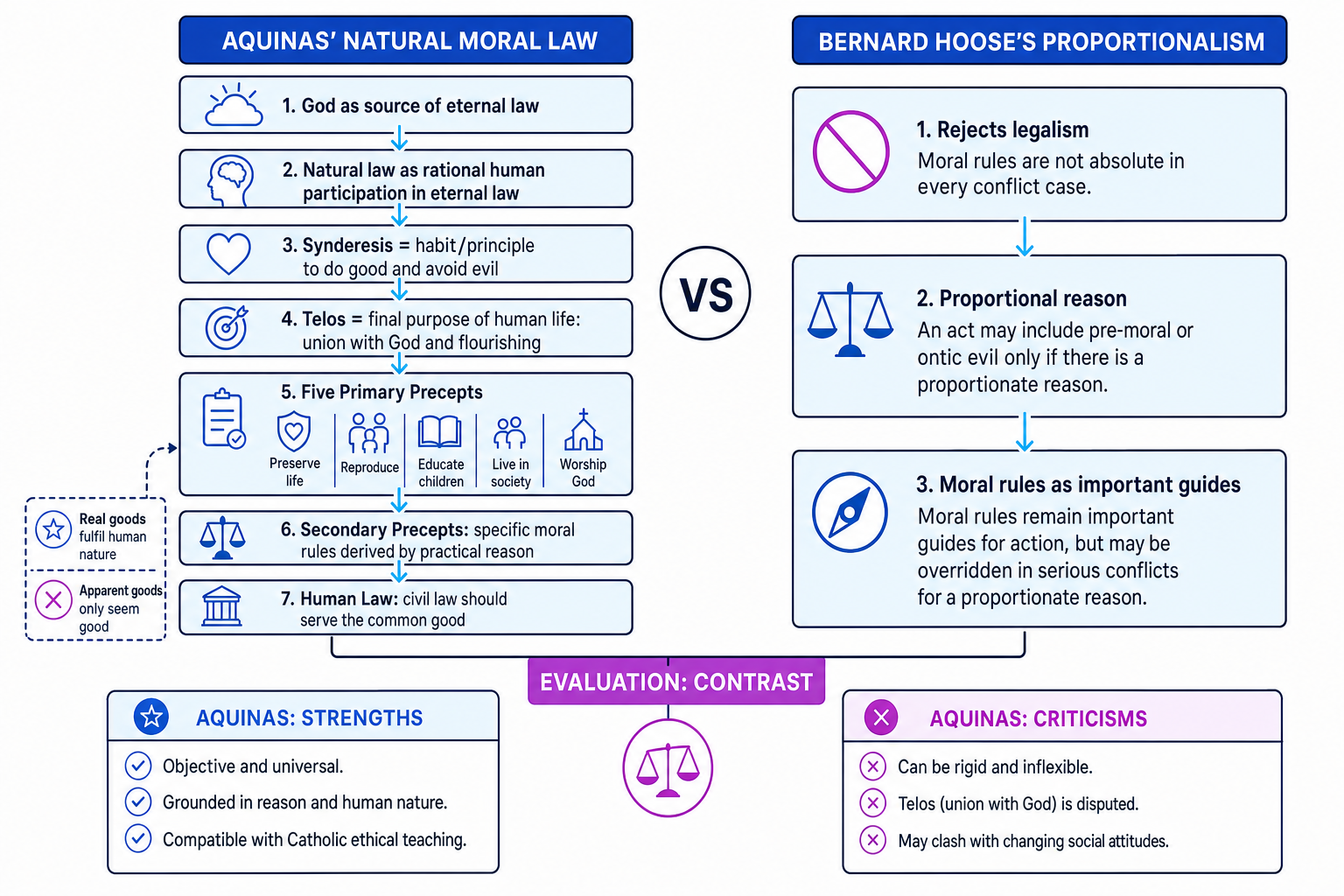
The map below shows how Aquinas’ theory moves from God’s eternal law to practical moral rules, and how Hoose’s proportionalism modifies the approach.
Key Idea
Aquinas in one sentence
For Aquinas, morality is discovered when rational humans identify the purposes God has built into human nature and act in ways that fulfil those purposes.
Aquinas also uses the term synderesis. This means the basic habit of practical reason by which we grasp the first moral principle: good is to be done and pursued, and evil is to be avoided. Conscience then applies this principle to particular situations, though it can make mistakes.
5. Primary and secondary precepts
A precept is a moral rule or command. Aquinas’ primary precepts are the most basic principles of Natural Law. They are usually listed as:
- Preserve life.
- Reproduce.
- Educate children.
- Live in an ordered society.
- Worship God.
From these, humans derive secondary precepts: more specific moral rules for particular situations. For example, from “preserve life” one might derive “do not murder” and “protect the vulnerable”.
Aquinas also distinguishes real goods from apparent goods. A real good truly fulfils human nature. An apparent good only seems good, perhaps because it gives pleasure or avoids pain, but actually leads us away from our telos.
Example
Applying Natural Law to assisted dying
- Start with the relevant primary precept: preserve life. Aquinas would treat innocent human life as a basic good that should not be directly attacked.
- Identify the moral object of the act. If assisted dying involves intentionally causing death to end suffering, Aquinas would see it as frustrating the purpose of preserving life.
- Derive a secondary precept: “Do not intentionally kill innocent human life.” This rule is not based only on consequences, but on the kind of act being chosen.
- Compare a different case: giving pain relief at the end of life may be allowed under the doctrine of double effect, if the intention is pain relief and any shortening of life is a foreseen side effect, not the chosen means.
- Evaluate the pressure point: compassion is morally important, but Aquinas would argue that compassion cannot justify choosing an intrinsically wrong means.
6. Contemporary applications and pressure points
Natural Moral Law remains influential, especially in Roman Catholic moral teaching, but it faces pressure in modern society.
Contraception and sex
Traditional Natural Law argues that sex has a procreative purpose. Artificial contraception is therefore often judged wrong because it deliberately separates sex from reproduction. This connects with Catholic teaching such as Humanae Vitae.
However, many modern societies legally and socially accept contraception as part of responsible family planning. Critics argue that Natural Law can reduce sex to biology and neglect love, consent and mutual commitment.
Abortion and embryo ethics
Aquinas’ precept to preserve life is used to oppose abortion and embryo destruction. Supporters argue this protects vulnerable human life. Critics reply that complex cases, such as rape, severe disability or risk to the mother’s life, show the need for a more flexible approach.
Same-sex relationships
Traditional Natural Law has often opposed same-sex sexual acts because they are not ordered towards reproduction. This now clashes sharply with changing social attitudes and laws, including same-sex marriage in the UK. Supporters of Natural Law may reply that law and popular opinion do not determine moral truth. Critics argue that the theory fails to recognise faithful, loving relationships as genuine human goods.
Tip
Use social change carefully
Do not simply write “society disagrees, so Natural Law is wrong”. A stronger evaluation is that social change tests whether Natural Law’s claim to universal human purpose is persuasive in a pluralist society.
7. Bernard Hoose and proportionalism
Bernard Hoose is a Catholic moral theologian associated with proportionalism, an adaptation of Natural Law. He rejects a purely legalistic approach where rules are applied without attention to context.
Definition
Proportionalism
Proportionalism is the view that moral rules are important guides, but an action involving a non-moral or “ontic” evil may be justified if there is a proportionate reason.
An ontic evil or pre-moral evil is a harm such as pain, death, infertility or loss. Hoose argues that not every physical harm is automatically a moral evil. What matters is whether there is a proportionate reason for allowing that harm.
This does not mean “anything goes”. Hoose is not simply a situation ethicist or crude consequentialist. He keeps moral norms, but he denies that every rule should be applied as exceptionless legalism in conflict cases.
Example
Applying proportionalism to contraception
- Begin with the Natural Law norm: sex should normally remain open to procreation, so contraception involves the pre-moral disvalue of blocking fertility.
- Weigh the relevant goods and disvalues in context, such as serious risk to a woman’s health, responsibility to existing children, marital stability and the value of life.
- Ask whether there is a proportionate reason. Hoose may judge contraception morally permissible if preventing pregnancy protects life and family welfare in a serious way.
- Compare Aquinas: Aquinas is more likely to treat directly frustrating the procreative purpose of sex as wrong, whereas Hoose treats the rule as a strong guide rather than an absolute in every case.
8. Strengths of Natural Moral Law
One major strength is objectivity. Natural Law offers a stable moral framework rather than leaving ethics to personal preference or cultural fashion. This is useful in debates about human rights, justice and protection of the vulnerable.
A second strength is that it values reason. Aquinas does not say “obey because God says so” in a simplistic way. He argues that human beings can rationally understand the good. This makes the theory potentially accessible beyond religious believers.
A third strength is its focus on human flourishing and the common good. It asks what kind of life fulfils human nature, not just what produces pleasure or satisfies individual choice.
9. Weaknesses and evaluation
The biggest weakness is disagreement about human purpose. Aquinas assumes a created order with God as its source. In a secular or pluralist society, many people reject this foundation. If there is no agreed telos, the secondary precepts become much less convincing.
Another criticism is rigidity. In hard cases, absolutist rules can seem lacking in compassion. Hoose’s proportionalism is attractive because it handles conflict cases more sensitively. However, critics of Hoose argue that proportionalism risks collapsing into consequentialism: if enough good consequences can justify breaking a rule, are any acts truly intrinsically wrong?
A further challenge is the relationship between morality and law. Aquinas thinks human law should reflect natural law and serve the common good. But many modern laws and attitudes now diverge from traditional Natural Law on contraception, divorce, abortion and sexuality. This raises the question of whether Natural Law is a timeless moral guide or an outdated framework shaped by older assumptions about biology, gender and religion.
10. Compatibility with religious approaches
Natural Moral Law is strongly compatible with Roman Catholic ethics because it links reason, creation and God’s purpose. It also fits biblical ideas about creation, conscience and moral order.
However, not all religious approaches agree with it. Some Protestant thinkers are more suspicious of human reason because of sin and may stress scripture or grace instead. Situation ethics, associated with Joseph Fletcher, rejects legalism and prioritises agape love in each situation. Hoose’s proportionalism can be seen as a middle path: still Catholic and rule-aware, but more flexible and pastoral.
A balanced judgement is that Aquinas gives Natural Law its intellectual strength: objective, rational and purpose-based. Hoose exposes its main weakness: strict rule application can struggle with complex moral reality. The best essays usually argue that Natural Law remains powerful, but only if you address whether its view of human telos is still believable today.
Exam technique
In the exam
- Build Aquinas clearly: eternal law → natural law → synderesis → primary precepts → secondary precepts → application.
- Compare Aquinas and Hoose directly: Aquinas stresses objective purposes and stronger absolutes; Hoose stresses proportionate reason in conflict cases.
- Evaluate using examples, not vague claims: contraception, assisted dying, abortion or same-sex relationships can show how law and social attitudes challenge the theory.
Self review
Check yourself
- What is the difference between a primary precept and a secondary precept?
- Why might Hoose say proportionalism is not the same as “do whatever has the best consequences”?
- How could changing social attitudes both challenge and fail to disprove Natural Moral Law?

Keep learning
Make a free account to read the full revision notes and worked examples.