Revision notes for Edexcel AS Level Religious Studies Titles of Jesus in the synoptic gospels and selected 'I am' sayings in John. Open the guide for explanations and worked examples. Written against the Edexcel AS Level Religious Studies specification, so the content matches what's examinable rather than general Religious Studies background.
Titles of Jesus in the synoptic gospels and selected 'I am' sayings in John
What you'll learn
- How the titles Messiah, Son of God and Son of Man work in the synoptic gospels.
- How John’s selected “I am” sayings present Jesus through rich Jewish symbolism.
- Why Old Testament background is essential for interpreting Jesus’ identity.
- How different understandings of Jesus shape Christian ethics, law and wider society.
Starting point: what is a “title” of Jesus?
A title is more than a nickname. In the Gospels, titles such as “Messiah” or “Son of God” are theological claims about who Jesus is and what his mission means.
Definition
Christology
Christology means the study of the person, identity and significance of Jesus Christ. In this topic, you are mainly asking: Who do the Gospels say Jesus is, and what difference does that make?
The synoptic gospels are Matthew, Mark and Luke. They are called “synoptic” because they can be “seen together”: they share many stories, structures and sayings. John’s Gospel is different in style and theology, especially in its long symbolic speeches and “I am” sayings.
The titles are easiest to understand as a map of Jesus’ identity.
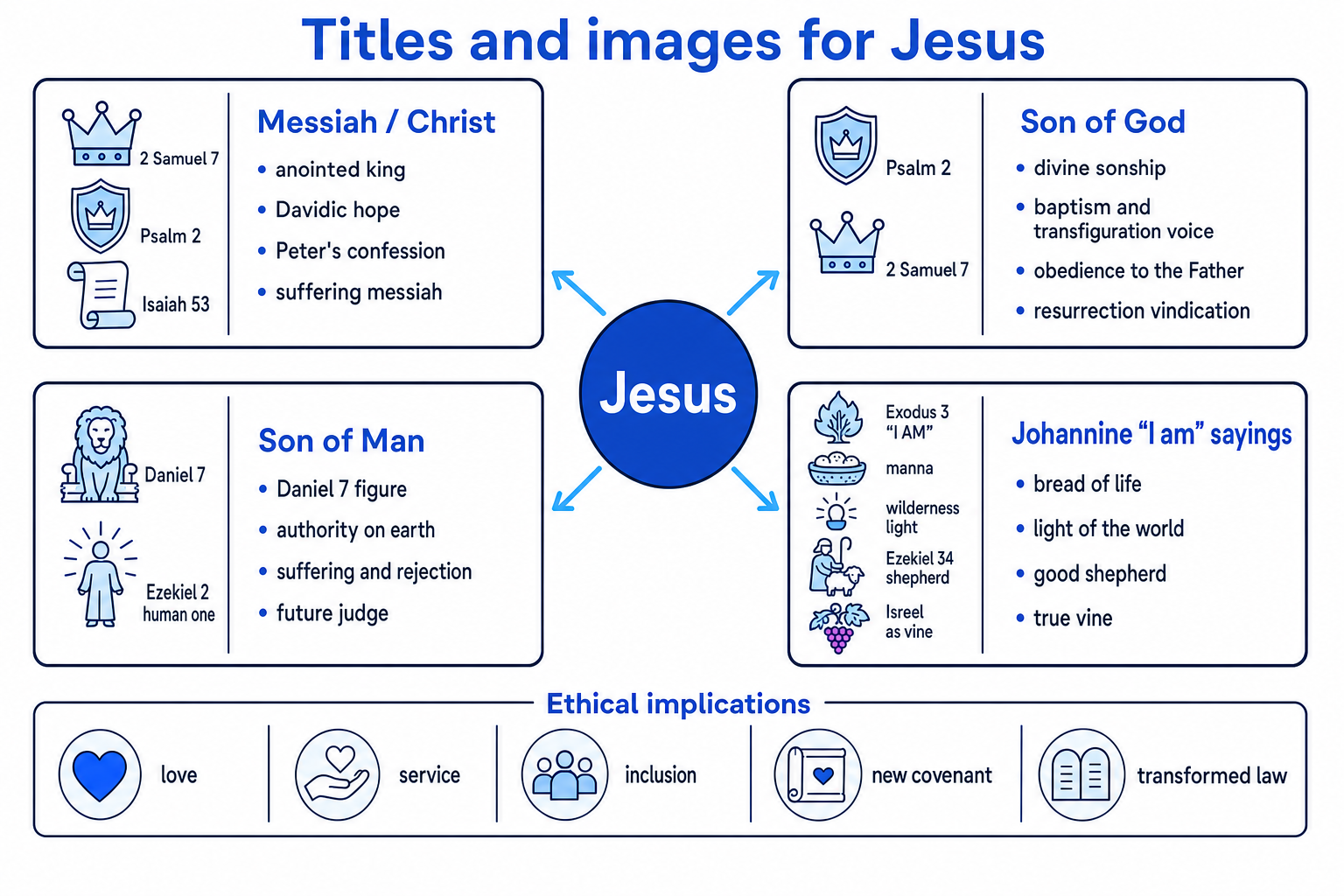
Messiah / Christ
Definition
Messiah
Messiah comes from the Hebrew word meaning “anointed one”. The Greek equivalent is Christos, from which we get “Christ”. In Jewish tradition, kings, priests and sometimes prophets could be anointed as a sign of being chosen for God’s work.
In the Old Testament, messianic hope is linked especially with the line of David. Key background texts include 2 Samuel 7, where God promises David an enduring dynasty, and Psalm 2, where the king is described as God’s anointed.
In the synoptic gospels, Jesus is recognised as Messiah, but the title is redefined. Peter confesses Jesus as the Messiah in Mark 8:29, but Jesus immediately teaches that the Son of Man must suffer. This is crucial: Jesus is not presented as a simple military liberator.
Key Idea
Messiah redefined
The synoptic gospels present Jesus as Messiah, but they reshape messianic expectation around suffering, service, death and resurrection, not political violence.
Why this matters
If Jesus is Messiah, then his followers owe him loyalty. But because his kingship is shown through suffering service, Christian discipleship becomes shaped by humility, forgiveness and self-giving love rather than domination.
Son of God
Definition
Son of God
Son of God can mean a uniquely close relationship with God, but its meaning develops across Scripture. In the Old Testament it can refer to Israel, the king, or a chosen representative of God.
The background includes Exodus 4:22, where Israel is called God’s son, and Psalm 2:7, where the king is addressed as God’s son. In the synoptics, the title appears at key moments:
- At Jesus’ baptism, the heavenly voice says, “You are my Son, the Beloved” in Mark 1:11.
- At the transfiguration, the voice says, “This is my Son, the Beloved; listen to him” in Mark 9:7.
- At the crucifixion, the centurion says, “Truly this man was God’s Son” in Mark 15:39.
The title therefore connects Jesus’ identity with divine approval, obedience and revelation. Importantly, the cross is not a failure of sonship; Mark presents it as the place where Jesus’ identity is paradoxically revealed.
Common Mistake
Reading later doctrine too quickly
Do not assume every use of “Son of God” automatically means the full later doctrine of the Trinity. In the Gospels, the title has Jewish royal and covenant background, though John especially develops it into a much higher Christology.
Son of Man
Definition
Son of Man
Son of Man can mean “human being”, but in the Gospels it becomes a major title Jesus uses for himself. It carries ideas of humanity, suffering, authority and future vindication.
The key Old Testament background is Daniel 7, where “one like a son of man” comes with the clouds of heaven and receives authority, glory and kingship from God. There is also a more ordinary background in Ezekiel, where “son of man” means a mortal human addressed by God.
In the synoptics, Son of Man sayings usually fall into three groups:
- Present authority — the Son of Man has authority to forgive sins and is “lord even of the Sabbath” in Mark 2.
- Suffering and death — the Son of Man must suffer, be rejected and be killed.
- Future glory and judgement — the Son of Man will come in glory.
Example
Interpreting Son of Man in Mark
- Start with the immediate context: in Mark 2, Jesus heals and forgives a paralysed man, causing controversy because forgiveness is seen as God’s authority.
- Connect the title to the claim being made: when Jesus says the Son of Man has authority on earth to forgive sins, the title is not just about being human; it is linked with divine authority.
- Compare this with later passion predictions: the same Son of Man who has authority must also suffer, so Mark combines exalted authority with humiliation.
- Draw the interpretation: Mark presents Jesus as the authoritative agent of God whose mission is revealed through suffering service.
John’s “I am” sayings
John’s Gospel contains several sayings where Jesus says “I am…” followed by a symbol. The selected sayings for this topic are:
- “I am the bread of life” — John 6:35.
- “I am the light of the world” — John 8:12.
- “I am the good shepherd” — John 10:11.
- “I am the true vine” — John 15:1.
These are not random metaphors. They draw on Old Testament imagery and Jewish religious life.
Bread of life
This saying follows the feeding of the five thousand and recalls manna, the bread God gave Israel in the wilderness in Exodus. Jesus is presented as the one who gives true life, not merely physical food.
Light of the world
Light symbolises revelation, guidance, truth and salvation. It recalls creation, the pillar of fire in the wilderness, and Jewish associations of Torah and wisdom with light. In John, Jesus reveals God and exposes darkness.
Good shepherd
This draws on Psalm 23 and Ezekiel 34, where bad shepherds represent failed leaders and God promises to shepherd his people. Jesus as the good shepherd knows his sheep and lays down his life for them.
True vine
In the Old Testament, Israel is often described as God’s vine or vineyard, for example in Isaiah 5 and Psalm 80. In John 15, Jesus is the true vine and disciples are branches who must “abide” in him and bear fruit.
Key Idea
John’s symbols
John uses familiar Jewish symbols — bread, light, shepherd and vine — to claim that Jesus fulfils what Israel hoped for from God: life, revelation, care and covenant fruitfulness.
Brown and Dodd: two key scholars
Raymond E. Brown argues that Gospel titles often have layers of meaning. A title may begin with a Jewish background, be used during Jesus’ ministry, and then be deepened by the early Christian community after the resurrection. Brown is especially important for John because he sees the Fourth Gospel as the product of theological reflection within the Johannine community, not simply a transcript of Jesus’ exact words.
C. H. Dodd is famous for realised eschatology.
Definition
Realised eschatology
Realised eschatology is the view that the blessings of the end time — judgement, eternal life and salvation — are already present in the ministry of Jesus, not only postponed to the future.
Dodd argued that John’s symbols are deeply rooted in Jewish Scripture and religious thought. For Dodd, John is not abandoning history but interpreting Jesus’ significance symbolically: eternal life is encountered now through response to Jesus.
Comparing them
Brown helps you avoid oversimplifying the titles. He would encourage you to ask how each title developed from Jewish expectation into Christian confession.
Dodd helps you see why John’s “I am” sayings are not decorative language. They present Jesus as the present fulfilment of God’s promises.
Tip
Using Brown and Dodd well
A strong essay can use Brown for development and layered Christology, and Dodd for symbolism and realised eschatology. Then evaluate whether John’s high Christology is faithful interpretation or later theological expansion.
Implications for religious laws and codes of living
Different understandings of Jesus’ identity lead to different ethical emphases.
If Jesus is Messiah, Christians may understand him as the true king. This challenges loyalty to political power when it conflicts with God’s kingdom. However, because Jesus’ messiahship is suffering service, it supports non-violence, humility and care for the poor.
If Jesus is Son of God, Christian ethics becomes imitation of Jesus’ obedience and intimacy with the Father. The command to love God and neighbour is deepened by Jesus’ own example of forgiveness and self-giving.
If Jesus is Son of Man, Jesus has authority over religious practice. In Mark 2:27, “The Sabbath was made for humankind, and not humankind for the Sabbath.” This does not abolish law, but it suggests that religious law should serve mercy, restoration and human flourishing.
If Jesus is the bread, light, shepherd and vine, Christian life becomes a life of dependence on him. This influences worship, Eucharistic practice, pastoral care, moral guidance and the command to “bear fruit” in love.
These ideas also influence life beyond religious communities. Jesus as servant-king has shaped models of servant leadership. Jesus as good shepherd has influenced ideals of pastoral care, charity, education and protection of the vulnerable. Jesus’ challenge to legalism has also contributed to wider debates about whether laws should be applied rigidly or interpreted through compassion.
Common Mistake
Separating identity from ethics
Do not treat the titles as abstract labels. In the Gospels, who Jesus is always affects how people should live.
Evaluation: how convincing are these titles?
One strength of the Gospel titles is that they are rooted in Jewish Scripture. This gives continuity: Jesus is interpreted through Israel’s hopes, symbols and covenant language. Dodd supports this by showing that John’s imagery is not random Greek philosophy but deeply connected to Jewish tradition.
However, there is also diversity. “Messiah” in Mark is secretive and suffering; “Son of God” in John is much more explicit and exalted. Brown’s layered approach is helpful because it explains why the same title can carry different levels of meaning in different Gospel contexts.
A critical issue is whether these titles go back to Jesus himself or reflect later Christian belief. Brown would allow for development within the community, while still seeing that development as rooted in Jesus’ impact. Dodd would argue that symbolic interpretation can reveal truth even if it is not straightforward biography.
A balanced judgement is that the titles are best read both historically and theologically. Historically, they emerge from Jewish expectation and early Christian experience. Theologically, they present Jesus as the one who fulfils and transforms those expectations.
Exam technique
In the exam
- Define each title precisely, then connect it to a Gospel passage and an Old Testament background.
- Use Brown and Dodd analytically: Brown for layered development, Dodd for symbolism and realised eschatology.
- Always move from identity to significance: explain what the title implies for discipleship, law, ethics and wider society.
Self review
Check yourself
- How does Mark redefine the title “Messiah” through suffering?
- Why is Daniel 7 important for understanding “Son of Man”?
- How do Brown and Dodd differ in their approach to John’s “I am” sayings?

Keep learning
Make a free account to read the full revision notes and worked examples.