Revision notes for Edexcel AS Level Religious Studies Miracles and signs. Open the guide for explanations and worked examples. Written against the Edexcel AS Level Religious Studies specification, so the content matches what's examinable rather than general Religious Studies background.
Miracles and signs
What you'll learn
- Why John’s miracles are called signs, not just wonders.
- The meaning of the seven signs in the Fourth Gospel.
- How R. E. Brown and C. H. Dodd interpret the signs.
- How the signs affect ideas about religious law, ethics and discipleship.
Starting point: what is a “sign”?
The Fourth Gospel means the Gospel according to John. Johannine simply means “relating to John’s Gospel”.
A miracle is an extraordinary act understood as caused by divine power. John usually prefers the word sign: the event matters, but its deeper meaning matters even more.
Definition
Sign
A sign is a visible action that points beyond itself to reveal Jesus’ identity, God’s glory and the gift of life. In John, the question is not only “What happened?” but “What does this disclose about Jesus?”
John gives you the purpose of the signs in John 20:30–31: they are written so that readers may believe Jesus is the Messiah — God’s anointed deliverer — and the Son of God, and have life in his name. The first sign at Cana “revealed his glory” and led the disciples to believe.
Key Idea
Two-level reading
Every Johannine sign has a visible level — wine, healing, bread, sight, life — and a theological level — glory, identity, eternal life, judgement and faith.
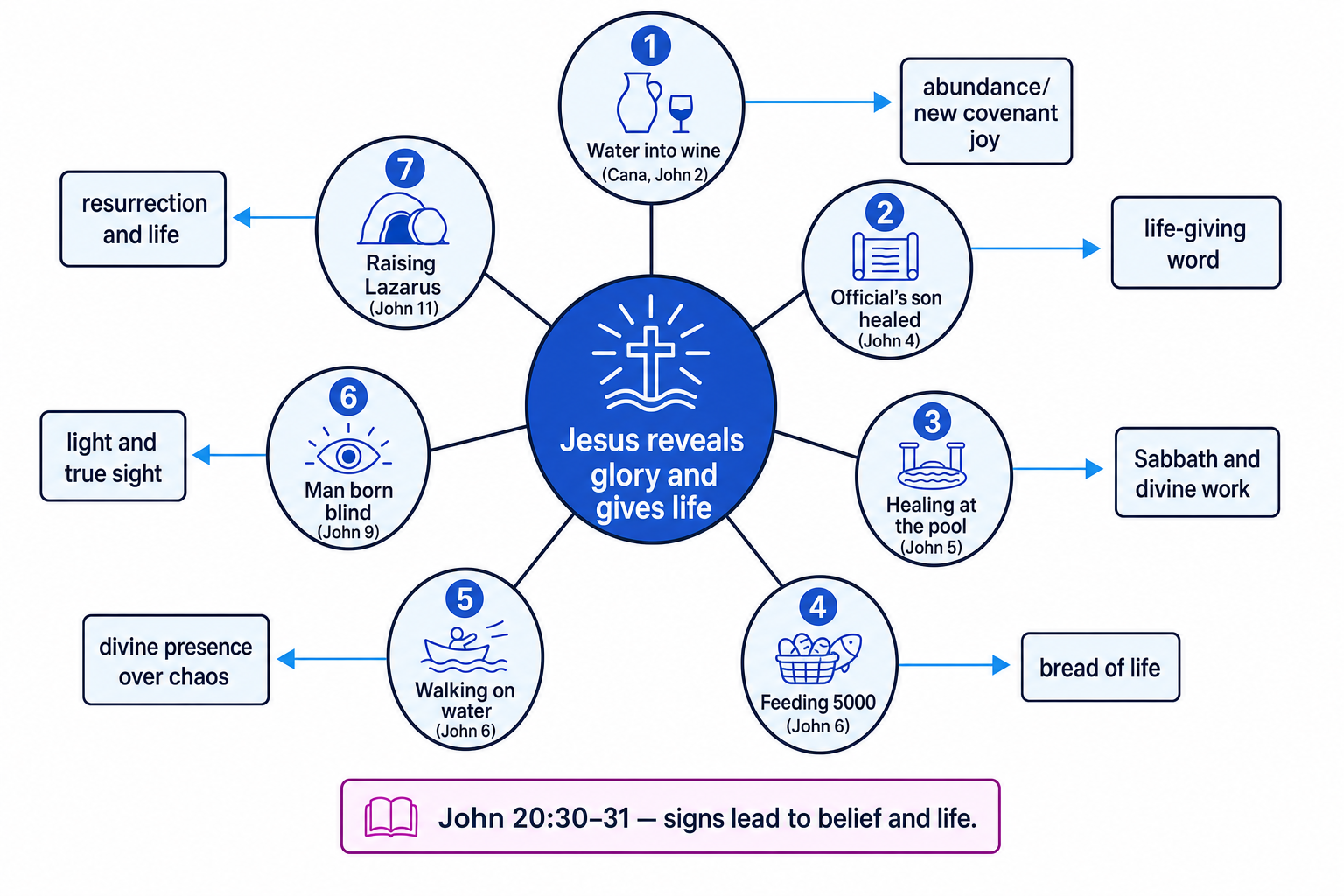
The map below shows the seven signs in narrative order and the main meaning each one points towards.
Example
Interpreting the feeding of the 5000
-
Notice the setting: John places the feeding near Passover, so the story echoes Moses, manna in the wilderness and God feeding Israel.
-
Link the sign to Jesus’ teaching: John 6 moves into the “Bread of Life” discourse, where Jesus says that true life comes through him, not merely through physical bread.
-
Draw out the identity claim: Jesus is not just a prophet like Moses; he is presented as the one who gives divine life.
-
Evaluate the response: the crowd wants to make Jesus king, but Jesus withdraws. Brown would stress that signs can be misunderstood; Dodd would stress that the physical sign points to present eternal life in Jesus.
The seven signs in the Fourth Gospel
| Sign | Passage | Meaning and significance |
|---|---|---|
| Turning water into wine | John 2 | At Cana, Jesus transforms water in Jewish purification jars into abundant wine. This suggests messianic joy, new creation and the reconfiguring of religious life around Jesus. |
| Healing the official’s son | John 4 | Jesus heals at a distance by his word. The official trusts before seeing the result, so the sign contrasts shallow sign-seeking with deeper faith in Jesus’ word. |
| Healing at the pool | John 5 | Jesus heals a man on the Sabbath. The conflict leads to Jesus’ claim that, like the Father, he is “working”, revealing his divine authority to give life. |
| Feeding the 5000 | John 6 | Jesus provides bread for the crowd. The sign points to Jesus as the Bread of Life and warns against reducing him to a political or material provider. |
| Walking on water | John 6 | Jesus comes to the disciples across the sea and says “It is I”, which can echo divine self-revelation. He is shown as God’s presence over chaos and fear. |
| Healing the man born blind | John 9 | Physical sight becomes a symbol of spiritual sight. The blind man gradually recognises Jesus, while the opponents become spiritually “blind”. |
| Raising Lazarus | John 11 | The climactic sign reveals Jesus as “the resurrection and the life”. It creates faith, but also triggers the decision to kill Jesus, linking life with the coming cross. |
Common Mistake
Reducing signs to proof
Avoid writing, “The signs simply prove Jesus is God.” In John, signs invite faith, but they can also produce misunderstanding, hostility or shallow belief.
What the signs reveal about Jesus
Christology means teaching about the identity and role of Jesus. John’s signs create a very high Christology: Jesus is not only a teacher or healer, but the divine Son who reveals the Father.
The signs show Jesus as:
- Revealer of glory: Cana reveals Jesus’ glory, continuing the Prologue’s claim that the Word became flesh.
- Life-giver: the official’s son, the man at the pool and Lazarus all show that life comes through Jesus.
- New Moses and bread-giver: the feeding sign echoes the wilderness tradition but places Jesus above Moses.
- Light of the world: the man born blind shows that true sight means recognising Jesus.
- Lord over creation and chaos: walking on water presents Jesus with divine authority.
- Cause of decision: each sign divides people into belief, misunderstanding or rejection.
Dodd and Brown: two scholar lenses
C. H. Dodd is especially associated with realised eschatology.
Definition
Realised eschatology
Realised eschatology is the view that final salvation, judgement and eternal life are already encountered in the present through Jesus, not only in the future.
For Dodd, the signs are symbolic deeds. They are not random wonders: the miracle and the discourse belong together. The feeding sign is interpreted by the Bread of Life discourse; the blind man sign is interpreted by the theme of light; Lazarus is interpreted by “I am the resurrection and the life.”
R. E. Brown is known for reading John 1–12 as the Book of Signs, the public section of the Gospel where Jesus’ identity is revealed before the passion-focused Book of Glory. Brown emphasises that signs create division: some believe, some misunderstand, and some oppose Jesus. He also connects this to the likely experience of the Johannine community, especially conflict with synagogue authorities.
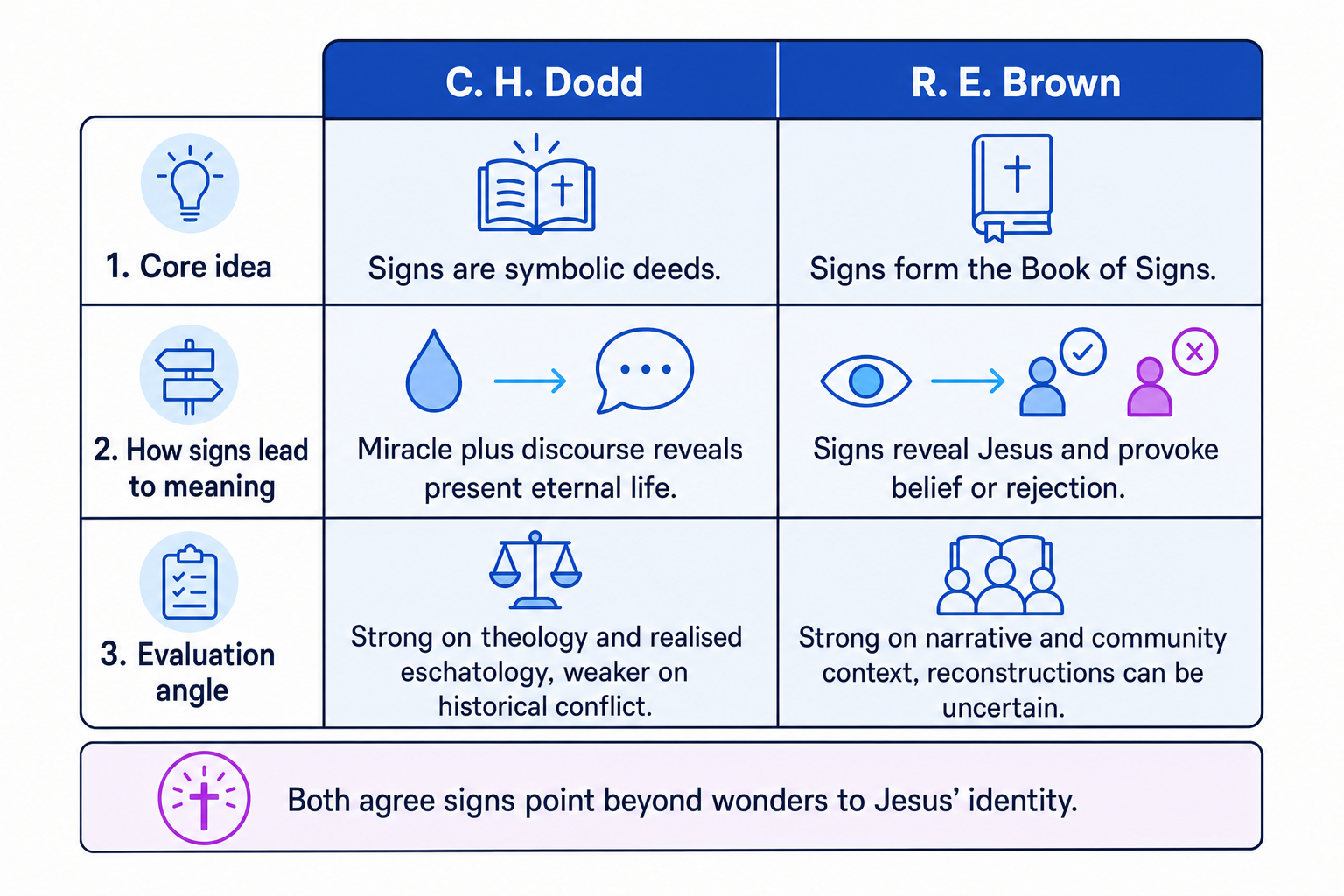
Dodd is strong for explaining the deep symbolism of the signs. Brown is strong for showing how the signs function within the whole narrative and the community context. A balanced essay can use both: signs are symbolic revelations, but they also create real conflict and force a response.
Signs, religious law and codes for living
Religious laws and codes for living means rules and practices that shape worship, morality and community life. In John, the key issues include Sabbath observance, purity, festival symbolism and belonging to the people of God.
The Sabbath signs are especially important. In John 5 and John 9, Jesus heals on the Sabbath, the Jewish day of rest and worship. The issue is not simply “Jesus ignores rules”. The deeper claim is that Jesus shares in the Father’s life-giving work, so the law is interpreted through his identity.
Common Mistake
Avoid anti-Jewish readings
Do not write as if “Judaism equals legalism” and “Christianity equals compassion”. John’s conflicts are intra-Jewish debates, shaped by the Gospel’s context, and must be handled carefully.
Different understandings of Jesus produce different implications:
- If Jesus is mainly a prophetic reformer, the signs challenge rigid religion and prioritise mercy.
- If Jesus is the Messiah, the signs show God’s promises being fulfilled through him.
- If Jesus is the divine Son and Logos — the Word of God in John 1 — then religious law is re-centred around his authority.
- If Jesus is misunderstood as a wonder-worker or political king, the signs become distorted; John rejects shallow sign-seeking.
Example
Applying a Sabbath sign to law and identity
-
Start with the law issue: in John 5, Jesus heals on the Sabbath and tells the healed man to carry his mat, creating conflict with religious authorities.
-
Connect the action to Jesus’ identity: Jesus says, “My Father is still working, and I also am working,” which presents him as sharing in God’s life-giving work.
-
Draw the implication for codes of living: Sabbath is not abolished, but it is interpreted through divine life, mercy and recognition of Jesus.
-
Evaluate with scholars: Dodd explains this as present eternal life breaking into the world; Brown adds that the conflict reflects the Gospel’s wider concern with belief, rejection and community identity.
Tip
Essay pattern
Use the pattern sign → misunderstanding or conflict → revelation → response. It helps you move beyond retelling the miracle and into analysis.
Overall judgement
The signs are essential for understanding Jesus’ ministry in John. They reveal who Jesus is, but they also expose whether people truly understand him. Dodd helps you explain the symbolic and theological depth of the signs. Brown helps you explain their narrative function, their link to belief and rejection, and their relevance to religious community boundaries.
For law and ethics, the safest judgement is: John does not present Jesus as casually abolishing religious law. Instead, the signs show Jesus as the one through whom law, worship and discipleship are reinterpreted around life, faith and love.
Exam technique
In the exam
-
Do not merely list the seven signs; choose two or three to analyse in depth, while showing awareness of the full set.
-
Link each sign to Jesus’ identity and role: Son of God, life-giver, revealer, Messiah or divine presence.
-
Compare Brown and Dodd directly: Dodd highlights symbolic meaning and realised eschatology; Brown highlights narrative structure, belief, misunderstanding and community conflict.
-
When discussing law, avoid crude contrasts between Judaism and Christianity. Use Sabbath conflict carefully and evaluate what John is claiming about Jesus’ authority.
Self review
Check yourself
- How is a “sign” different from a miracle in John’s Gospel?
- Which two signs most clearly create conflict over Sabbath law?
- How would Dodd and Brown each interpret the raising of Lazarus?