Revision notes for Edexcel AS Level Religious Studies The Prologue in John. Open the guide for explanations and worked examples. Written against the Edexcel AS Level Religious Studies specification, so the content matches what's examinable rather than general Religious Studies background.
The Prologue in John
What you'll learn
- How John 1:1–18 presents Jesus as the Word made flesh.
- Why themes such as life, light, darkness, belief, law, grace and truth matter for the whole Gospel.
- How Judaism and Hellenism influenced John’s language.
- How to use C H Dodd and Morna Hooker in an Edexcel essay.
1. What is the Prologue?
The Prologue is John 1:1–18, the opening section of the Gospel. It works like an “overture” in music: it introduces the key themes that will return throughout the Gospel — Jesus’ identity, revelation, belief, rejection, light, life and the relationship between Jesus and God.
Definition
Prologue
A prologue is an opening passage that introduces the themes, purpose and theological direction of a text.
John’s Prologue is especially important for Christology, which means the study of the person, nature and significance of Jesus Christ.
John does not begin with Jesus’ birth in Bethlehem, as Matthew and Luke do. He begins before creation: “In the beginning was the Word.” This immediately places Jesus in a cosmic and divine context.
Key Idea
John's opening claim
John presents Jesus not merely as a prophet or teacher, but as the eternal divine Word through whom God creates, reveals and saves.
2. “In the beginning was the Word”
The central term is Word, from the Greek Logos. Logos can mean “word”, “reason”, “message” or “rational principle”.
Definition
Logos
Logos is the Greek term translated as “Word” in John 1. In John, it refers to God’s self-expression, now identified with Jesus Christ.
John 1:1 says:
“In the beginning was the Word, and the Word was with God, and the Word was God.”
This makes three claims:
- The Word existed “in the beginning”, before creation.
- The Word was “with God”, suggesting relationship or distinction.
- The Word “was God”, suggesting full divinity.
This is the basis for the doctrine of pre-existence, the belief that Christ existed before his earthly life.
Definition
Pre-existence
Pre-existence means that Christ existed before his human birth and before the events of history.
John 1:3 then says that all things came into being through the Word. So Jesus is linked not only with salvation, but with creation itself.
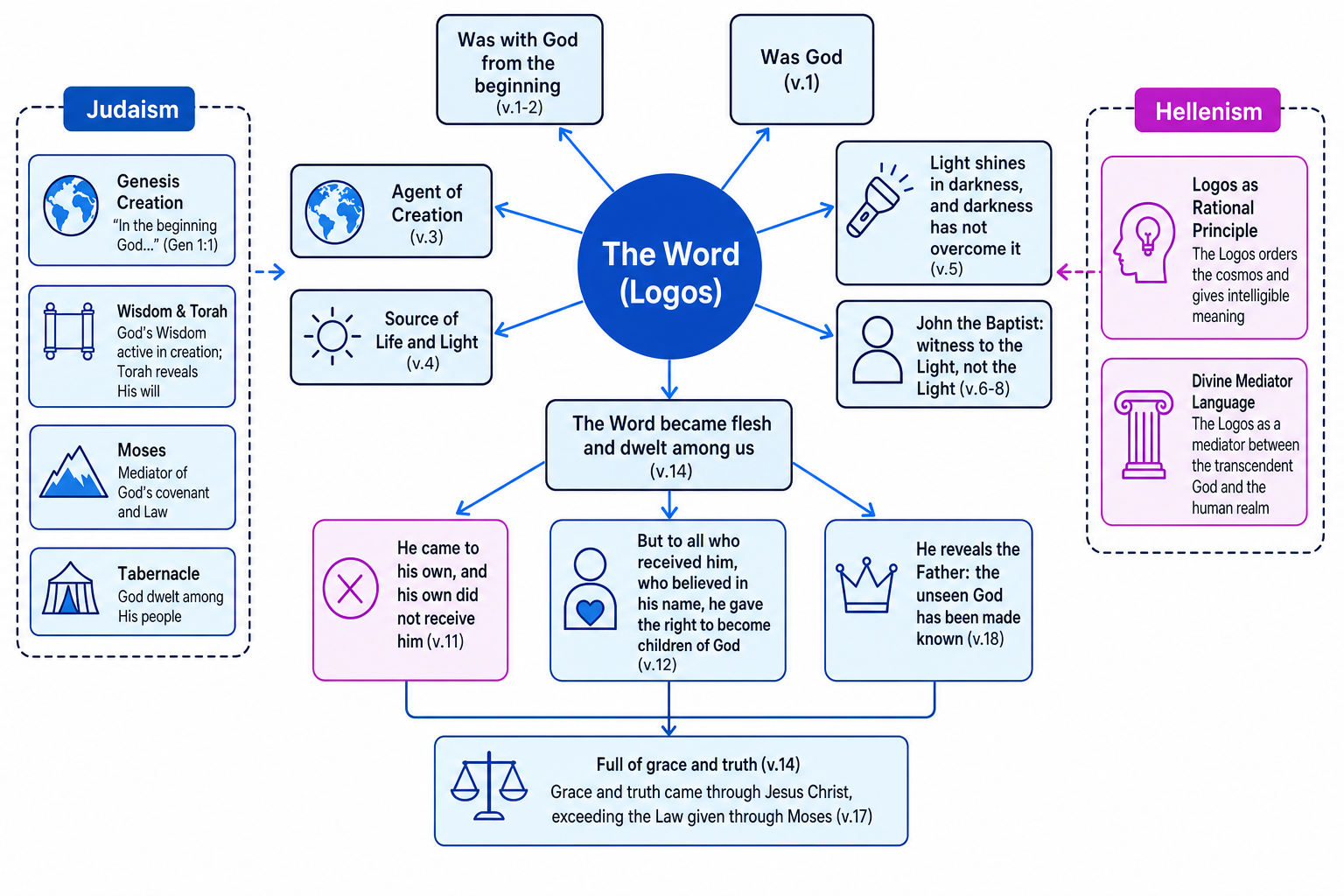
The map below shows how the main Prologue themes connect.
3. “The Word became flesh”
John 1:14 is the turning point:
“And the Word became flesh and lived among us.”
This is the doctrine of incarnation.
Definition
Incarnation
Incarnation means “taking flesh”: the belief that God became truly human in Jesus Christ.
The word flesh here does not mean “evil body”. It means full, real human existence: weakness, vulnerability, physical life and mortality. John is saying that the divine Word did not merely appear human; the Word became genuinely human.
The phrase “lived among us” can also be translated as “pitched his tent” or “tabernacled among us”. This echoes the tabernacle, the tent-shrine where God’s presence was believed to dwell among Israel in the wilderness.
So John combines a very high view of Jesus’ divinity with a strong claim about his humanity.
Common Mistake
Making Jesus less than human
Do not say John only presents Jesus as divine. John’s Prologue is powerful because it holds together both claims: the Word was God, and the Word became flesh.
4. Life, light and darkness
John says:
“In him was life, and the life was the light of all people.”
In John, life means more than biological existence. It points towards eternal life, a relationship with God that begins now and continues beyond death.
Light symbolises revelation, truth, goodness and God’s presence. Darkness symbolises ignorance, sin, rejection and opposition to God.
This is not just decorative imagery. It prepares the reader for later Johannine themes: Jesus says “I am the light of the world” in John 8:12, and the Gospel repeatedly contrasts those who come to the light with those who reject it.
Definition
Dualism
Dualism is a way of thinking in sharp contrasts, such as light and darkness, truth and falsehood, belief and unbelief.
John’s dualism is theological rather than simply moral. The issue is how people respond to Jesus, the light.
5. Belief and becoming children of God
John 1:11–12 says that the Word came to “his own”, but “his own people did not accept him”. Yet those who did receive him were given power to become “children of God”.
In John, belief is not just agreeing that something is true. It means trust, commitment and personal response to Jesus.
Definition
Belief in John
In John’s Gospel, belief means trusting in Jesus, recognising his identity and responding to him with commitment.
“Children of God” means people whose identity comes from God rather than merely from ancestry, ethnicity or social status. John 1:13 says they are born “not of blood” or human will, but “of God”.
This links to the later contrast between flesh and spirit in John 3, where Jesus tells Nicodemus that people must be “born from above” or “born of the Spirit”.
Definition
Flesh and spirit
In John, flesh can mean ordinary human origin or weakness, while spirit refers to life and birth given by God.
6. Law, grace and truth
John 1:17 says:
“The law indeed was given through Moses; grace and truth came through Jesus Christ.”
The Law, or Torah, refers to God’s teaching and commandments given to Israel, especially associated with Moses.
Definition
Torah
Torah means “teaching” or “instruction” and refers to the Jewish Law, traditionally associated with Moses.
Grace means God’s generous favour, not earned by human achievement. Truth in John means not just factual correctness, but the full reality of God made known.
John is not simply saying, “Judaism was bad and Christianity is good.” A better reading is that Jesus fulfils and completes what the Law pointed towards.
Common Mistake
Reading John as anti-Jewish
Avoid presenting the Prologue as a crude rejection of Judaism. John’s language is deeply Jewish: creation, Moses, Torah, Wisdom and tabernacle imagery all shape the passage.
7. Judaism and Hellenism
John’s Prologue is influenced by both Judaism and Hellenism.
Definition
Hellenism
Hellenism refers to the spread of Greek language, culture and philosophy across the ancient Mediterranean world after Alexander the Great.
Jewish influences
The opening words, “In the beginning”, echo Genesis 1:1. In Genesis, God creates by speaking: “Let there be light.” This makes the Word a creative agent.
Jewish Wisdom traditions are also important. In texts such as Proverbs 8, Wisdom is with God at creation. The Prologue also echoes Moses, Torah and the tabernacle.
Hellenistic influences
In Greek thought, Logos could mean the rational principle ordering the universe. In some Hellenistic Jewish thought, especially Philo of Alexandria, Logos language was used to describe a mediator between the transcendent God and the created world.
John’s use of Logos would therefore make sense to readers shaped by Greek-speaking culture.
Dodd and Hooker
C H Dodd argued that John’s Gospel uses language that would speak to the wider Hellenistic world, but that its deepest roots remain Jewish. For Dodd, the Prologue is a key to the whole Gospel: it introduces Jesus as the divine self-expression of God, bringing revelation and life.
Morna Hooker emphasises that the Prologue should not be treated as abstract Greek philosophy detached from the story of Israel. Its imagery of creation, Wisdom, Moses, dwelling among God’s people, grace and truth makes best sense within Jewish theology.
Example
Comparing Jewish and Hellenistic influences
-
Start with the word Logos. It has a Hellenistic resonance because Greek philosophy used Logos language for reason, order and mediation.
-
Compare this with the opening phrase “In the beginning”. This strongly echoes Genesis, where God creates through speech, so the Prologue is also rooted in Jewish scripture.
-
Apply Dodd: John can use language meaningful in a Greek-speaking world while still expressing a fundamentally Jewish theology of creation and revelation.
-
Apply Hooker: the passage should not be reduced to Greek philosophy, because Moses, Torah, Wisdom and tabernacle imagery are central to its meaning.
-
Reach a judgement: the Prologue is best read as a Jewish theological text expressed in language that also communicates powerfully in a Hellenistic setting.
8. Why this matters for understanding the Gospel
The Prologue shapes how you read everything that follows.
If Jesus is the Word, then his signs and speeches are not merely miracles and teachings; they are revelations of God. If Jesus is light, then responses to him reveal whether people are open to God. If Jesus brings life, then salvation is not only future heaven but present relationship with God.
Dodd’s idea of realised eschatology is useful here.
Definition
Realised eschatology
Realised eschatology is the view, associated with C H Dodd, that the blessings of God’s kingdom or final salvation are already present in Jesus, not only future.
This fits John because eternal life is often presented as something believers can possess now through Christ.
9. Implications for laws and codes for living
Different understandings of Jesus’ identity lead to different ethical implications.
If Jesus is seen mainly as a moral teacher, then his message may be treated as wise guidance. But if Jesus is the incarnate Word of God, then his teaching has ultimate authority for believers.
The Prologue also affects how religious law is understood. John 1:17 does not abolish moral living. Instead, it suggests that law must be interpreted through Jesus, who embodies grace and truth.
This influences Christian codes of living in several ways:
- Grace challenges purely legalistic religion.
- Truth demands integrity, honesty and faithfulness to God.
- Light encourages moral transparency and rejection of evil.
- Children of God supports a community based on divine gift rather than status or ancestry.
- Incarnation can support concern for human dignity, because human flesh is honoured by God taking it on.
The influence goes beyond religious communities too. Ideas such as human dignity, equality before God, servant leadership, forgiveness and conscience have shaped wider culture, law, education and social reform, even where society is not explicitly Christian.
Example
Applying Jesus' identity to ethics
-
Identify the Christological claim: John presents Jesus as the incarnate Word, not merely a human rabbi.
-
Draw the ethical implication: if Jesus reveals God, then Christian moral life is centred on responding to him, not simply obeying rules as external commands.
-
Connect to John 1:17: “grace and truth” means Christian ethics should combine moral seriousness with mercy, rather than becoming harsh legalism.
-
Extend beyond the Church: belief that the Word became flesh can support wider respect for embodied human life, including care for the vulnerable.
Tip
Essay judgement
A strong answer will avoid choosing between Judaism and Hellenism too simplistically. Argue that John uses Hellenistic language, but fills it with Jewish theological content focused on Jesus.
10. Overall significance
The Prologue presents Jesus as the decisive revelation of God. He is pre-existent, divine, creative, life-giving and incarnate. The themes of light and darkness prepare the reader for conflict and response. The themes of belief and becoming children of God show that Jesus creates a new identity for those who receive him.
Dodd helps you show the Prologue’s broad intellectual world and its role as the key to John’s Gospel. Hooker helps you keep the Jewish scriptural background central. Together, they support a balanced interpretation: John’s Prologue is both universal in scope and deeply rooted in Israel’s story.
Exam technique
In the exam
-
Begin with the text: refer directly to John 1:1, 1:14 and 1:17 rather than writing generally about Jesus.
-
Use Dodd and Hooker analytically: Dodd is useful for Logos, revelation and the Gospel’s wider Hellenistic setting; Hooker is useful for Jewish roots such as Genesis, Wisdom, Moses and tabernacle imagery.
-
Make a judgement: do not just list themes. Explain how the Prologue shapes John’s whole presentation of Jesus and its implications for belief, law and ethical living.
Self review
Check yourself
- Why is “the Word became flesh” central to John’s Christology?
- How do Jewish and Hellenistic influences both help explain the term Logos?
- What ethical implications might follow from seeing Jesus as grace and truth rather than merely a lawgiver?

Keep learning
Make a free account to read the full revision notes and worked examples.